1. What Is a Self-Improvement Routine?
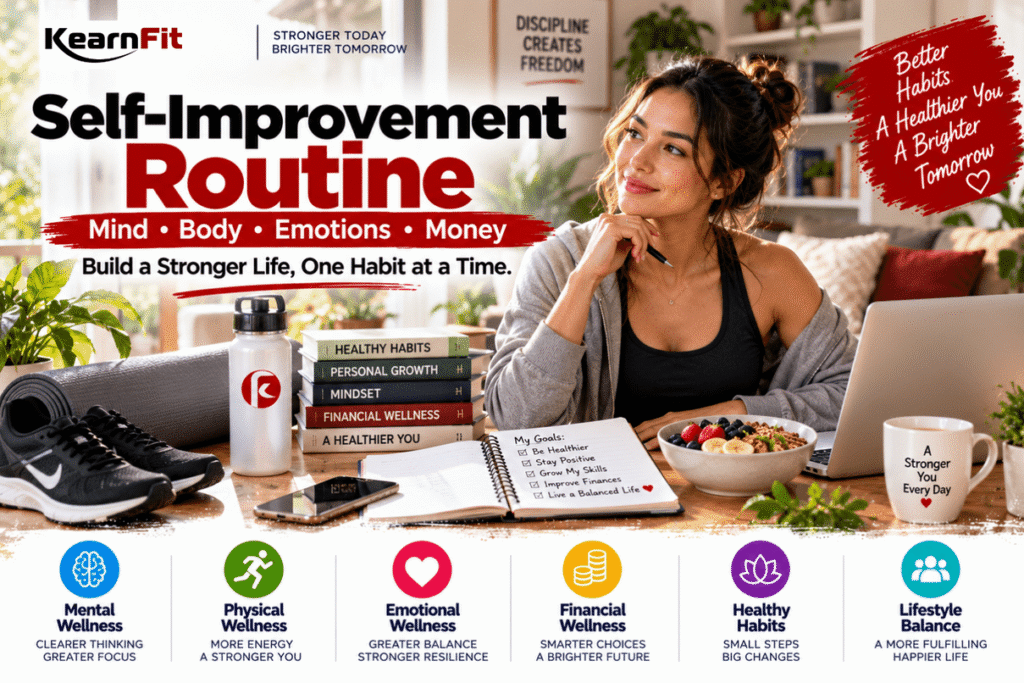
Self-improvement is often presented as a dramatic transformation.
Wake up at 5 a.m. Read dozens of books. Exercise every day. Start a business. Save more money. Become more productive. Eliminate every bad habit. Completely change your life in 30 days.
That sounds exciting.
It also sounds exhausting.
A better approach is to build a Self-Improvement Routine that fits into your actual life.
A Self-Improvement Routine is not about becoming perfect. It is about creating repeatable actions that help you become healthier, more capable, more confident, and more intentional over time.
The most effective routine is not necessarily the most complicated one. It is the one you can realistically repeat.
Self-improvement can involve learning new skills, becoming more physically active, managing stress, improving emotional awareness, strengthening relationships, becoming more financially organized, setting meaningful goals, and creating healthier daily habits.
The World Health Organization describes self-care as including healthy practices, habits, and lifestyle choices such as healthy eating, physical activity, sufficient sleep, and connection with others.
That broader definition matters because personal growth is not only about productivity.
You can become more productive while becoming more exhausted.
You can earn more money while feeling more stressed.
You can become physically stronger while ignoring your emotional needs.
You can achieve professional goals while losing connection with the people who matter most.
True self-improvement should help you build a stronger life—not simply a busier one.
That is why this KearnFit approach looks at four important areas:
Mind. Body. Emotions. Money.
When these areas are supported together, your personal growth becomes more balanced, practical, and sustainable.
2. Why Self-Improvement Should Include More Than Productivity
Productivity is useful.
But productivity is not the same thing as wellbeing.
Imagine someone who finishes every task on their list but sleeps five hours a night, never exercises, constantly worries about money, avoids difficult emotions, and has little time for meaningful relationships.
Are they truly improving their life?
Maybe in one area.
But the bigger picture tells a different story.
A strong Self-Improvement Routine should help you make progress without sacrificing the foundations that allow you to enjoy that progress.
Think about four questions:
How is your mind doing?
Are you learning? Thinking clearly? Managing distractions? Making time for reflection?
How is your body doing?
Are you moving regularly? Eating in a way that supports your lifestyle? Sleeping enough? Giving yourself time to recover?
How are your emotions doing?
Can you recognize what you feel? Can you communicate your needs? Do you have healthy ways to manage stress and difficult emotions?
How is your financial life doing?
Do you understand your spending? Are you working toward meaningful goals? Are you building greater financial awareness and control?
These questions create a more complete definition of personal growth.
The goal is not to optimize every part of your life every day.
The goal is to pay attention to the parts of your life that need support.
Sometimes your next improvement is a workout.
Sometimes it is an earlier bedtime.
Sometimes it is having an honest conversation.
Sometimes it is reviewing your spending.
Sometimes it is simply taking ten quiet minutes to think.
Self-improvement becomes powerful when it becomes practical.
3. The Four Areas of a Complete Self-Improvement Routine
A complete Self-Improvement Routine can be built around four connected dimensions.
Mind
Your mind needs stimulation, rest, focus, and reflection.
Reading, learning, journaling, problem-solving, practicing mindfulness, limiting unnecessary distractions, and making time for focused work can all become part of mental development.
Mental growth is not about knowing everything.
It is about remaining curious.
Body
Your physical health influences how you move through everyday life.
Movement, strength, mobility, nutrition, hydration, sleep, and recovery all belong in a complete routine.
Current CDC guidance recommends that adults aim for at least 150 minutes of moderate-intensity physical activity each week, along with muscle-strengthening activity on at least two days. The guidance also emphasizes that some activity is better than none.
That means your routine does not have to begin with an extreme workout plan.
Start where you are.
Emotions
Emotional wellness involves recognizing, processing, expressing, and managing emotions in healthy ways.
The CDC highlights practices such as identifying difficult emotions, using healthy coping strategies, communicating effectively, maintaining relationships, practicing mindfulness, and taking care of physical health as ways to support emotional wellbeing.
Your emotions are not obstacles to personal growth.
They are information.
Learning to listen to them can help you make better decisions.
Money
Financial wellness is another important part of lifestyle wellbeing.
Money affects choices, responsibilities, opportunities, and future planning.
The Consumer Financial Protection Bureau describes financial well-being in terms of having control over day-to-day finances, being able to absorb financial shocks, being on track toward financial goals, and having freedom of choice.
A healthy financial routine therefore does not need to mean becoming wealthy overnight.
It can begin with awareness.
Know what comes in.
Know what goes out.
Understand your priorities.
Create realistic goals.
Build healthier habits.
Small financial improvements can create greater confidence over time.
4. Why Small Daily Actions Create Bigger Change
One of the biggest mistakes people make with self-improvement is trying to change everything at once.
They create a huge checklist:
- Exercise every morning.
- Meditate for 30 minutes.
- Read 50 pages.
- Cook every meal.
- Save half their income.
- Journal every night.
- Wake up before sunrise.
- Stop using social media.
- Learn a new skill.
- Work harder.
Then real life happens.
A busy meeting appears.
You sleep poorly.
Your schedule changes.
You have family responsibilities.
You feel stressed.
You miss one habit.
Then another.
Eventually, the entire plan disappears.
A better Self-Improvement Routine starts with small actions.
Instead of saying:
“I will completely transform my lifestyle.”
Try:
“I will walk for 20 minutes today.”
Instead of:
“I will become financially disciplined.”
Try:
“I will review my spending for ten minutes every Sunday.”
Instead of:
“I will never feel stressed again.”
Try:
“I will take five quiet minutes to check in with myself.”
Small actions reduce friction.
They also make success easier to repeat.
The objective is not to make every day perfect.
The objective is to create a system that helps you return to healthy actions again and again.
5. 10 Powerful Self-Improvement Routine Habits
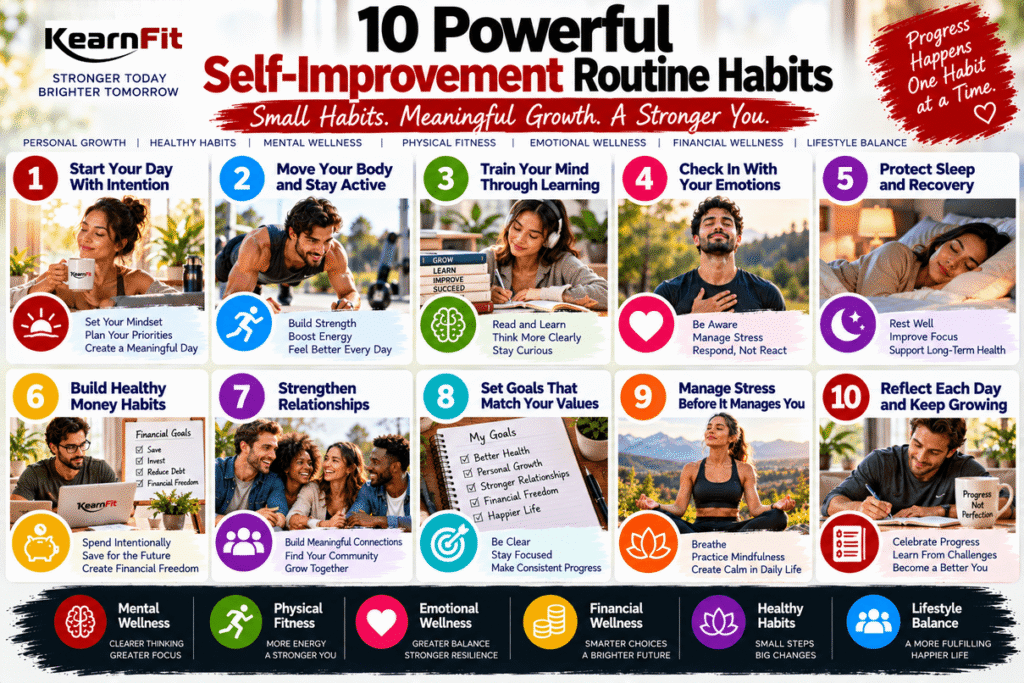
Your Self-Improvement Routine does not need dozens of complicated habits.
Start with these 10 powerful foundations:
- Start your day with intention.
- Move your body regularly.
- Train your mind through learning and reflection.
- Check in with your emotions.
- Protect sleep and recovery.
- Create healthy money habits.
- Strengthen relationships and community.
- Set goals that match your values.
- Manage stress proactively.
- Reflect at the end of the day.
These habits work because they support different parts of your life without requiring a complete lifestyle overhaul.
The goal is to create a routine that feels like an investment in yourself rather than another source of pressure.
6. Habit #1: Start Your Day With Intention
The first part of your day can influence how intentionally you move through the rest of it.
That does not mean you need a perfect morning.
Your morning can be simple.
Drink water.
Open the curtains.
Get natural light.
Stretch.
Walk.
Write down your priorities.
Take a few quiet minutes before checking notifications.
Think about what matters today.
A powerful morning question is:
“What would make today feel meaningful?”
Your answer might be:
- Completing an important project.
- Moving your body.
- Spending time with family.
- Making progress on a financial goal.
- Learning something new.
- Protecting your mental energy.
- Having an honest conversation.
A Self-Improvement Routine works better when your habits connect to your priorities.
You are not simply checking boxes.
You are creating direction.
Try a simple 10-minute intention routine:
Minute 1–2: Breathe and settle.
Minute 3–4: Drink water and get ready to move.
Minute 5–6: Identify your most important priority.
Minute 7–8: Check your schedule.
Minute 9–10: Decide what one action would make you proud tonight.
You do not need an elaborate morning ritual.
You need intention.
7. Habit #2: Move Your Body and Protect Your Physical Health
Your body is the foundation that allows you to experience everything else.
When you move, you are not simply training your muscles.
You are investing in your ability to work, explore, connect, play, and participate in everyday life.
The CDC recommends at least 150 minutes of moderate-intensity physical activity each week for adults, plus muscle-strengthening activity on at least two days. Activity can be spread throughout the week and broken into smaller periods.
But your Self-Improvement Routine should be personalized.
You could:
- Walk after lunch.
- Strength train two or three times a week.
- Stretch in the morning.
- Cycle on weekends.
- Take the stairs.
- Play a sport.
- Dance.
- Hike.
- Practice yoga.
- Take movement breaks during work.
The best movement is movement you can continue.
Do not compare your routine to someone else’s.
Your starting point matters more than someone else’s finish line.
And remember that recovery belongs here too.
Your physical routine should include sleep, rest, nutrition, hydration, and appropriate recovery.
A stronger body is not built only during workouts.
It is also supported by what you do between them.
8. Habit #3: Train Your Mind Through Learning and Reflection
Personal growth requires mental growth.
Your mind needs opportunities to learn, question, explore, and reflect.
Create a daily learning habit.
It could take 10 minutes.
Read a few pages.
Listen to an educational podcast.
Study a professional skill.
Take notes.
Learn about something outside your normal field.
Ask better questions.
Write down what you learned.
You can also create a daily reflection question.
Try:
What did I learn today?
Or:
What could I have handled differently?
Or:
What decision today moved me closer to the person I want to become?
Learning becomes more powerful when it turns into application.
Do not simply collect information.
Use it.
If you read about better communication, practice listening.
If you learn about budgeting, review your spending.
If you learn about fitness, improve your routine.
If you learn about emotional awareness, pause before reacting.
Knowledge becomes personal growth when it changes behavior.
9. Habit #4: Check In With Your Emotions
Many people build routines around what they need to do while ignoring how they feel.
That can eventually create emotional overload.
A simple emotional check-in can take less than five minutes.
Ask yourself:
What am I feeling?
Why might I be feeling this way?
What do I need right now?
Is there something I need to communicate?
What would help me respond rather than react?
You do not need to label every emotion perfectly.
The goal is awareness.
You might discover that irritation is actually exhaustion.
You might discover that procrastination is anxiety.
You might discover that constant scrolling is an attempt to escape stress.
You might discover that you need support rather than another productivity strategy.
The CDC recommends healthy approaches such as identifying difficult emotions, practicing mindfulness, communicating openly, maintaining supportive relationships, and using healthy activities to cope with stress.
Emotional awareness can therefore become a practical part of your Self-Improvement Routine.
And if difficult emotions become overwhelming or interfere significantly with daily life, professional support can be an important and appropriate part of your wellness journey.
10. Habit #5: Build Better Sleep and Recovery Habits
You cannot build sustainable personal growth on constant exhaustion.
Sleep is not wasted time.
It is part of your recovery system.
The CDC notes that good sleep is important for health and emotional wellbeing, and adults generally need at least seven hours of sleep per night, depending on age.
A stronger Self-Improvement Routine should therefore include a realistic sleep routine.
Try:
- Going to bed around the same time.
- Waking at a consistent time.
- Creating a calmer evening environment.
- Reducing unnecessary stimulation before bed.
- Keeping your bedroom comfortable.
- Giving yourself enough time to sleep.
- Avoiding the temptation to sacrifice sleep for productivity.
You can also create an evening shutdown ritual.
For example:
10 minutes: Prepare tomorrow’s priorities.
5 minutes: Review your schedule.
5 minutes: Put away unnecessary digital distractions.
5 minutes: Reflect on what went well.
Then: Transition toward sleep.
The goal is to help your mind understand that the day is ending.
Recovery is not the opposite of self-improvement.
Recovery makes sustainable self-improvement possible.
11. Habit #6: Create Healthy Money Habits
Money deserves a place in your personal growth routine.
Financial wellness is not simply about earning more.
It is also about becoming more aware of your choices.
A simple weekly money routine can include:
- Reviewing recent spending.
- Checking upcoming bills.
- Tracking savings.
- Reviewing financial goals.
- Identifying unnecessary expenses.
- Planning major purchases.
- Checking progress toward priorities.
The CFPB emphasizes that financial well-being includes day-to-day control, the ability to absorb financial shocks, progress toward goals, and financial freedom to make choices that support the life you value.
This gives financial self-improvement a practical foundation.
You do not need to obsess over every transaction.
Instead, create a consistent relationship with your money.
Try the 15-minute money check-in:
5 minutes: What did I spend?
5 minutes: What is coming up?
5 minutes: What action can improve my financial position?
That final question matters.
Maybe you transfer money to savings.
Maybe you cancel an unused subscription.
Maybe you make a debt payment.
Maybe you research a financial question.
Maybe you simply update your budget.
Progress comes from action.
12. Habit #7: Strengthen Your Relationships and Community
Personal growth should not become isolation.
People need connection.
Your relationships can influence your emotional wellbeing, motivation, perspective, and sense of belonging.
Make connection a deliberate part of your Self-Improvement Routine.
Call someone.
Have lunch with a friend.
Walk with a family member.
Join a fitness group.
Volunteer.
Attend a community event.
Ask someone how they are—and genuinely listen.
You can also review your social environment.
Ask:
Who encourages me to grow?
Who makes me feel safe being myself?
Who challenges me in healthy ways?
Where do I feel connected?
Where do I need stronger boundaries?
Self-improvement is not about becoming independent from everyone.
It is about becoming strong enough to build healthy interdependence.
The right community can make healthy behaviors easier to maintain because growth becomes something you experience with others.
13. Habit #8: Set Goals That Match Your Values
Goals are powerful.
But not every goal deserves your energy.
Before setting a goal, ask:
Why do I want this?
You may discover that your goal is influenced by comparison rather than genuine desire.
Maybe you want a particular body because of social media.
Maybe you want a particular salary because you believe you should.
Maybe you want a productivity schedule because someone online says successful people wake up at 4 a.m.
Maybe you want to start a business because you feel behind.
Instead, build goals around your values.
If you value health, your goal might be regular movement.
If you value family, your goal might be protected family time.
If you value freedom, your goal might be improving financial organization.
If you value learning, your goal might be completing a course.
If you value creativity, your goal might be making time for a personal project.
A meaningful Self-Improvement Routine should help you build the life you actually want.
Not the life that looks impressive from the outside.
14. Habit #9: Manage Stress Before It Manages You
Stress is part of life.
The goal is not to eliminate every stressful moment.
The goal is to develop healthier ways to respond.
Build short recovery periods into your day.
Take a walk.
Breathe slowly.
Stretch.
Step outside.
Journal.
Listen to music.
Talk to someone you trust.
Practice mindfulness.
Do something enjoyable.
The CDC recommends approaches including physical activity, journaling, relaxation techniques, mindfulness, social connection, and healthy self-care as ways to support emotional wellbeing and cope with stress.
You can also identify your biggest stress triggers.
Ask:
What repeatedly drains my energy?
What situations make me reactive?
What can I control?
What needs a boundary?
What needs a conversation?
What needs professional support?
Stress management becomes easier when you stop treating every stressful experience as an emergency.
Create systems before you need them.
15. Habit #10: End Your Day With Reflection
Your morning creates direction.
Your evening creates learning.
A five-minute evening reflection can transform your Self-Improvement Routine.
Ask yourself:
What went well today?
What challenged me?
What did I learn?
Did I take care of my mind?
Did I take care of my body?
Did I acknowledge my emotions?
Did I make one healthy financial decision?
What is one thing I will do differently tomorrow?
Do not use reflection to criticize yourself.
Use it to understand yourself.
The difference is important.
Self-criticism says:
“I failed again.”
Reflection says:
“That approach did not work. What can I change?”
That mindset creates room for growth.
You are not keeping score to prove your worth.
You are gathering information to make tomorrow better.
16. Self-Improvement Routine for Busy Professionals
Busy professionals often believe they need more time before they can work on themselves.
Usually, they need a simpler system.
Try a 30-minute professional Self-Improvement Routine:
5 minutes — Mind: Review priorities.
10 minutes — Body: Walk, stretch, or perform a short workout.
5 minutes — Emotions: Check in with yourself.
5 minutes — Money: Review one financial item.
5 minutes — Planning: Prepare your next action.
You can also use existing routines as triggers.
After brushing your teeth → stretch.
After lunch → walk.
After closing your laptop → review tomorrow.
Before dinner → check in emotionally.
Sunday morning → review finances.
Friday evening → reflect on the week.
This is habit stacking in practical form.
You do not need to find completely new time.
You can attach personal growth to things you already do.
17. Self-Improvement Routine for Beginners
If you are new to personal development, do less.
Start with four habits.
Morning: Drink water and identify one priority.
Daytime: Move for at least a few minutes.
Evening: Write down one thought or feeling.
Weekly: Review your money and upcoming priorities.
Do this consistently before adding anything else.
After a few weeks, consider adding:
- Reading.
- Strength training.
- Meditation.
- Meal planning.
- Goal tracking.
- Social activities.
- Financial planning.
- Skill development.
Your first Self-Improvement Routine should feel achievable.
If your routine already feels overwhelming, it is too complicated.
18. Self-Improvement Routine When Motivation Is Low
Motivation is useful.
But it is unreliable.
Some days you will feel energized.
Other days you will not.
Your routine needs a minimum version for low-motivation days.
For example:
Mind: Read one page.
Body: Walk for five minutes.
Emotions: Name how you feel.
Money: Check one financial task.
That is enough.
The purpose is not to maximize performance.
It is to maintain continuity.
You can also create a normal version and an excellent version.
Minimum Day
Five minutes of movement.
One minute of reflection.
One healthy meal choice.
One useful financial action.
Normal Day
20–30 minutes of movement.
10 minutes of learning.
Emotional check-in.
Healthy meals.
Financial awareness.
Excellent Day
Workout.
Deep learning.
Focused work.
Meaningful connection.
Detailed financial planning.
Longer reflection.
This flexible structure prevents one difficult day from becoming a lost week.
19. How Mind, Body, Emotions and Money Work Together

The most powerful part of this approach is understanding that these areas are connected.
Consider a simple example.
You are worried about money.
That worry keeps you mentally distracted.
You sleep poorly.
You have less energy.
You skip your workout.
You become more irritable.
You have less patience with people.
Your relationships feel strained.
You spend money impulsively to feel better.
Now the problem is no longer only financial.
It has become a lifestyle issue.
The reverse can also happen.
You begin tracking your spending.
You create a realistic plan.
You feel more organized.
Your mind feels clearer.
You sleep better.
You have more energy.
You return to movement.
You feel more confident.
You become more present in your relationships.
One small improvement creates a ripple effect.
That is the philosophy behind KearnFit.
Your wellbeing should not be divided into isolated boxes.
Mental fitness, physical fitness, emotional wellness, financial wellness, and community can influence one another.
A better routine therefore looks at the whole person.
20. Morning Self-Improvement Routine
Here is a practical 30-minute morning routine:
Minutes 1–5: Wake and reset
Avoid immediately filling your mind with notifications.
Drink water.
Open the curtains.
Take a few calm breaths.
Minutes 6–10: Move
Stretch, walk, or complete a short mobility routine.
Minutes 11–15: Mind
Read, journal, meditate, or review your priorities.
Minutes 16–20: Plan
Identify your top three priorities.
Do not create a list of 25 tasks.
Choose what matters.
Minutes 21–25: Emotional check-in
Ask:
“How do I want to show up today?”
Minutes 26–30: Financial awareness
On selected mornings, review your budget, upcoming payment, savings goal, or financial priority.
You do not need to do financial tasks every morning.
The point is to keep money from becoming something you only think about when there is a problem.
21. Evening Self-Improvement Routine
Your evening routine should help you transition from achievement to recovery.
Try:
10 minutes: Tidy your environment.
5 minutes: Prepare tomorrow’s priorities.
5 minutes: Review your emotions.
5 minutes: Note one thing you learned.
5 minutes: Review one positive action from the day.
Then transition toward sleep.
Avoid turning your evening routine into another performance challenge.
You are not trying to earn a perfect score.
You are creating closure.
A good evening tells your mind:
The work is done for today.
Tomorrow will have its own opportunities.
22. Weekly Self-Improvement Routine
Your weekly review is where your four dimensions can come together.
Choose one day each week.
Spend approximately 30–45 minutes reviewing:
Mind
What did I learn?
What challenged me?
What do I want to understand better?
Body
Did I move consistently?
How was my sleep?
Did I allow enough recovery?
Emotions
What emotions appeared repeatedly?
What energized me?
What drained me?
Money
What did I spend?
What are my upcoming obligations?
Am I moving toward my financial goals?
Relationships
Who did I connect with?
Who do I want to reach out to?
Goals
What matters most next week?
Then choose three priorities.
Not ten.
Three.
One for health.
One for personal growth.
One for lifestyle or financial progress.
This makes your Self-Improvement Routine easier to maintain.
23. 7 Common Self-Improvement Mistakes to Avoid
Mistake #1: Trying to Change Everything at Once
Too many habits create unnecessary friction.
Start small.
Mistake #2: Confusing Productivity With Personal Growth
Doing more does not automatically mean becoming better.
Make space for rest, relationships, and wellbeing.
Mistake #3: Comparing Your Journey
Someone else’s routine may not fit your life.
Build your own.
Mistake #4: Ignoring Emotional Wellness
You cannot build sustainable growth by constantly suppressing what you feel.
Create space for emotional awareness.
Mistake #5: Treating Money as Separate From Wellness
Financial decisions influence lifestyle choices.
Give financial awareness a regular place in your routine.
Mistake #6: Sacrificing Sleep for Productivity
Sleep supports health, recovery, attention, and emotional wellbeing.
Protect it.
Mistake #7: Quitting After One Bad Day
One missed workout does not erase your progress.
One unhealthy meal does not define your lifestyle.
One poor financial decision does not determine your future.
Return to the routine.
That is the real skill.
24. How to Make Your Self-Improvement Routine Sustainable
A sustainable routine should pass five tests.
Is it realistic?
Can you do it during a busy week?
Is it flexible?
Can you adapt it when your schedule changes?
Is it meaningful?
Do the habits connect to something you genuinely value?
Is it measurable?
Can you tell whether you are making progress?
Is it enjoyable enough?
Your routine does not need to be exciting every day, but it should not make you miserable.
You can also use a simple weekly scorecard.
| Area | Question | Weekly Goal |
|---|---|---|
| Mind | Did I learn or reflect? | 3–5 times |
| Body | Did I move regularly? | Consistent movement |
| Emotions | Did I check in with myself? | Daily |
| Money | Did I review my finances? | 1 time |
| Relationships | Did I connect meaningfully? | 2–3 times |
| Recovery | Did I protect sleep and rest? | Most nights |
| Goals | Did I move forward? | 1–3 priorities |
These numbers are not rigid rules.
They are prompts.
The goal is awareness.
25. Your 30-Day Self-Improvement Routine Challenge
Ready to start?
Use the following four-week challenge.
Week 1: Awareness
Focus on understanding your current lifestyle.
Track:
- Sleep.
- Movement.
- Mood.
- Spending.
- Screen time.
- Energy.
- Priorities.
Do not judge yourself.
Collect information.
Week 2: Build the Foundation
Introduce four daily actions:
Mind: 10 minutes of learning.
Body: Daily movement.
Emotions: One emotional check-in.
Money: One weekly financial review.
Keep everything simple.
Week 3: Strengthen Your Routine
Add:
- Better sleep consistency.
- More intentional meals.
- Meaningful social connection.
- A clear weekly goal.
- A stress-management practice.
Notice which habits feel natural.
Week 4: Refine and Personalize
Ask:
What worked?
What did not?
What felt forced?
What gave me energy?
What created stress?
What do I want to continue?
Then create your personal long-term routine.
Your goal after 30 days is not to have a perfect lifestyle.
It is to understand yourself better and have a system you can continue.
26. How KearnFit Supports Complete Personal Growth

KearnFit believes wellness is bigger than a workout.
Your health is not simply about how much you exercise.
It is about how you think, move, feel, manage your resources, connect with others, and grow through everyday life.
That is why KearnFit brings together multiple dimensions of wellness.
Mental fitness helps you build clarity and resilience.
Physical fitness helps you build strength, movement, energy, and healthy routines.
Emotional wellness helps you understand yourself, communicate better, and navigate challenges.
Financial wellness helps you develop greater awareness and more intentional money habits.
Community provides connection, support, accountability, and shared growth.
If you want to understand how these areas connect, explore the four dimensions of fitness and discover how mental, physical, emotional, and financial wellness can work together to create a stronger, more balanced lifestyle.
The KearnFit philosophy is simple:
You do not have to improve every part of yourself overnight.
You simply need to start.
One better decision.
One healthier habit.
One honest reflection.
One workout.
One meaningful conversation.
One financial check-in.
One intentional day.
Then repeat.
For more wellness, lifestyle, fitness, and personal-growth resources, visit www.kearnfit.com.
27. Conclusion: Become Better Without Becoming Someone Else
Self-improvement should not require you to become a completely different person.
It should help you become more fully yourself.
The ultimate Self-Improvement Routine is not about perfection.
It is about direction.
You are choosing to take care of your mind.
You are choosing to respect your body.
You are choosing to understand your emotions.
You are choosing to become more intentional with money.
You are choosing healthier relationships.
You are choosing meaningful goals.
You are choosing progress over perfection.
And most importantly, you are choosing to build a life that feels better from the inside—not simply one that looks successful from the outside.
Start small.
Build slowly.
Adjust when life changes.
Celebrate progress.
Return after setbacks.
Your mind, body, emotions, and money do not need separate lives.
They are part of the same life.
And every small decision you make today can help shape the person you become tomorrow.
Start where you are. Choose one habit. Take one step. Keep growing.
That is where real self-improvement begins.