1. What Is a Personalized Wellness Plan?
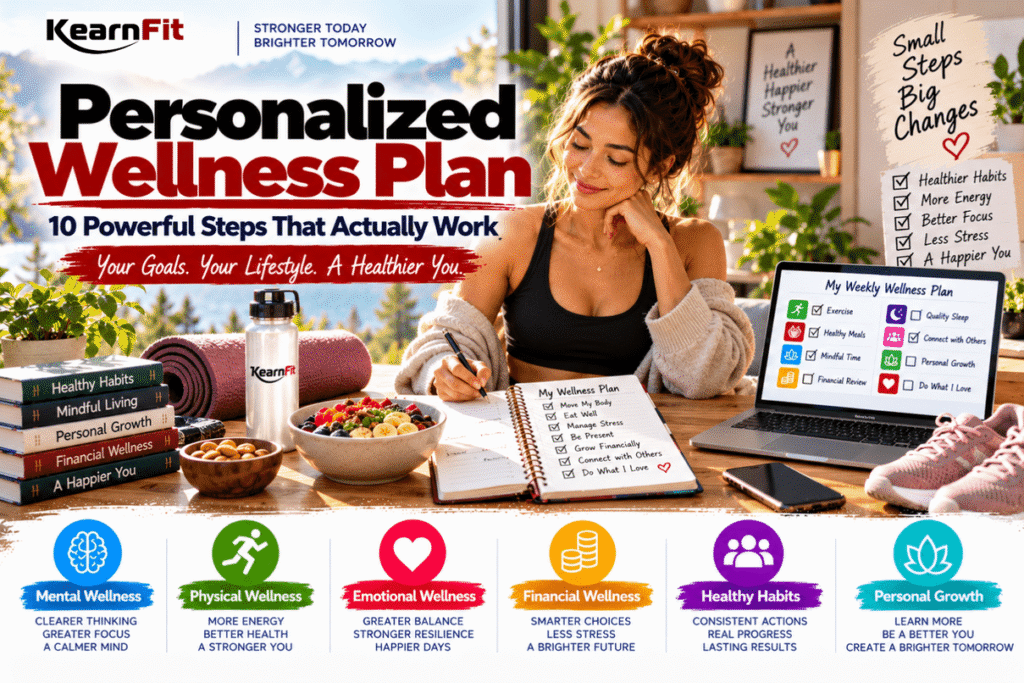
A wellness plan sounds simple until you try to create one.
You may know that you want to sleep better, exercise more, eat healthier, reduce stress, improve your finances, spend more time with people you care about, or simply feel more balanced.
But knowing what you want is not the same as knowing how to build a routine that works.
That is where a personalized wellness plan can make a powerful difference.
Instead of copying someone else’s morning routine, workout schedule, diet, productivity system, or self-care checklist, a personalized wellness plan starts with you.
Your schedule.
Your priorities.
Your current habits.
Your energy.
Your environment.
Your responsibilities.
Your goals.
Your definition of a healthier and more fulfilling life.
The World Health Organization describes self-care as including healthy practices, habits, and lifestyle choices such as healthy eating, physical activity, adequate sleep, and connection with others.
That idea fits naturally with personalized wellness: your plan should help you actively support your wellbeing while recognizing that your circumstances are different from everyone else’s.
A strong personalized wellness plan is not a perfect schedule.
It is a practical system that helps you make better choices consistently.
And most importantly, it should be flexible enough to survive real life.
2. Why Generic Wellness Plans Often Fail
The internet is full of wellness advice.
Wake up at 5 a.m.
Exercise every day.
Meditate for 30 minutes.
Meal prep everything on Sunday.
Read 50 pages before bed.
Track every calorie.
Journal every morning.
Take cold showers.
Spend less money.
Avoid your phone.
The problem is not necessarily that these habits are bad.
The problem is that one routine cannot fit every person.
A parent with young children has different responsibilities from a college student.
A busy entrepreneur has a different schedule from someone working remotely.
A beginner has different fitness needs from an experienced athlete.
Someone recovering from a stressful period may need more recovery and emotional support rather than another demanding goal.
A person trying to improve their finances may need a very different wellness strategy from someone focused primarily on physical fitness.
When a wellness plan ignores context, it can become another source of pressure.
You miss a workout and feel guilty.
You sleep late and feel like you failed.
You eat something outside your plan and abandon the entire routine.
You spend more money than expected and decide financial wellness is too difficult.
This all-or-nothing mindset can make healthy change harder to maintain.
A better approach is to ask:
What does wellness need to look like for me right now?
That question is the foundation of a personalized wellness plan.
3. Why Personalization Makes Wellness More Sustainable
Personalization creates ownership.
When your plan reflects your actual lifestyle, you are more likely to understand why each habit matters and how it fits into your day.
For example, instead of saying:
“I need to exercise more.”
You might decide:
“I will take a 25-minute walk after work on Monday, Wednesday, and Friday.”
Instead of:
“I need to eat healthier.”
You might decide:
“I will prepare two simple lunches at home each Sunday and Wednesday.”
Instead of:
“I need to manage stress.”
You might decide:
“I will spend ten minutes without screens after dinner and use that time to breathe, stretch, or journal.”
The difference is clarity.
A personalized wellness plan transforms broad intentions into behaviors you can actually perform.
It also allows you to start at the right level.
CDC guidance notes that adults should aim for at least 150 minutes of moderate-intensity physical activity per week along with muscle-strengthening activity on at least two days, while also emphasizing that some physical activity is better than none.
That means your plan does not need to begin with the final destination.
It can begin with your current starting point.
Your first goal might simply be moving more consistently.
Then you build.
That is how a personalized wellness plan becomes sustainable instead of overwhelming.
4. The 5 Areas Your Wellness Plan Should Support
A truly complete wellness plan should look beyond workouts and food.
At KearnFit, wellness can be viewed through five connected areas:
1. Mental wellness
How you think, focus, learn, adapt, and manage everyday mental demands.
2. Physical wellness
How you move, eat, sleep, recover, and care for your body.
3. Emotional wellness
How you understand emotions, manage stress, communicate, and maintain healthy relationships.
4. Financial wellness
How you manage money, spending, planning, priorities, and financial confidence.
5. Community and connection
How you build supportive relationships, participate in communities, and create a sense of belonging.
These areas influence one another.
Poor sleep can affect your energy.
Financial pressure can make it harder to relax.
Stress can disrupt your routines.
Isolation can make healthy habits harder to maintain.
A supportive community can make consistency easier.
CDC guidance also recognizes social connection as important to mental and physical health and notes that supportive connections can contribute to healthier behaviors and wellbeing.
This is why your personalized wellness plan should not be a collection of disconnected goals.
It should be a connected lifestyle strategy.
5. 10 Powerful Steps to Create a Personalized Wellness Plan
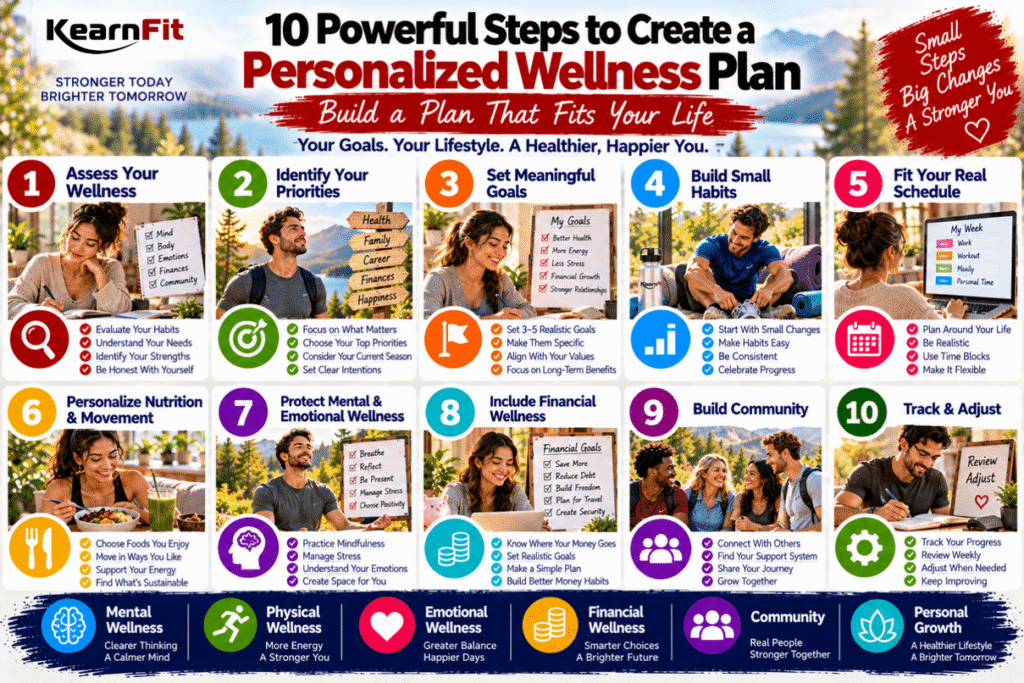
Creating a personalized wellness plan does not have to be complicated.
You can build one using ten practical steps:
- Assess where you are.
- Identify what matters most.
- Set three to five meaningful goals.
- Turn goals into small habits.
- Build around your real schedule.
- Personalize nutrition and movement.
- Protect mental and emotional wellness.
- Include financial wellness.
- Build connection and community.
- Track, review, and adjust.
The goal is not to transform everything overnight.
The goal is to create a system you can continue using when life becomes busy, stressful, unpredictable, or imperfect.
Let’s break down each step.
6. Step #1: Start With an Honest Wellness Assessment
Before deciding where you want to go, understand where you are.
Take 15–20 minutes and evaluate your current lifestyle.
Ask yourself:
Physical wellness
- How often do I move?
- How is my energy?
- Am I getting enough recovery?
- What does my typical eating pattern look like?
- How consistent is my sleep?
Mental wellness
- How focused do I feel?
- How often do I feel mentally overloaded?
- Do I make time to learn or reflect?
- How much time do I spend consuming information?
Emotional wellness
- How well do I recognize my emotions?
- What situations regularly drain me?
- Do I have healthy ways to manage stress?
- Do I make time for myself?
Financial wellness
- Do I know where my money goes?
- Do I have clear financial priorities?
- Do my spending habits support my goals?
- What money-related issue creates the most stress?
Community
- Do I feel connected to people?
- Who supports me?
- Do I have people who encourage healthy growth?
- Where could I build stronger connections?
Do not judge your answers.
You are gathering information.
A personalized wellness plan should begin with awareness rather than criticism.
7. Step #2: Identify What Matters Most Right Now
You cannot improve everything simultaneously.
Trying to do so often creates unnecessary pressure.
Instead, identify your current priority.
Maybe your biggest need is sleep.
Maybe you have been sitting too much.
Maybe stress is affecting your daily life.
Maybe your finances need attention.
Maybe you feel disconnected from friends.
Maybe you have lost your sense of direction.
Your current priority does not need to remain your priority forever.
Think in seasons.
For the next 30 days, your personalized wellness plan might focus heavily on physical activity and sleep.
For the next 30 days after that, you might focus more on emotional wellness and financial organization.
This approach makes wellness feel manageable.
Ask:
“If I improved one area of my life over the next month, which improvement would create the biggest positive difference?”
Start there.
8. Step #3: Set 3–5 Meaningful Wellness Goals
Once you know your priorities, choose a small number of goals.
Three to five is often enough.
Your goals should be meaningful and measurable.
Instead of:
“Get healthier.”
Try:
“Walk for 30 minutes four days a week.”
Instead of:
“Sleep better.”
Try:
“Create a consistent bedtime routine and aim for at least seven hours of sleep.”
Adults generally need at least seven hours of sleep, although sleep needs vary by age and individual circumstances.
Instead of:
“Manage money better.”
Try:
“Review my spending every Sunday and automatically transfer a set amount toward my savings goal.”
Instead of:
“Improve relationships.”
Try:
“Schedule one meaningful conversation or activity with someone important to me each week.”
Your personalized wellness plan becomes much stronger when your goals tell you exactly what action to take.
9. Step #4: Turn Goals Into Small Daily Habits
Goals describe the destination.
Habits create the path.
If your goal is to become more active, decide when and how you will move.
If your goal is better sleep, decide what happens during the final hour of your day.
If your goal is better nutrition, decide what food you will keep available.
If your goal is lower financial stress, decide when you will review your money.
If your goal is emotional wellness, decide what your emotional reset looks like.
Small habits reduce friction.
For example:
Goal: Improve physical fitness.
Habit: Walk for 20 minutes after lunch.
Goal: Improve mental wellness.
Habit: Spend 10 minutes journaling before opening social media.
Goal: Improve financial wellness.
Habit: Review spending every Sunday evening.
Goal: Improve relationships.
Habit: Message one person you care about every weekday.
A personalized wellness plan becomes actionable when every major goal has a corresponding behavior.
10. Step #5: Build a Wellness Routine Around Your Real Schedule
Do not build your plan around an imaginary version of yourself.
Build it around your real life.
If you work from 9 a.m. to 7 p.m., a two-hour morning routine may not be realistic.
If you travel frequently, your plan needs travel-friendly habits.
If your weekends are packed with family responsibilities, your wellness routine should account for that.
If you work from home, use the flexibility to create movement breaks.
Your schedule is not an obstacle to wellness.
It is part of the information you need to personalize your plan.
Try creating three levels:
Minimum day:
The smallest version of your routine.
Standard day:
Your normal wellness routine.
High-energy day:
The expanded version you can use when you have more time and energy.
For example:
Minimum: 10-minute walk + five-minute reflection.
Standard: 30-minute workout + healthy meals + evening wind-down.
High-energy: Full workout + meal preparation + longer outdoor activity + weekly planning.
This creates flexibility without losing direction.
11. Step #6: Personalize Your Nutrition and Movement
Nutrition and movement are major parts of most wellness plans, but neither should be copied blindly from someone else’s lifestyle.
Your food choices should reflect your preferences, culture, budget, schedule, access to food, and individual needs.
WHO emphasizes that healthy diets can take different forms and should be based on principles such as adequacy, balance, moderation, and diversity.
That means your personalized wellness plan does not need to look like someone else’s meal plan.
Build meals around foods you enjoy and can realistically access.
Think:
- Variety
- Nutrient-dense foods
- Fruits and vegetables
- Whole grains
- Protein sources
- Healthy fats
- Adequate hydration
- Reasonable portions
- Sustainable choices
The same principle applies to exercise.
Choose activities that fit your abilities and that you are willing to repeat.
Walking, cycling, swimming, strength training, yoga, mobility work, sports, dancing, or home workouts can all become part of an active lifestyle.
CDC guidance encourages adults to choose activities that work for them and notes that activities can be spread across the week.
Your personalized wellness plan should make movement feel possible, not intimidating.
12. Step #7: Protect Your Mental and Emotional Wellness
A wellness plan that focuses only on physical habits is incomplete.
Mental and emotional wellness deserve dedicated space.
Start by identifying what helps you feel mentally clear.
Maybe it is journaling.
Maybe it is walking outdoors.
Maybe it is reading.
Maybe it is meditation.
Maybe it is meaningful conversation.
Maybe it is reducing unnecessary notifications.
Maybe it is creating stronger boundaries around work.
Your emotional wellness plan can include:
- Daily emotional check-ins
- Journaling
- Mindful breathing
- Time outdoors
- Healthy boundaries
- Meaningful relationships
- Rest
- Creative activities
- Stress-management practices
- Professional support when appropriate
You do not need to eliminate every stressful situation.
Instead, build better ways to respond.
A personalized wellness plan should help you develop resilience rather than demanding perfection.
13. Step #8: Include Financial Wellness in Your Plan
Money may not be the first thing people think about when they hear the word wellness.
But financial pressure can affect many areas of everyday life.
That is why financial wellness deserves a place in your personalized wellness plan.
Start simple.
Review your income and regular expenses.
Identify unnecessary spending.
Create realistic priorities.
Build an emergency cushion if possible.
Review recurring subscriptions.
Set short-term and long-term goals.
Create a weekly or monthly money check-in.
Most importantly, remove shame from the process.
Financial wellness is not about appearing wealthy.
It is about developing greater awareness, control, preparedness, and confidence around money.
Your financial goals should support the lifestyle you actually want.
For example:
Goal: Reduce financial stress.
Habit: 20-minute weekly money review.
Goal: Save for a future experience.
Habit: Automatic weekly transfer.
Goal: Reduce impulse spending.
Habit: Use a 24-hour pause before non-essential purchases.
Small financial habits can become an important part of a complete wellness routine.
14. Step #9: Build Connection and Community Into Your Lifestyle
Wellness should not always be a solo project.
Your environment matters.
Your relationships matter.
Your community matters.
A personalized wellness plan can include social goals just as easily as physical or financial goals.
For example:
- Schedule weekly time with friends.
- Join a fitness or wellness community.
- Exercise with a partner.
- Attend a group activity.
- Call a family member regularly.
- Find an accountability partner.
- Volunteer.
- Participate in meaningful community activities.
CDC guidance highlights that supportive social connections can contribute to mental and physical health, stress management, healthier behaviors, and quality of life.
This is especially important if your wellness journey feels difficult alone.
The right community can provide encouragement, accountability, learning, and belonging.
Your personalized wellness plan should ask not only:
“What can I do for myself?”
but also:
“Who can I grow with?”
15. Step #10: Track, Review, and Adjust Your Plan
Your first plan will not be perfect.
It does not need to be.
The most effective personalized wellness plan is one that evolves.
Choose a weekly review day.
Spend 15–20 minutes asking:
What worked?
What felt difficult?
What did I enjoy?
What did I avoid?
What gave me energy?
What drained me?
What should I change next week?
Do not track everything.
Choose a few useful indicators.
For example:
| Wellness Area | Simple Metric |
|---|---|
| Physical | Movement sessions |
| Sleep | Consistent bedtime/wake time |
| Nutrition | Home-prepared meals |
| Mental | Reflection or quiet time |
| Emotional | Stress check-in |
| Financial | Weekly money review |
| Community | Meaningful connection |
| Personal Growth | Learning or goal progress |
Tracking should create awareness, not obsession.
If something is not working, change it.
That is not failure.
That is personalization.
16. Personalized Wellness Plan for Busy Professionals
Busy professionals often do not need more wellness information.
They need a plan that fits into a demanding schedule.
Start by identifying your non-negotiables.
For example:
Morning:
Water + five-minute planning + short movement.
Workday:
Movement breaks + nutritious lunch + hydration.
After work:
Walk, workout, or decompression ritual.
Evening:
Digital boundaries + simple dinner + sleep routine.
Weekend:
Meal preparation + financial review + social connection + recovery.
Use transitions.
Walk during a phone call.
Stretch between meetings.
Take a short outdoor break instead of scrolling.
Prepare simple meals rather than complicated recipes.
Use your calendar to protect wellness time.
The best personalized wellness plan for a busy professional is not necessarily the most ambitious.
It is the one that survives a busy Tuesday.
17. Personalized Wellness Plan for Beginners
If you are new to wellness, resist the urge to change everything immediately.
Start with four basics:
1. Move regularly.
Choose walking, beginner strength training, cycling, yoga, or another activity you enjoy.
2. Improve your food environment.
Keep nourishing foods available and make simple meals easier.
3. Protect sleep.
Create a consistent evening routine and prioritize adequate sleep.
4. Build one mental or emotional wellness habit.
Try journaling, mindful breathing, time outdoors, or a short daily reflection.
After these habits become more comfortable, add another layer.
Your personalized wellness plan should grow with you.
You do not need to become a completely different person in 30 days.
You need to become slightly more consistent with the behaviors that support the person you want to become.
18. Personalized Wellness Plan When Motivation Is Low
Motivation will change.
Some days you will feel energized.
Other days you will not.
Your plan needs to account for both.
Create a low-motivation version of your routine.
Instead of a full workout, take a 10-minute walk.
Instead of cooking an elaborate meal, make a simple nutritious option.
Instead of a 30-minute meditation session, take five quiet minutes.
Instead of a full financial review, check your account and one important expense.
Instead of a long social event, send one meaningful message.
The purpose is not to force yourself through exhaustion.
The purpose is to maintain connection with your habits.
Remember:
Consistency does not mean doing the maximum every day.
Consistency means continuing to participate in your own wellbeing.
That mindset can make a personalized wellness plan much easier to sustain.
19. How the Four Dimensions of Fitness Strengthen Your Plan
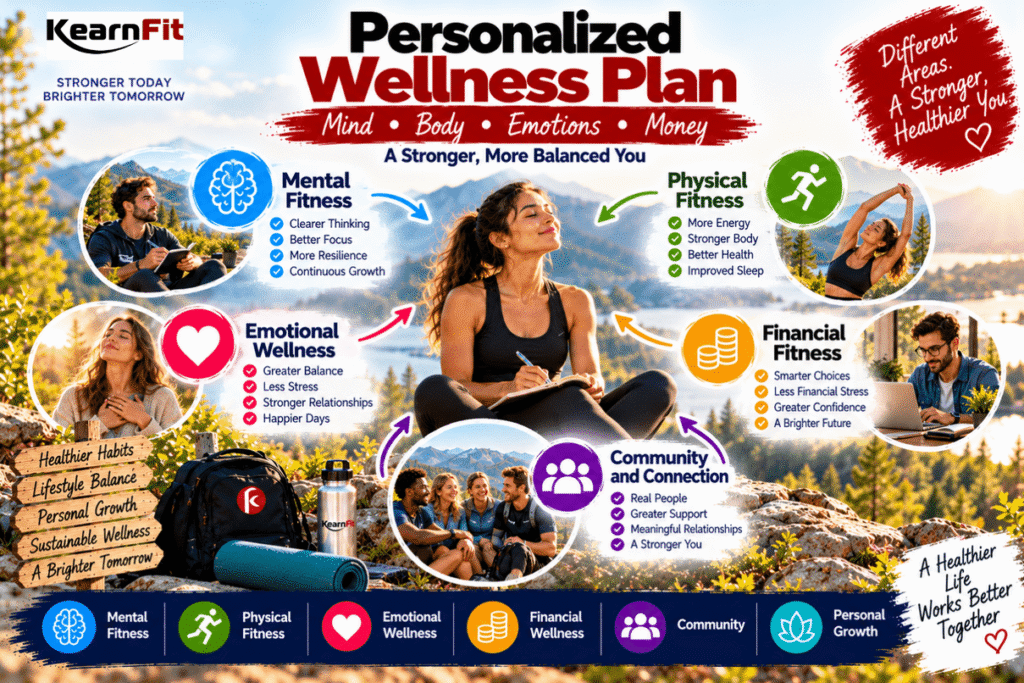
A personalized wellness plan becomes more powerful when you see wellness as a connected system.
KearnFit’s approach centers on four dimensions of fitness:
Mental fitness
Build clarity, focus, resilience, learning, and stronger thinking habits.
Physical fitness
Develop movement, strength, energy, mobility, nutrition, sleep, and recovery.
Emotional fitness
Understand emotions, manage stress, strengthen relationships, and build emotional resilience.
Financial fitness
Develop awareness, intentional money habits, realistic goals, and greater financial confidence.
These dimensions are not isolated.
They influence one another.
Better sleep may support your mental and physical wellbeing.
Reduced financial stress may create more emotional space.
Movement can become part of your stress-management routine.
Supportive relationships can make healthy habits easier to maintain.
This interconnected approach is one reason a personalized wellness plan should be broader than a workout schedule.
You are not just building a fitter body.
You are building a stronger lifestyle.
20. Create a Personalized Morning Wellness Routine
Your morning routine should support your priorities rather than imitate someone else’s routine.
Start by choosing three to five habits.
For example:
5 minutes: Hydrate and open the curtains.
10 minutes: Stretch or walk.
5 minutes: Journal or review your priorities.
10 minutes: Eat a nourishing breakfast.
2 minutes: Review the day’s most important task.
You could also create different morning versions.
Busy morning: Water + movement + priorities.
Normal morning: Water + movement + breakfast + reflection.
Slow morning: Movement + mindfulness + breakfast + planning + reading.
This makes your routine adaptable.
The objective is not to create a picture-perfect morning.
It is to begin the day in a way that supports your mental, physical, emotional, and lifestyle priorities.
21. Create a Personalized Evening Wellness Routine
Your evening routine should help you transition out of work and into recovery.
Consider:
- Reviewing tomorrow’s priorities.
- Preparing clothes or meals.
- Reducing unnecessary screen stimulation.
- Spending time with family or friends.
- Journaling.
- Stretching.
- Reading.
- Practicing relaxation.
- Reviewing your emotions.
- Preparing for consistent sleep.
Your evening routine does not have to be long.
Even 20–30 intentional minutes can create a valuable transition.
Sleep should be treated as part of your wellness strategy rather than leftover time.
CDC guidance emphasizes that adequate, quality sleep is essential for health and emotional wellbeing.
Build your personalized wellness plan around protecting that recovery period.
22. Build a Weekly Wellness Review
A weekly review keeps your plan alive.
Choose a consistent day and ask seven questions:
1. What went well?
2. What felt difficult?
3. Which habit gave me the most value?
4. Which habit felt unrealistic?
5. What needs more attention?
6. What can I simplify?
7. What is my priority for next week?
Then update your plan.
For example:
Last week:
Five workouts felt unrealistic.
Adjustment:
Three structured workouts plus two walking sessions.
Last week:
Meal preparation took too long.
Adjustment:
Prepare ingredients instead of full meals.
Last week:
Evening phone use disrupted the wind-down routine.
Adjustment:
Charge the phone outside the bedroom.
This is how your personalized wellness plan becomes smarter over time.
23. 7 Common Personalized Wellness Plan Mistakes to Avoid
Even a well-designed plan can fail if it becomes too rigid.
Avoid these seven mistakes.
1. Copying someone else’s routine
Inspiration is useful. Copying is not personalization.
2. Setting too many goals
Ten goals can quickly become ten sources of pressure.
3. Starting too aggressively
Extreme changes are difficult to maintain.
4. Ignoring your schedule
A routine that does not fit your life will eventually break.
5. Tracking everything
More data does not automatically mean more progress.
6. Treating one bad day as failure
One difficult day is information, not a verdict.
7. Never reviewing your plan
Your life changes.
Your wellness plan should change with it.
The goal is not perfection.
The goal is alignment.
24. How to Make Your Wellness Plan Flexible
Flexibility is one of the most important features of a sustainable personalized wellness plan.
Create anchors, not rigid rules.
For example:
Instead of:
“I must exercise at 6 a.m. every day.”
Try:
“I will complete movement before the end of the day.”
Instead of:
“I must cook every meal.”
Try:
“I will make nutritious choices that fit my schedule and budget.”
Instead of:
“I can never miss a workout.”
Try:
“If I miss a workout, I will return to my routine at the next opportunity.”
This difference is powerful.
Your plan gives you direction without trapping you.
Life will include travel, deadlines, celebrations, illness, fatigue, family responsibilities, unexpected expenses, and difficult emotions.
A flexible plan is designed for real life.
25. Your 30-Day Personalized Wellness Plan Challenge
Ready to create your own plan?
Use this simple 30-day framework.
Days 1–3: Assess
Write down your current habits, priorities, challenges, and strengths.
Days 4–7: Choose
Select three to five wellness goals.
Week 2: Build
Turn each goal into one small repeatable behavior.
Week 3: Strengthen
Improve your environment.
Prepare meals.
Schedule movement.
Create reminders.
Reduce friction.
Ask someone to support you.
Week 4: Review
Look at what worked.
Remove what did not.
Strengthen what helped.
Then create your next 30-day cycle.
Here is an example:
| Area | Goal | Habit | Frequency |
|---|---|---|---|
| Physical | Improve fitness | Walk/workout | 4x weekly |
| Mental | Improve focus | Quiet reflection | Daily |
| Emotional | Reduce stress | Evening reset | Daily |
| Financial | Improve awareness | Money review | Weekly |
| Community | Strengthen connection | Meaningful conversation | Weekly |
The goal of this challenge is not to create a perfect lifestyle.
It is to create your lifestyle system.
26. How KearnFit Can Support Your Wellness Journey

Your wellness journey does not have to happen alone.
At KearnFit, we believe wellness is bigger than a workout, a diet, a productivity routine, or a single goal.
It is about building a stronger and more balanced life.
That means looking at mental fitness, physical fitness, emotional wellness, financial wellness, and community as connected parts of your overall lifestyle.
A personalized wellness plan gives you a framework for putting those ideas into action.
You can start small.
Choose one area.
Create one habit.
Track your progress.
Learn from the experience.
Then build from there.
If you want to explore a broader approach to fitness, learn more about the four dimensions of fitness and how mental, physical, emotional, and financial wellness can work together to support a stronger lifestyle.
Visit www.kearnfit.com to explore KearnFit and continue building healthier habits, stronger connections, and meaningful personal growth.
27. Conclusion: Build a Wellness Plan That Fits Your Life
The best wellness plan is not the one that looks impressive on paper.
It is the one you can actually live.
A personalized wellness plan should reflect your goals, schedule, priorities, preferences, environment, challenges, and current starting point.
Start by assessing where you are.
Choose what matters most.
Set a few meaningful goals.
Turn those goals into small habits.
Build routines around your real schedule.
Personalize your nutrition and movement.
Protect your mental and emotional wellness.
Include financial wellness.
Strengthen your community.
Then review and adjust.
Most importantly, give yourself permission to evolve.
Your needs will change.
Your schedule will change.
Your priorities will change.
Your wellness plan can change too.
You do not need a perfect routine.
You need a realistic direction and repeatable actions.
Start with one meaningful improvement today.
Then another tomorrow.
Over time, those small decisions can become the foundation of a healthier, stronger, more balanced lifestyle.
Your wellness plan should not be someone else’s routine. It should be a reflection of the life you want to build.