1. What Are Healthy Relationships and Wellness?
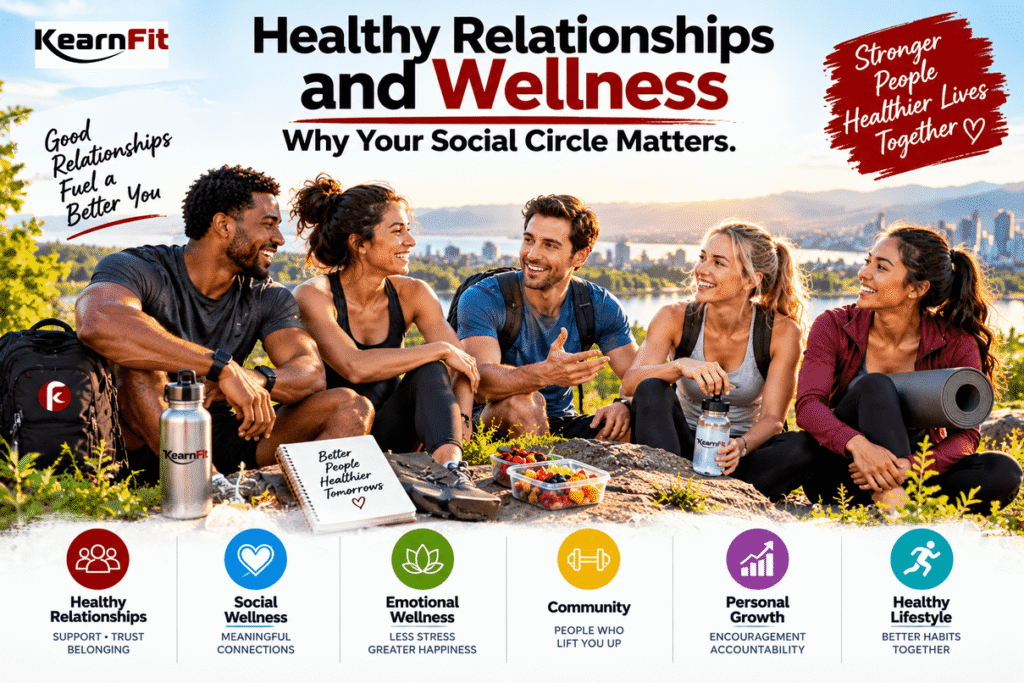
When people think about wellness, they often think about exercise, nutrition, sleep, stress management, or personal development.
But there is another powerful part of a healthy lifestyle that can be easy to overlook: the people around you.
Your friends, family members, coworkers, mentors, teammates, neighbors, and community connections can influence how you think, behave, feel, and respond to everyday challenges.
That is where Healthy Relationships and Wellness come together.
Healthy Relationships and Wellness begin with recognizing that the people around us can influence how we think, feel, behave, and experience everyday life.
Healthy relationships are not simply about having a large social circle. They are about having connections that provide respect, trust, encouragement, honesty, belonging, and mutual support.
Your social circle can influence the habits you practice, the goals you pursue, the way you handle stress, and even whether you feel comfortable asking for help when life becomes difficult.
A strong social life does not mean saying yes to everyone or constantly being surrounded by people. Sometimes wellness means having a smaller circle of meaningful relationships that make you feel supported rather than drained.
The goal is not to create the biggest network.
The goal is to create a healthier network.
When your relationships support your mental, physical, emotional, and personal wellbeing, they can become an important part of your overall wellness lifestyle.
Think about the people you spend the most time with.
What do they talk about?
What habits do they encourage?
How do you feel after spending time with them?
Do you feel energized, respected, motivated, and understood?
Or do you regularly feel criticized, exhausted, pressured, or disconnected?
Your social environment can influence your everyday experience in subtle ways.
For example, one friend may encourage you to go for a walk when you have had a stressful day. Another may motivate you to return to a healthy routine after missing several workouts. A supportive coworker may remind you to take a proper break. A mentor may encourage you to think bigger about your goals.
These moments may seem small, but repeated social experiences can shape your lifestyle.
The CDC notes that social connection is important for mental and physical health, and supportive relationships can contribute to healthier behaviors, better stress management, and better overall wellbeing.
That makes social wellness more than a feel-good concept.
It is part of a complete lifestyle.
Your social circle can influence whether healthy choices feel easier or harder.
That does not mean your friends determine your behavior. You are still responsible for your choices.
But the environment around you matters.
If your relationships consistently support growth, healthy routines, emotional safety, and positive experiences, they can make your wellness journey feel more sustainable.
3. The Connection Between Relationships and Overall Wellness
Wellness is interconnected.
Your mental health can influence your physical habits.
Your physical energy can influence your emotional wellbeing.
Financial stress can influence your relationships.
Your relationships can influence how you manage stress.
A complete wellness approach looks beyond any single area of health; learn more about the four dimensions of fitness and how mental, physical, emotional, and financial wellness connect.
Understanding Healthy Relationships and Wellness means looking at social connection as an important part of a complete lifestyle rather than treating relationships as separate from health.
A supportive relationship can give you a place to talk when you are overwhelmed.
A walking group can combine physical activity with social connection.
A professional community can help you learn, grow, and build confidence.
A trusted friend can encourage you to maintain a healthy habit when motivation disappears.
A family member can provide practical support during a challenging period.
Social connection can also create a sense of belonging.
And belonging matters.
People generally need meaningful human connection. When people experience persistent loneliness or social isolation, their mental and physical wellbeing can be affected.
The goal, therefore, is not simply to become more social.
The goal is to become more connected in meaningful ways.
That distinction is important.
You can have hundreds of followers and still feel lonely.
You can attend dozens of events and still feel disconnected.
You can also have three close friends and feel deeply supported.
Wellness is not measured by the size of your contact list.
It is influenced by the quality and meaning of your connections.
4. Why Quality Matters More Than Quantity
One of the biggest misconceptions about social wellness is that you need a large network.
You do not.
A healthier approach is to focus on quality, trust, compatibility, and mutual support.
Consider the difference between these two situations.
In the first, you have 100 contacts but rarely feel comfortable talking honestly with anyone.
In the second, you have five people who genuinely care about your wellbeing and whom you can call during both good and difficult moments.
The second situation may provide far more meaningful social support.
Quality relationships tend to include:
- Respect
- Trust
- Honest communication
- Mutual support
- Emotional safety
- Shared values
- Healthy boundaries
- Encouragement
- Accountability
- Room for individuality
Healthy relationships also allow people to disagree.
Healthy Relationships and Wellness are built through meaningful connection, mutual respect, trust, and relationships that allow you to feel supported while remaining true to yourself.
You do not need identical personalities, opinions, careers, interests, or lifestyles.
Healthy connection does not require constant agreement.
It requires respect.
The best social circles allow you to become more yourself rather than forcing you to become someone else.
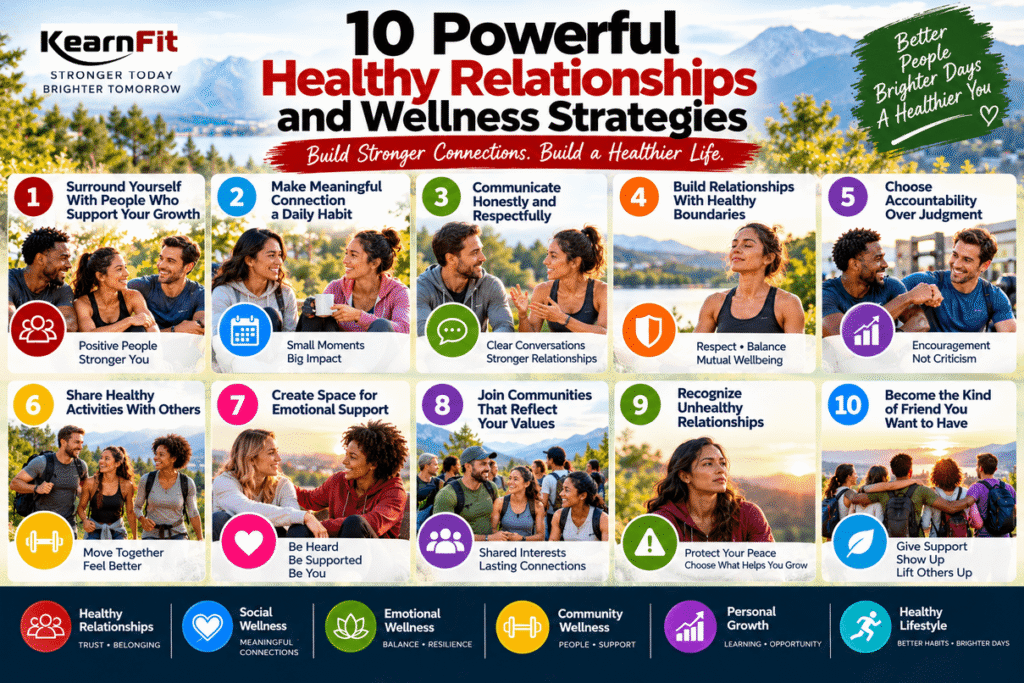
5. 10 Powerful Healthy Relationships and Wellness Strategies
Building stronger relationships does not have to require a dramatic social transformation.
Small actions can make a meaningful difference.
Here are 10 practical strategies to strengthen your social wellness and create relationships that support a healthier lifestyle.
6. Strategy #1: Surround Yourself With People Who Support Your Growth
The people around you can influence your mindset.
That does not mean you need to remove everyone who thinks differently from you.
It means becoming more intentional about who receives regular access to your time, attention, energy, and trust.
Strong Healthy Relationships and Wellness habits start with choosing connections that encourage respect, growth, balance, and positive lifestyle choices.
Ask yourself:
Who brings out the best version of me?
Maybe it is the friend who encourages you to keep going.
Maybe it is the colleague who challenges you to improve professionally.
Maybe it is the family member who listens without immediately judging.
Maybe it is the mentor who helps you see possibilities you had not considered.
These relationships can become powerful sources of positive reinforcement.
Look for people who:
- Respect your boundaries
- Celebrate your progress
- Encourage healthy choices
- Listen when you need support
- Tell you the truth respectfully
- Want to see you grow
- Respect your individuality
- Encourage balance rather than burnout
At the same time, pay attention to relationships that consistently undermine your wellbeing.
Your social circle should not become another source of unnecessary stress.
7. Strategy #2: Make Meaningful Connection a Daily Habit
You do not need to wait for a birthday, holiday, crisis, or special occasion to connect with someone.
Connection can become part of your everyday routine.
Send a thoughtful message.
Call someone while taking a walk.
Ask a coworker how they are actually doing.
Have breakfast with a family member.
Invite a friend for coffee.
Share a healthy meal.
Take a walk together.
Put your phone away and have a real conversation.
The CDC recommends simple acts of connection, including reaching out, spending meaningful time with others, participating in groups, and strengthening existing relationships.
The key is consistency.
A five-minute genuine conversation can sometimes be more meaningful than two hours of distracted socializing.
Try creating a simple daily connection habit.
For example:
Morning: Send one encouraging message.
Afternoon: Have one real conversation without multitasking.
Evening: Check in with someone you care about.
These small habits can help relationships remain active instead of becoming something you only think about when you have free time.
8. Strategy #3: Communicate Honestly and Respectfully
Healthy relationships require communication.
You cannot expect people to automatically understand your needs, boundaries, expectations, or emotions.
Learn to communicate clearly.
Clear communication is one of the foundations of Healthy Relationships and Wellness because it helps people express their needs while maintaining respect for one another.
Instead of saying:
“You never listen.”
Try:
“I feel unheard when I am interrupted. Can we slow down and talk about this?”
Instead of:
“You don’t care about me.”
Try:
“I would appreciate more support when I am dealing with something difficult.”
Healthy communication is not about winning.
It is about understanding.
Practice:
- Listening without immediately interrupting
- Asking questions
- Expressing your needs clearly
- Using respectful language
- Taking responsibility for your part
- Clarifying misunderstandings
- Saying what you actually mean
- Giving others space to respond
Good communication does not eliminate conflict.
It gives you a healthier way to handle conflict.
9. Strategy #4: Build Relationships With Healthy Boundaries
Connection does not mean unlimited access.
You can love someone and still need boundaries.
You can support a friend without becoming responsible for every problem they experience.
You can care about your family without allowing constant interference in your decisions.
You can be a supportive coworker without being available 24 hours a day.
Healthy boundaries help protect your time, emotional energy, privacy, and wellbeing.
Examples include:
- Saying no when you genuinely cannot help
- Protecting your personal time
- Limiting unnecessary digital communication
- Communicating expectations clearly
- Avoiding repeated disrespect
- Taking breaks from emotionally intense conversations
- Separating work and personal life
- Protecting your sleep and recovery time
Boundaries are not walls.
They are guidelines for healthier interaction.
A strong relationship should have room for both connection and individuality.
10. Strategy #5: Choose Accountability Over Judgment
One of the most valuable things a healthy relationship can provide is accountability.
Accountability means having someone who helps you stay aligned with what matters to you.
It might be:
“Did you get your workout in today?”
“How did that project go?”
“Are you still working toward that goal?”
“Have you taken a break?”
“How are you actually feeling?”
Healthy accountability is different from judgment.
Judgment says:
“You failed again.”
Accountability says:
“You had a difficult week. What can we change so next week feels easier?”
That difference can completely change how people respond to setbacks.
Choose relationships where people help you move forward rather than constantly reminding you of your mistakes.
And offer the same support in return.
Wellness can become more enjoyable when you do it with people.
Instead of always exercising alone, invite a friend for a walk.
Cook a healthy meal together.
Join a recreational sports group.
Take a weekend hike.
Try a yoga class.
Create a small accountability group.
Attend a wellness workshop.
Explore your neighborhood.
These activities combine social connection with healthy lifestyle habits.
This can also make healthy routines feel less like obligations.
You are not simply “doing exercise.”
You are spending time with someone you care about while moving your body.
You are not simply “following a meal plan.”
You are learning to cook together.
You are not simply “working on personal growth.”
You are participating in a community that encourages development.
That is the power of combining wellness with connection.
Combining movement, connection, and enjoyable experiences is a practical way to make Healthy Relationships and Wellness part of your everyday routine.
12. Strategy #7: Create Space for Emotional Support
Not every conversation needs to be productive.
Sometimes people simply need to be heard.
A strong social circle includes people with whom you can talk about difficult experiences without immediately feeling like you have to fix everything.
Emotional support may include:
- Listening
- Encouragement
- Empathy
- Reassurance
- Practical help
- Compassion
- Shared experiences
- Honest conversations
You can also practice becoming a better listener.
Instead of immediately giving advice, try asking:
“What do you need right now?”
“Do you want advice or do you just want me to listen?”
“How can I support you?”
These questions create space for the other person to communicate what they actually need.
And remember that friends are not substitutes for professional care.
If someone is experiencing serious emotional distress, persistent mental health symptoms, or a crisis, encourage them to seek appropriate professional support.
Emotional support is an important part of Healthy Relationships and Wellness because feeling heard and understood can make difficult experiences easier to navigate.
Healthy relationships can provide support, but they do not have to carry every problem alone.
13. Strategy #8: Join Communities That Reflect Your Values
Sometimes your existing social circle is not enough.
That is okay.
You can build new connections through shared interests and values.
Consider joining:
- Fitness communities
- Walking groups
- Running clubs
- Book clubs
- Volunteer organizations
- Professional networks
- Creative groups
- Community events
- Educational groups
- Wellness communities
- Sports teams
- Local interest groups
Shared activities make connection easier because you already have something in common.
Communities can make Healthy Relationships and Wellness easier to practice because shared interests create natural opportunities for connection, encouragement, and accountability.
You do not need to walk into a room expecting to make ten new friends.
Start with one conversation.
Then another.
Over time, repeated interaction can create familiarity and belonging.
Community can be especially powerful because it creates opportunities for people to support one another while working toward shared goals.
14. Strategy #9: Learn to Recognize Unhealthy Relationships
Healthy relationships and wellness also require knowing when a relationship is harming rather than supporting you.
Not every difficult relationship is automatically unhealthy.
People make mistakes.
Friends disagree.
Families experience conflict.
Coworkers have misunderstandings.
The important question is whether the overall pattern is respectful and constructive.
Warning signs can include:
- Repeated disrespect
- Manipulation
- Constant criticism
- Controlling behavior
- Frequent dishonesty
- One-sided emotional demands
- Repeated boundary violations
- Feeling afraid to express yourself
- Persistent humiliation
- Pressure to abandon your values
- Isolation from other supportive people
If a relationship repeatedly damages your wellbeing, consider what boundaries, distance, support, or professional guidance may be appropriate.
Your wellbeing matters.
You do not have to maintain every relationship at the same level simply because it has existed for a long time.
Healthy relationships should have room for mutual respect.
15. Strategy #10: Become the Kind of Friend You Want to Have
Social wellness is not only about what other people give you.
It is also about what you contribute.
If you want supportive relationships, practice being supportive.
If you want people to listen, become a better listener.
If you want honesty, communicate honestly.
If you want encouragement, learn to celebrate other people’s progress.
If you want accountability, offer accountability without judgment.
Ask yourself:
What kind of person do I want to be in someone else’s wellness journey?
You could become the friend who sends the encouraging message.
The colleague who notices when someone needs a break.
The workout partner who keeps showing up.
The family member who listens.
The community member who welcomes newcomers.
The mentor who shares what you have learned.
Healthy relationships become stronger when support moves in both directions.
16. Healthy Relationships and Wellness for Busy Professionals
Busy professionals often say they do not have enough time for relationships.
But the problem may not always be a lack of time.
For busy professionals, Healthy Relationships and Wellness become more sustainable when meaningful connection is intentionally included alongside work, fitness, family, and personal responsibilities.
Sometimes it is a lack of intention.
A demanding schedule can gradually turn relationships into something that happens only when everything else is finished.
And everything else is rarely finished.
Instead, integrate connection into your existing lifestyle.
Have a walking meeting.
Call a friend during your commute.
Schedule a weekly dinner.
Exercise with a colleague.
Take lunch away from your desk.
Create a monthly catch-up with close friends.
Join a professional or wellness community.
Use weekends for meaningful experiences rather than only recovering from the workweek.
Social connection does not always require large amounts of time.
It requires attention.
Five focused minutes can be more meaningful than an hour spent scrolling while half-listening to someone.
Protect relationships the same way you protect important work commitments.
Put them on the calendar.
Make them part of your lifestyle.
17. Healthy Relationships and Mental Wellness
Your social environment can influence your emotional experience.
Supportive relationships can provide opportunities to talk, laugh, reflect, receive encouragement, and feel understood.
They can also help people cope with difficult periods.
Healthy Relationships and Wellness can support mental wellbeing by creating opportunities for connection, encouragement, conversation, and a sense of belonging.
On the other hand, chronic conflict, rejection, isolation, or unhealthy social environments can contribute to emotional strain.
That is why mental wellness should not be treated as an entirely individual project.
Meditation, journaling, exercise, sleep, and self-care are valuable.
But connection matters too.
Ask yourself:
Who can I talk to when life feels difficult?
Who celebrates my progress?
Who can I be completely honest with?
Where do I feel that I belong?
If you struggle to answer these questions, that does not mean something is wrong with you.
It simply identifies an area where you may want to build stronger connections.
18. Healthy Relationships and Physical Wellness
Your social circle can also influence physical habits.
Think about how much easier some activities become when another person is involved.
A workout partner can make exercise more enjoyable.
This is another reason Healthy Relationships and Wellness belong in a holistic approach to fitness: supportive people can make healthy physical activities more enjoyable and sustainable.
A friend can motivate you to take a walk.
A family can create shared meal routines.
A community can provide opportunities for recreation and physical activity.
The CDC highlights community and social-support approaches as useful ways to encourage physical activity and stronger connections.
This is one reason social wellness fits naturally into a holistic lifestyle.
You do not have to separate:
Fitness + Friendship
Movement + Community
Nutrition + Connection
Recovery + Relationships
They can reinforce one another.
A healthier lifestyle becomes more sustainable when it fits naturally into your relationships and environment.
19. Healthy Relationships and Emotional Wellness
Emotional wellness involves recognizing, expressing, and managing emotions in healthy ways.
Relationships can influence this process.
A supportive person can provide perspective when you are overwhelmed.
A trusted friend can help you see a situation differently.
A healthy relationship can give you space to express emotions without feeling ashamed.
But emotional wellness also requires personal responsibility.
Do not expect your social circle to regulate every emotion for you.
Build your own emotional skills while allowing relationships to provide healthy support.
Practice:
- Naming your emotions
- Taking a pause before reacting
- Communicating your needs
- Listening carefully
- Setting boundaries
- Asking for help
- Giving yourself time to recover
- Practicing self-compassion
Healthy Relationships and Wellness become stronger when connection and self-awareness work together.
20. Healthy Relationships and Financial Wellness
Financial wellness may seem unrelated to relationships, but the connection is significant.
Money can influence stress, lifestyle decisions, family conversations, social activities, and long-term goals.
Healthy relationships can create space for better financial conversations.
For couples, families, or business partners, this might mean discussing:
- Shared goals
- Spending priorities
- Saving
- Debt
- Lifestyle expectations
- Emergency planning
- Financial responsibilities
- Long-term priorities
Financial wellness does not mean everyone in your social circle needs the same income or financial goals.
It means creating relationships where money can be discussed responsibly when appropriate.
Be careful, however, about comparing your financial life with your friends.
Someone else’s lifestyle may not reflect their financial reality.
You do not need to spend more money to maintain relationships.
Some of the best social experiences are inexpensive or free:
- Walking together
- Cooking at home
- Visiting a park
- Reading together
- Exercising
- Volunteering
- Having meaningful conversations
Healthy relationships should not require unhealthy financial pressure.
21. Healthy Relationships and Personal Growth
The right people can challenge you to grow.
They may encourage you to apply for an opportunity.
They may introduce you to a new idea.
They may tell you something you need to hear.
They may celebrate a goal you once thought was impossible.
Personal growth becomes more sustainable when you are surrounded by people who respect who you are while encouraging who you can become.
Ask yourself:
Does my social circle support the person I am becoming?
This does not mean everyone needs to understand every goal.
It means your closest relationships should not consistently force you backward.
Find people who encourage learning.
Find people who celebrate progress.
Find people who have goals of their own.
Find people who can admit mistakes.
Find people who are willing to grow.
Your social environment can become a powerful learning environment.
Healthy Relationships and Wellness can also create an environment where learning, confidence, accountability, and personal development become part of everyday life.
Technology has made connection easier than ever.
But easier connection does not always mean deeper connection.
You can message someone instantly without having a meaningful conversation.
You can watch hundreds of people’s lives without actually feeling close to anyone.
You can spend hours scrolling while avoiding the person sitting beside you.
Digital tools can support relationships, especially across distance.
In the digital age, Healthy Relationships and Wellness require using technology intentionally while still making room for genuine conversations and face-to-face connection.
The goal is not to reject technology.
The goal is to use it intentionally.
Try:
- Calling instead of always texting
- Scheduling video conversations with people who live far away
- Putting your phone away during meals
- Creating screen-free conversations
- Turning off unnecessary notifications
- Avoiding social comparison
- Using online communities to support real interests
- Choosing meaningful interaction over endless scrolling
Technology should help connection, not replace every form of connection.
Even people who value relationships can fall into habits that weaken social wellness.
Mistake #1: Waiting for Others to Always Initiate
If you want connection, sometimes you need to make the first move.
Mistake #2: Confusing Popularity With Belonging
A large network does not guarantee meaningful relationships.
Mistake #3: Ignoring Boundaries
Constant availability can eventually create resentment and emotional exhaustion.
Mistake #4: Staying in Every Relationship Forever
Some relationships change naturally. Others may require distance or stronger boundaries.
Mistake #5: Using Relationships Only When You Need Something
Healthy connection involves giving as well as receiving.
Social media can make other people’s lives look more connected than they actually are.
Mistake #7: Forgetting Yourself
Healthy relationships should complement your identity, not replace it.
Your social circle matters.
But so does your relationship with yourself.
Building a healthier social circle does not happen overnight.
Think of it as a long-term wellness habit.
Start by identifying the relationships you already value.
Who do you want to spend more time with?
Who makes you feel supported?
Who encourages healthy choices?
Who shares interests or values that matter to you?
Then identify opportunities for new connection.
Building a healthier social circle is one of the most practical ways to turn Healthy Relationships and Wellness from an idea into a consistent lifestyle practice.
Join a group.
Attend a community event.
Try a fitness class.
Volunteer.
Take part in a professional network.
Start a small wellness group.
Invite someone for coffee.
The key is repetition.
Connection grows through repeated interaction.
Do not judge your progress based on how quickly you make new friends.
Instead, focus on showing up consistently.
A simple weekly plan could look like this:
| Day | Social Wellness Action |
|---|---|
| Monday | Send an encouraging message |
| Tuesday | Have one meaningful conversation |
| Wednesday | Exercise with someone |
| Thursday | Check in with a friend |
| Friday | Share a meal or activity |
| Saturday | Join a community activity |
| Sunday | Reflect on your relationships |
You do not need to follow this exact schedule.
The point is to make connection intentional.
25. Your 30-Day Healthy Relationships and Wellness Challenge
Ready to strengthen your social wellness?
Try this 30-day challenge.
Week 1: Reconnect
Day 1: Message someone you care about.
Day 2: Call a friend or family member.
Day 3: Ask someone how they are really doing.
Day 4: Have a conversation without your phone nearby.
Day 5: Thank someone for their positive influence.
Day 6: Spend quality time with someone.
Day 7: Reflect on which relationships energize you.
Week 2: Strengthen
Day 8: Listen without interrupting.
Day 9: Give someone genuine encouragement.
Day 10: Invite someone for a walk.
Day 11: Share a healthy meal.
Day 12: Ask for support if you need it.
Day 13: Offer support to someone else.
Day 14: Practice one healthy boundary.
Week 3: Expand
Day 15: Join a group.
Day 16: Attend a community activity.
Day 17: Talk to someone new.
Day 18: Try a shared physical activity.
Day 19: Participate in a learning event.
Day 20: Volunteer or help someone.
Day 21: Identify one community you want to become part of.
Week 4: Grow
Day 22: Reflect on your closest relationships.
Day 23: Have an honest conversation.
Day 24: Celebrate someone’s progress.
Day 25: Review your social boundaries.
Day 26: Plan a recurring connection ritual.
Day 27: Put your phone away during meaningful time.
Day 28: Do something healthy with a friend.
Day 29: Write down three relationships you appreciate.
Day 30: Create your personal social wellness plan for the next month.
The goal is not to complete every activity perfectly.
The goal is to become more intentional about connection.
26. How KearnFit Supports Healthy Relationships and Wellness
At KearnFit, wellness is bigger than physical fitness.
We believe a healthier life involves developing multiple areas of wellbeing while creating meaningful connections with people who encourage growth.
That is why community is such an important part of the KearnFit philosophy.
Your journey toward better health does not have to happen alone.
You can learn with others.
Move with others.
Grow with others.
Share goals with others.
Celebrate progress with others.
And support others when their journey becomes difficult.
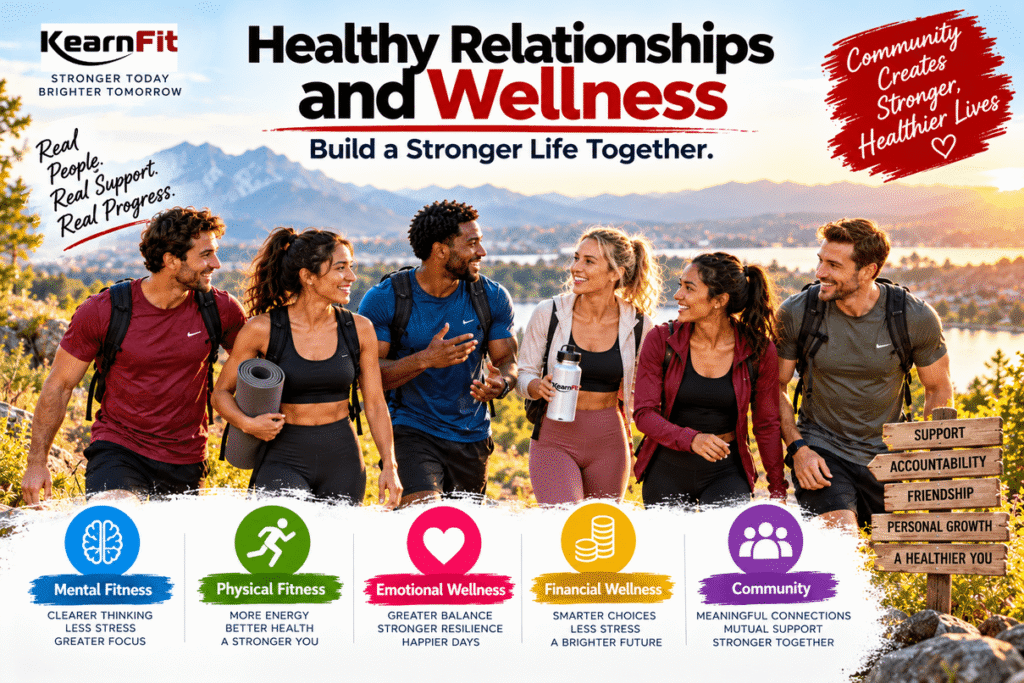
KearnFit brings together mental fitness, physical fitness, emotional wellness, financial wellness, and community to create a more complete approach to lifestyle improvement.
If you want to explore how these areas connect, learn more about the four dimensions of fitness and discover how a broader approach to wellness can help you build a stronger, more balanced life.
The goal is not perfection.
The goal is progress supported by community.
Whether you are working on healthier habits, personal growth, physical fitness, emotional balance, financial awareness, or simply creating a better everyday lifestyle, having the right people around you can make the journey more meaningful.
Visit www.kearnfit.com to explore the KearnFit approach and become part of a community focused on stronger lives and healthier futures.
27. Conclusion: Build a Healthier Life Together
Your wellness journey is personal, but it does not have to be lonely.
The people around you can influence your habits, mindset, emotional wellbeing, motivation, confidence, and sense of belonging.
That is why Healthy Relationships and Wellness deserve a place in your overall lifestyle strategy.
You do not need hundreds of friends.
You do not need a perfect social life.
You do not need to attend every event or constantly be surrounded by people.
You need meaningful connection.
Start small.
Reach out to someone.
Have a real conversation.
Invite someone for a walk.
Join a community.
Set a healthy boundary.
Healthy Relationships and Wellness remind us that becoming healthier is not only about improving ourselves individually, but also about creating meaningful connections that help us grow together.
Listen more carefully.
Celebrate someone else’s progress.
Ask for help when you need it.
And become the kind of person who helps others feel supported too.
A healthier lifestyle is not only about what you do when you are alone.
It is also about the people you grow alongside.
Your social circle can become a source of encouragement, accountability, learning, connection, and shared progress.
At KearnFit, we believe stronger lives are built together.
Because when you grow with the right people, wellness becomes more than a goal.
It becomes a way of life.