Becoming a better version of yourself does not usually happen in one dramatic moment.
It happens quietly.
It happens when you choose to wake up a little earlier and use a few minutes intentionally.
It happens when you decide to take a walk instead of staying stuck at your desk.
It happens when you read instead of endlessly scrolling.
It happens when you finally start paying attention to your emotions.
It happens when you make a healthier meal.
It happens when you set a boundary.
It happens when you save instead of spending impulsively.
It happens when you call someone you care about.
Most importantly, it happens repeatedly.
This is where Personal Growth and Wellness come together.
Personal growth is about becoming more aware, capable, resilient, intentional, and aligned with the person you want to become.
Wellness is about supporting your overall wellbeing across different areas of life.
When you combine the two, your everyday habits become more than routines.
They become tools for transformation.
You do not need to reinvent your entire life.
You need to start making small choices that move your life in the direction you want it to go.
The World Health Organization recognizes self-care as including healthy practices, habits, and lifestyle choices that support health and wellbeing, while also emphasizing that self-care complements rather than replaces professional healthcare.
That is an important distinction.
Personal growth is not about trying to fix yourself because you are broken.
It is about recognizing that you have room to learn, grow, improve, and become more intentional.
At KearnFit, we believe growth is strongest when it includes more than physical fitness.
Mental fitness matters.
Physical fitness matters.
Emotional wellness matters.
Financial wellness matters.
Community matters.
Your daily habits connect all of these areas.
This article explores 10 powerful Personal Growth and Wellness habits that can help you create a healthier lifestyle, strengthen your mindset, and make becoming better part of your everyday life.
What Is Personal Growth and Wellness?
Personal Growth and Wellness are closely connected because both focus on improving the quality of your life.
Personal growth involves developing greater self-awareness, knowledge, skills, confidence, resilience, and intentionality.
Wellness is broader.
It includes the everyday choices and conditions that support your physical, mental, emotional, social, and overall wellbeing.
When combined, they create a powerful framework.
You are not simply asking:
“How can I become more successful?”
You are also asking:
“How can I become healthier while I pursue success?”
You are not only thinking about productivity.
You are thinking about energy.
You are not only thinking about achievement.
You are thinking about meaning.
You are not only thinking about earning money.
You are thinking about financial wellbeing.
You are not only thinking about physical appearance.
You are thinking about strength, movement, recovery, and capability.
You are not only thinking about relationships.
You are thinking about connection and community.
That is why Personal Growth and Wellness should not be treated as separate projects.
They can reinforce each other.
A healthier body can give you more capacity to pursue your goals.
Better stress management can help you navigate challenges.
Meaningful relationships can provide connection and support.
Financial awareness can create greater clarity around your future.
Learning can expand your confidence and possibilities.
Self-reflection can help you make better decisions.
The result is not perfection.
It is progress.
Why Personal Growth Starts With Daily Habits
Big goals are exciting.
But your daily habits determine what actually happens between today and the future you imagine.
You may want to become healthier.
You may want to read more.
You may want to build a successful business.
You may want to improve your relationships.
You may want to become financially secure.
You may want to manage stress better.
You may want to become more confident.
Those are meaningful goals.
But goals need behaviors.
If your goal is to become healthier, you need daily choices that support health.
If your goal is to learn, you need time for learning.
If your goal is to improve your finances, you need financial habits.
If your goal is stronger relationships, you need connection.
If your goal is emotional resilience, you need practices that help you understand and manage your emotions.
This is why habits are so powerful.
Research into habit formation and behavior change emphasizes the importance of context, motivation, reinforcement, and the environment in helping people adopt and maintain behaviors.
In other words, knowing what you should do is not always enough.
You need a lifestyle that makes the desired behavior easier to repeat.
That is where daily routines become important.
The Connection Between Growth and Wellness
Imagine two people.
Person A is extremely ambitious.
They work constantly.
They chase goals.
They pursue promotions.
They are always learning.
But they rarely sleep enough, rarely exercise, ignore their emotions, have little time for relationships, and constantly feel overwhelmed.
Personal Growth and Wellness work best together when your goals improve not only what you achieve, but also how you live, feel, think, and care for yourself.
Person B is focused on wellbeing.
They exercise.
They eat reasonably well.
They sleep consistently.
But they have stopped learning, avoid challenges, rarely set goals, and have become comfortable without pursuing meaningful growth.
Neither approach is complete.
Personal Growth and Wellness create a more balanced perspective.
Growth without wellness can become exhausting.
Wellness without growth can become stagnant.
You need both.
Growth asks:
Who can I become?
Wellness asks:
How can I take care of the person I am becoming?
Together, they create a better question:
How can I grow without losing myself in the process?
That is a powerful foundation for a healthier lifestyle.
Why Small Habits Can Create Meaningful Change
One of the biggest misconceptions about personal development is that change needs to feel dramatic.
It does not.
Small habits can become powerful because they are easier to repeat.
A ten-minute walk.
Five pages of reading.
A few minutes of journaling.
One nourishing meal.
A short financial check-in.
A phone call to someone you care about.
Five minutes of stretching.
Ten minutes of learning.
One intentional boundary.
One moment of reflection.
None of these actions will transform your entire life overnight.
But repeated actions create patterns.
Patterns influence routines.
Routines influence lifestyle.
And lifestyle influences the direction of your life.
WHO has highlighted the value of small changes to daily routines and habits as a practical way to support health and wellbeing.
The goal is therefore not to ask:
“What huge change can I make?”
Ask:
“What small action can I repeat?”
That question can change everything.
10 Powerful Personal Growth and Wellness Habits
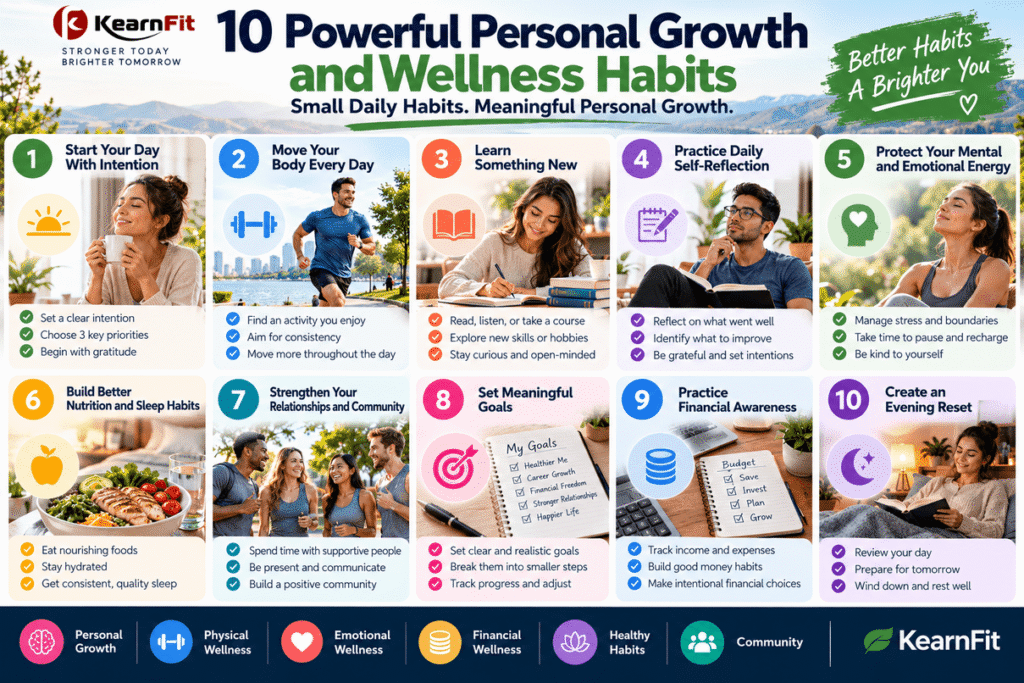
There is no universal daily routine that works for everyone.
Your habits should fit your schedule, responsibilities, preferences, environment, culture, goals, and current level of energy.
The following ten habits provide a flexible framework.
You can start with one.
You can adapt them.
You can build gradually.
The goal is progress you can maintain.
Habit #1: Start Your Day With Intention
How you begin your morning can influence how intentionally you move through the rest of the day.
You do not need a two-hour morning routine.
You need a few minutes of clarity.
Before immediately checking messages and social media, pause.
Ask yourself:
What matters today?
What do I want to accomplish?
How do I want to feel?
What is one thing I can do for my health?
What is one thing I can do for my growth?
Then choose three priorities.
One could be professional.
One could be personal.
One could be related to wellness.
For example:
Work: Complete an important project.
Growth: Read for 15 minutes.
Wellness: Walk for 20 minutes.
This creates balance.
Your entire day does not need to revolve around productivity.
You are building a life.
A simple morning intention might be:
“Today I will make choices that support the person I want to become.”
Write it down.
Put it on your phone.
Keep it near your workspace.
Use it as a reminder.
The purpose is not to control everything.
It is to begin with awareness rather than reaction.
Habit #2: Move Your Body Every Day
Physical movement is one of the simplest ways to connect personal growth with wellness.
You do not need to become a professional athlete.
You need to make movement part of your lifestyle.
Walking.
Cycling.
Swimming.
Dancing.
Yoga.
Strength training.
Sports.
Hiking.
Mobility exercises.
Even small opportunities to move throughout the day can be useful.
Current CDC guidance emphasizes that any amount of moderate-to-vigorous physical activity can provide some health benefits, while adults are generally advised to work toward 150 minutes of moderate-intensity activity each week plus muscle-strengthening activity on at least two days.
But do not let the recommended target become a reason to do nothing.
If you currently move very little, start smaller.
Walk for ten minutes.
Take the stairs.
Stretch between tasks.
Go outside.
Try a beginner class.
Then build.
Physical activity can also support mental wellbeing, sleep, and day-to-day functioning.
This creates an important connection.
When you take care of your body, you are also creating capacity for personal growth.
Habit #3: Learn Something New
Growth requires learning.
That does not mean you need another degree.
Learning can be simple.
Read a book.
Listen to a thoughtful podcast.
Take an online course.
Learn a language.
Practice a professional skill.
Explore a new hobby.
Study personal finance.
Learn how to cook.
Understand a new technology.
Ask someone experienced for advice.
Read about a topic that challenges your perspective.
Give yourself 15 minutes.
Fifteen minutes a day becomes more than 90 minutes a week.
Over a year, that creates hundreds of minutes of intentional learning.
But the real benefit is not just knowledge.
Learning keeps you curious.
Curiosity encourages exploration.
Exploration can lead to new skills.
New skills can create confidence.
Confidence can encourage action.
That is the growth cycle.
Try creating a daily learning ritual.
Morning: Read an article.
Lunch: Listen to a useful podcast.
Evening: Read five pages.
Or choose one topic for an entire month.
For example:
January: Financial literacy
February: Nutrition
March: Communication
April: Leadership
May: Emotional intelligence
The topic does not matter as much as the habit of learning.
Habit #4: Practice Daily Self-Reflection
Growth requires awareness.
Without reflection, you can repeat the same behaviors without understanding why they are happening.
Self-reflection gives you a moment to pause.
At the end of the day, ask:
What went well today?
What did I learn?
What challenged me?
How did I respond?
What could I do differently tomorrow?
What am I grateful for?
What deserves more attention?
You do not need to write pages.
Three minutes can be enough.
Try keeping a simple journal.
Write:
Today I learned…
Today I felt…
Today I improved…
Tomorrow I will…
This practice can help you notice patterns.
Maybe you become impatient when you skip lunch.
Maybe you feel better when you walk in the morning.
Maybe social media makes you lose focus.
Maybe certain conversations energize you.
Maybe financial uncertainty causes stress.
Awareness creates information.
Information creates better decisions.
And better decisions create opportunities for growth.
Habit #5: Protect Your Mental and Emotional Energy
You cannot continuously give energy without recovering.
Modern life can create constant stimulation.
Messages.
Notifications.
Deadlines.
News.
Social media.
Work.
Family responsibilities.
Financial concerns.
Personal expectations.
Your mind needs space.
Create small periods of mental recovery.
Turn off unnecessary notifications.
A strong Personal Growth and Wellness routine should include time to pause, process your emotions, reduce unnecessary stress, and protect your mental energy.
Take a walk without your phone.
Sit quietly.
Practice slow breathing.
Journal.
Spend time outdoors.
Listen to music.
Talk to someone supportive.
Do something creative.
Protect your boundaries.
Learn to recognize when you are overloaded.
Emotional wellness is also part of this habit.
Ask:
What am I feeling?
What caused it?
What do I need?
What can I control?
Who can support me?
You do not need to eliminate difficult emotions.
You need to become more capable of responding to them.
CDC guidance on emotional wellbeing encourages healthy eating, sleep, physical activity, supportive relationships, and strategies for managing emotions and stress.
If emotional distress becomes persistent or difficult to manage, consider seeking support from an appropriate healthcare or mental health professional.
Personal growth should never mean forcing yourself to handle everything alone.
Habit #6: Build Better Nutrition and Sleep Habits
Your body needs a foundation.
That foundation includes nourishment and recovery.
Healthy eating does not need to be complicated.
Build meals around foods that provide useful nutrition and variety.
Include vegetables and fruits.
Choose suitable protein sources.
Include whole grains where appropriate.
Drink water regularly.
Reduce your reliance on highly processed foods when practical.
Your choices should reflect your preferences, culture, budget, and dietary needs.
Sleep is equally important.
CDC guidance notes that sleep supports health, mood, attention, and daily functioning, and recommends consistent sleep habits. Most adults need at least seven hours of sleep, although individual needs vary.
Create a simple evening routine.
Go to bed at a consistent time.
Reduce unnecessary screen use before bed.
Keep your bedroom comfortable.
Avoid turning your bed into a workspace.
Give yourself time to wind down.
Think of sleep as part of your growth system.
When you are constantly exhausted, even meaningful goals can feel difficult.
Recovery creates capacity.
Habit #7: Strengthen Your Relationships and Community
Personal growth is not a solo project.
The people around you can influence your perspective, motivation, habits, and sense of belonging.
That does not mean you need hundreds of connections.
Focus on meaningful ones.
Call a friend.
Have dinner with family.
Join a community.
Find an accountability partner.
Attend a group fitness session.
Participate in a professional network.
Volunteer.
Ask someone how they are doing.
Be available when someone needs support.
And remember that healthy relationships involve boundaries.
You do not need to maintain every relationship at the same level.
You can choose relationships that encourage mutual respect, honesty, growth, and support.
Community also creates opportunities for learning.
Someone else may have already solved a problem you are facing.
Someone may introduce you to an opportunity.
Someone may challenge an assumption.
Someone may encourage you when your motivation disappears.
This is one reason community belongs within a complete wellness philosophy.
You grow differently when you grow with people.
Habit #8: Set Meaningful Goals
Personal growth needs direction.
Goals can give your habits somewhere to go.
But not every goal needs to be enormous.
Choose goals that matter to you.
Instead of:
“I want to be successful.”
Try:
“I will complete one professional course this quarter.”
Instead of:
“I want to get fit.”
Try:
“I will walk three evenings each week.”
Instead of:
“I want better finances.”
Try:
“I will review my spending every Sunday.”
Instead of:
“I want stronger relationships.”
Try:
“I will have one meaningful conversation with someone I care about each week.”
Make your goals specific enough to act on.
Then connect each goal to a habit.
Goal → behavior → routine → review.
For example:
Goal: Improve physical fitness.
Behavior: Walk more.
Routine: Walk after lunch.
Review: Check consistency every Sunday.
This transforms an abstract goal into something practical.
Habit #9: Practice Financial Awareness
Financial wellness is often overlooked in conversations about personal growth.
But money decisions influence many parts of life.
Financial stress can affect your sense of security.
Career decisions affect income.
Spending habits affect flexibility.
Savings can create options.
Learning about money can improve confidence.
You do not need to become a financial expert.
Start with awareness.
Spend ten minutes each week reviewing:
- Income
- Expenses
- Savings
- Subscriptions
- Debt
- Upcoming bills
- Financial goals
Then ask:
Is my money supporting my priorities?
Maybe you discover that you are spending heavily on convenience because your schedule is disorganized.
Maybe you are paying for subscriptions you rarely use.
Maybe you need to create a savings target.
Maybe you want to invest in education.
Maybe you want to build an emergency fund.
Personal growth means becoming more intentional about the resources available to you.
Financial wellness does not mean becoming obsessed with money.
It means using money as a tool rather than allowing it to control every decision.
Habit #10: Create an Evening Reset
Your evening can become the bridge between today’s experiences and tomorrow’s growth.
Instead of ending the day by scrolling until you fall asleep, create a short reset.
Review your day.
Prepare tomorrow.
Tidy your environment.
Put away work.
Write down unfinished tasks.
Choose tomorrow’s priorities.
Prepare clothes.
Prepare breakfast or lunch if helpful.
Then create a relaxing wind-down.
Read.
Stretch.
Talk to someone.
Listen to music.
Practice relaxation.
The goal is not productivity until bedtime.
The goal is closure.
Your brain should not have to keep remembering every unfinished task while you are trying to rest.
An evening reset can also become a moment of self-reflection.
Ask:
Did I live according to my priorities today?
Where did I grow?
Where did I react instead of respond?
What is one thing I want to improve tomorrow?
Then let the day end.
You are allowed to have unfinished work.
You are allowed to make mistakes.
You are allowed to try again tomorrow.
That is part of sustainable Personal Growth and Wellness.
Personal Growth and Wellness for Busy Professionals
A busy schedule can make personal growth seem impossible.
But growth does not always require large amounts of time.
You can create small windows.
5 minutes: Journal.
10 minutes: Walk.
15 minutes: Read.
20 minutes: Exercise.
10 minutes: Review finances.
5 minutes: Plan tomorrow.
The key is consistency.
Instead of asking:
“Where can I find an extra hour?”
Ask:
“Where are five minutes already available?”
You may find opportunities during your commute, lunch break, morning routine, waiting periods, or evening wind-down.
You can also combine habits.
Listen to an educational podcast while walking.
Reflect while drinking your morning coffee.
Discuss goals with a friend during a walk.
Review finances while preparing your weekly schedule.
Prepare tomorrow’s meals while listening to an audiobook.
Habit stacking can reduce friction because the new behavior becomes connected to something you already do.
The objective is not to fill every empty minute.
Rest matters too.
The goal is to use selected moments intentionally.
For busy professionals, Personal Growth and Wellness do not need to become another demanding project; small habits built into an existing schedule can make the process more realistic.
Personal Growth and Wellness When Motivation Is Low
Motivation is useful.
But motivation is unreliable.
Some mornings you will feel inspired.
Other mornings you will not.
Some weeks your goals will feel exciting.
Other weeks they will feel like work.
That is normal.
Instead of building your lifestyle around motivation, build around systems.
Prepare your workout clothes.
Keep healthy foods accessible.
Schedule learning time.
Put your journal somewhere visible.
Automate savings when appropriate.
Keep your goals somewhere you can see them.
Create routines that reduce decision-making.
NIA research on healthy habit formation emphasizes that maintaining behavior change can be difficult and that environmental and contextual factors can influence whether new behaviors become sustainable.
This means your environment matters.
If you want to read, keep a book beside your bed.
If you want to exercise, keep your shoes accessible.
If you want to journal, keep your notebook visible.
If you want to drink more water, keep a bottle nearby.
Do not rely on willpower for everything.
Design your environment to support your intentions.
Personal Growth and Wellness and Your Mindset
Your mindset influences how you interpret challenges.
A fixed mindset might say:
“I am just not disciplined.”
A growth-oriented mindset asks:
“What could I change about my environment or approach?”
A fixed mindset says:
“I failed.”
A growth-oriented approach says:
“What did this teach me?”
A fixed mindset says:
“I am too old to start.”
A growth-oriented approach says:
“What can I learn now?”
This does not mean pretending everything is positive.
Real growth requires honesty.
Sometimes you need to admit that something is not working.
Sometimes you need to change direction.
Sometimes you need help.
Sometimes you need rest.
Sometimes you need to let go of a goal.
Growth is not endless pushing.
Growth is becoming better at knowing what you need and what matters.
That is why self-awareness is such an important part of Personal Growth and Wellness.
Personal Growth and Wellness and Physical Fitness
Your body gives you the physical capacity to experience life.
Movement can support strength, mobility, cardiovascular health, sleep, and mental wellbeing.
Current CDC guidance notes that physical activity can provide immediate and long-term health benefits and that adults benefit from reducing sedentary time and incorporating regular activity.
But physical fitness is also about capability.
Can you carry your groceries?
Can you climb stairs comfortably?
Can you play with your children?
Can you enjoy a hike?
Can you move without fear?
Can you participate in activities you enjoy?
Fitness is not only about appearance.
It is about what your body allows you to do.
That makes physical fitness a valuable part of personal development.
Every time you improve your strength, mobility, endurance, or consistency, you are building evidence that you can develop through practice.
Personal Growth and Wellness and Emotional Wellness
You cannot grow without experiencing emotions.
Excitement.
Fear.
Frustration.
Joy.
Disappointment.
Confidence.
Uncertainty.
Emotional wellness does not require eliminating difficult emotions.
It requires learning how to recognize them and respond thoughtfully.
Start practicing emotional awareness.
When something happens, pause before reacting.
Ask:
What am I feeling?
Why might I be feeling this?
What response would align with my values?
That pause can create space.
You may decide to communicate.
You may decide to walk away.
You may decide to ask for help.
You may decide to rest.
You may realize that the issue is smaller than your initial reaction suggested.
Personal growth happens when awareness becomes action.
Personal Growth and Wellness and Financial Wellness
Money can either support your goals or create friction around them.
Financial wellness therefore belongs within a broader personal-growth strategy.
Start by learning.
Understand where your money goes.
Understand your recurring expenses.
Understand your financial goals.
Learn basic concepts around saving, investing, debt, taxes, and risk using reliable sources appropriate to your circumstances.
Then build habits.
Weekly spending review.
Monthly budget review.
Automatic saving where suitable.
Regular benefit review.
Career skill development.
Thoughtful purchasing.
Avoiding unnecessary lifestyle inflation.
The purpose is not to make every decision based on money.
The purpose is to make financial decisions more intentional.
Your future self benefits from today’s awareness.
Personal Growth and Wellness also includes becoming more intentional about your financial choices, spending habits, goals, and long-term lifestyle priorities.
Personal Growth and Wellness and Community
Growth becomes richer when it is shared.
You may learn from someone else’s experience.
You may teach someone what you know.
You may discover new opportunities through relationships.
You may find encouragement when things become difficult.
Community can also make healthy habits more enjoyable.
Walk with someone.
Train together.
Cook together.
Learn together.
Discuss books.
Attend events.
Volunteer.
Join a professional network.
Build something.
Celebrate progress.
At KearnFit, community complements the broader dimensions of wellness because becoming stronger does not have to be an individual journey.
Your relationships can become part of your growth environment.
Choose people who encourage you to become healthier, more intentional, and more authentic.
And aim to be that person for others too.
7 Common Personal Growth Mistakes to Avoid
Personal development can become counterproductive when it becomes another source of pressure.
Watch out for these seven mistakes.
1. Trying to Improve Everything at Once
Choose a few priorities.
You can build gradually.
2. Comparing Your Journey With Someone Else’s
Their starting point is different.
Their responsibilities are different.
Their goals are different.
Stay focused on your own progress.
3. Confusing Productivity With Personal Growth
Doing more does not automatically mean becoming better.
Rest, relationships, reflection, and wellbeing matter too.
4. Consuming More Information Than You Apply
Another book will not change your life if you never implement what you learn.
Turn knowledge into action.
5. Relying Entirely on Motivation
Create systems that work when motivation is low.
6. Ignoring Recovery
You cannot continuously push without consequences.
Rest is part of sustainable growth.
7. Being Too Hard on Yourself
Self-improvement should not become self-rejection.
You can want to improve while appreciating who you are today.
How to Build a Simple Daily Growth Routine
You can bring the ten habits together without creating an overwhelming schedule.
The most effective Personal Growth and Wellness routines are simple enough to repeat, flexible enough to adapt, and meaningful enough to keep you engaged.
Try this framework.
Morning — 10 minutes
Drink water.
Set an intention.
Choose three priorities.
During the day
Move regularly.
Eat nourishing meals.
Take mental breaks.
Learn something small.
Connect with someone.
Evening — 15 minutes
Review your day.
Prepare tomorrow.
Check your priorities.
Write one reflection.
Create a calming wind-down.
Weekly — 30 minutes
Review your goals.
Review your finances.
Plan movement.
Plan meals.
Schedule something enjoyable.
Connect with someone important.
Reflect on what is working.
This is enough to create a foundation.
You do not need to optimize every minute.
You need to create a rhythm that supports your priorities.
Your 30-Day Personal Growth and Wellness Challenge
Ready to put the ideas into practice?
Use this 30-day challenge.
Days 1–3: Awareness
Observe your current habits.
Notice where your time and energy go.
Days 4–6: Morning Intention
Start each day by identifying three priorities.
Days 7–9: Movement
Add at least one intentional movement session each day.
Days 10–12: Learning
Spend 10–15 minutes learning something useful.
Days 13–15: Reflection
Journal for three minutes each evening.
Days 16–18: Emotional Wellness
Practice an emotional check-in each day.
Days 19–21: Nutrition and Sleep
Improve one meal and create a more consistent sleep routine.
Days 22–24: Relationships
Connect intentionally with someone who matters to you.
Days 25–27: Financial Wellness
Review spending, savings, or another financial priority.
Days 28–30: Integration
Choose your five most useful habits and build them into your regular routine.
At the end of the month, ask:
What changed?
What became easier?
What gave me more energy?
What helped me grow?
What do I want to continue?
Do not judge the challenge by whether you completed every single day.
Judge it by what you learned.
The goal is to discover a sustainable system.
How KearnFit Supports Personal Growth and Wellness
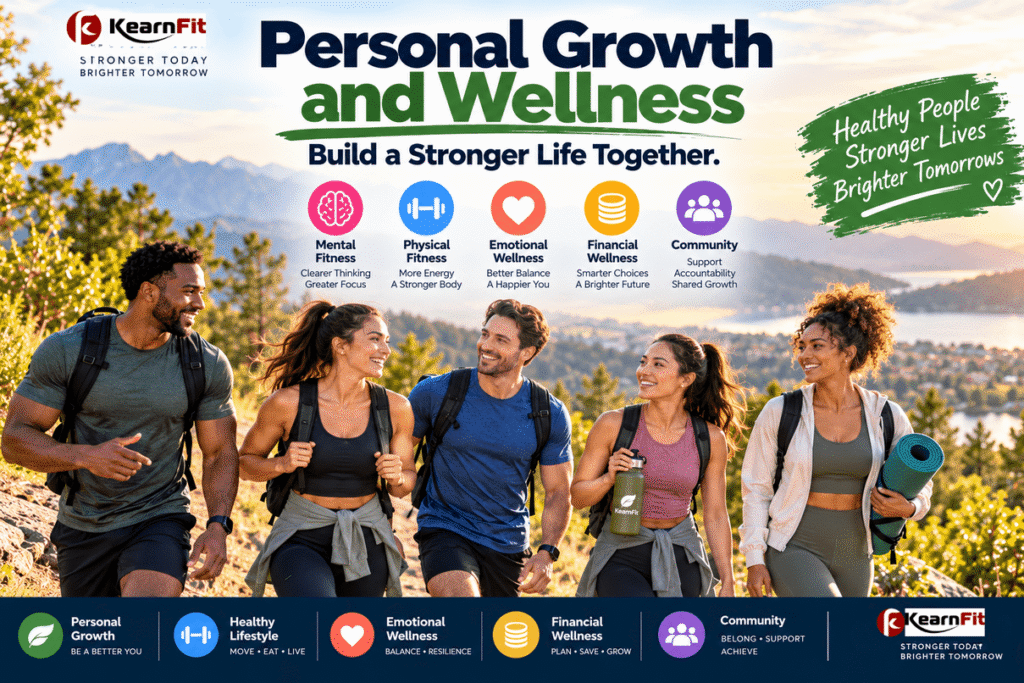
Personal growth becomes more sustainable when it supports every part of your life. Explore the four dimensions of fitness to understand how mental, physical, emotional, and financial wellness can work together to create a stronger, more balanced lifestyle.
That is why our approach connects multiple dimensions of a healthy life.
Mental fitness helps you strengthen your thinking, awareness, resilience, and focus.
Physical fitness helps you build strength, movement, mobility, and physical capability.
Emotional wellness helps you understand your emotions, communicate better, and develop healthier relationships.
Financial wellness helps you become more intentional about the resources and decisions that shape your future.
Community gives you connection, accountability, learning, and shared growth.
Together, these dimensions create a broader approach to Personal Growth and Wellness.
You do not need to improve every dimension simultaneously.
Start with the area that needs the most attention.
Then build.
Maybe your first step is physical.
Maybe it is emotional.
Maybe it is financial.
Maybe you need better relationships.
Maybe you need to slow down mentally.
Your starting point does not matter as much as your willingness to begin.
At KearnFit, the goal is to help you create a lifestyle where growth and wellbeing support each other.
Visit www.kearnfit.com to explore the KearnFit approach and discover ways to build a stronger, healthier, and more balanced life.
You are not finished becoming.
And that is a good thing.
Conclusion: Become Better One Day at a Time
Personal growth does not require a dramatic transformation.
It requires daily intention.
You become better through what you repeatedly do.
Read.
Move.
Reflect.
Learn.
Rest.
Connect.
Plan.
Save.
Communicate.
Recover.
Try again.
These actions may seem ordinary.
But ordinary actions repeated consistently can shape extraordinary change.
That is the real power of Personal Growth and Wellness.
You are not trying to become perfect.
You are becoming more aware.
More capable.
More resilient.
More intentional.
More connected.
More aligned with the life you want to build.
Your daily habits are not just things you do.
They are votes for the person you are becoming.
Every time you choose movement, you support your physical wellbeing.
Every time you learn, you invest in growth.
Every time you reflect, you build awareness.
Every time you manage stress, you protect your energy.
Every time you connect with someone, you strengthen community.
Every time you make a thoughtful financial decision, you support your future.
Every time you rest, you give yourself room to recover.
The goal is not to make every day perfect.
Some days will be messy.
Some goals will change.
Some habits will disappear and need to be rebuilt.
Some plans will fail.
That is part of the process.
The most important skill is learning how to return.
Return to your priorities.
Return to your habits.
Return to your health.
Return to your growth.
Return to yourself.
Start with one habit today.
Make it small enough to repeat.
Make it meaningful enough to matter.
Then do it again tomorrow.
That is how becoming better begins.
Not someday.
Not when life becomes easier.
Not when you finally have more time.
Today.
At KearnFit, we believe a stronger life is built across mental, physical, emotional, financial, and community wellness.
So take the next step.
Learn something.
Move your body.
Protect your mind.
Care for your emotions.
Strengthen your relationships.
Become more intentional with your finances.
And keep growing.
You do not have to become a completely different person. You simply have to keep becoming a better version of yourself.
Visit www.kearnfit.com and continue your journey toward a stronger, healthier, and more balanced life.