A busy workday can make healthy living feel like something you will get around to later.
You wake up with a plan. Then the emails begin. Meetings fill your calendar. Deadlines move closer. Lunch becomes a quick snack at your desk. Hours pass without enough movement. Your water bottle is still half full. Your shoulders feel tense. And before you realize it, the workday is over.
The problem is not necessarily that you do not care about your health.
The problem is that work can make unhealthy patterns incredibly easy to repeat.
That is why Wellness at Work matters.
Your workplace is a major part of your daily environment, and the habits you practice during working hours can influence how you feel physically, mentally, and emotionally throughout the day.
You do not need to completely redesign your career or spend hours exercising at your desk. You can begin with small, realistic changes that fit into the way you already work.
Wellness at Work is about creating healthier choices within your existing routine.
It can mean standing up between tasks, drinking water consistently, eating a more balanced lunch, adjusting your workstation, taking a genuine break, protecting your attention, communicating your needs, or giving yourself a few quiet minutes to reset.
These actions may look small individually.
Together, they can create a much healthier workday.
At KearnFit, we believe wellness is bigger than physical fitness. Your mental fitness, physical fitness, emotional wellness, financial wellness, and community all contribute to the life you are building.
So instead of waiting for the perfect schedule, start with the schedule you already have.
This guide explores 10 powerful Wellness at Work habits that can help you protect your health during busy days while creating a more sustainable lifestyle.
What Does Wellness at Work Really Mean?
Wellness at Work means creating habits, routines, and environments that support your wellbeing while you work.
It does not mean turning your office into a gym.
It does not mean being perfectly productive every minute.
And it does not mean buying expensive wellness products.
Instead, workplace wellness can be built through simple daily decisions.
You can stand up more often. You can improve your workstation. You can make time for lunch instead of treating food as an interruption. You can drink water throughout the day. You can pause before responding to a stressful message. You can walk during a phone call. You can communicate when your workload becomes unrealistic.
These choices support different dimensions of wellbeing.
Physical wellness may involve movement, posture, hydration, nutrition, and rest.
Mental wellness may involve focus, stress management, healthy workload boundaries, and recovery.
Emotional wellness may involve recognizing your emotions, communicating effectively, and building supportive relationships.
Financial wellness may involve managing income, expenses, benefits, savings, and career decisions with greater awareness.
Community wellness can involve connection, collaboration, belonging, and supportive relationships.
The goal is not perfection.
The goal is to make healthier behavior easier to repeat.
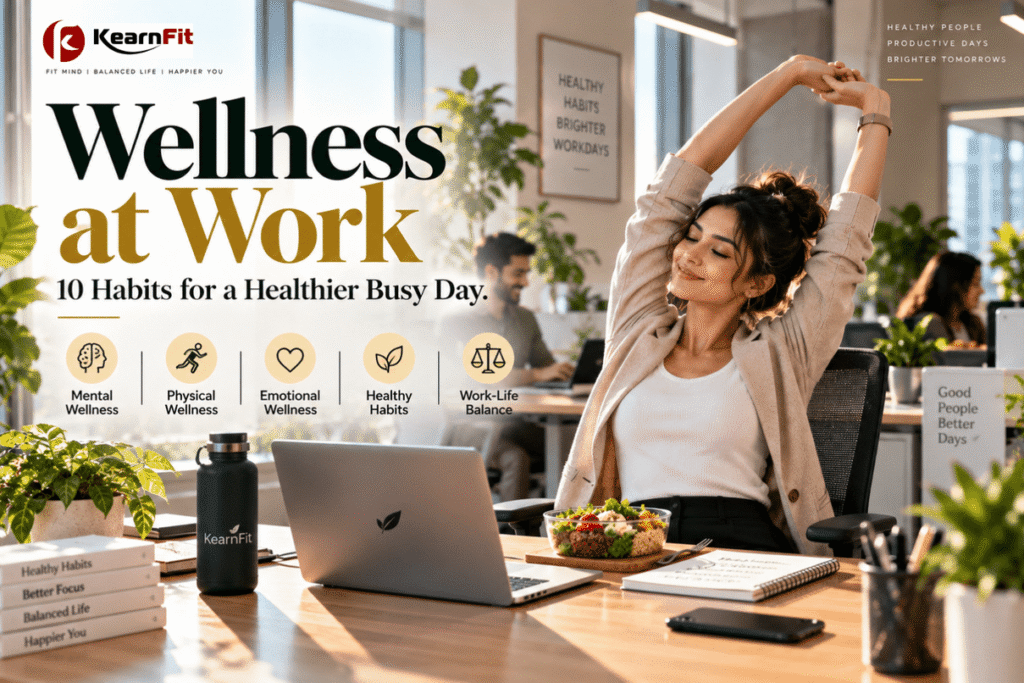
Why Your Workday Habits Matter
Work occupies a significant portion of many people’s waking lives.
That means the workplace is not separate from your health.
Your work environment can influence how much you move, how often you take breaks, how you eat, how much stress you experience, how you interact with others, and how easily you transition between work and personal life.
The World Health Organization describes workplaces as important settings for protecting and promoting health, while also recognizing that sedentary behavior, workplace stress, and other challenges can affect worker wellbeing.
For computer-based workers, the physical setup matters too.
OSHA recommends workstation arrangements that support neutral postures and emphasizes changing positions and incorporating movement rather than remaining in one position for prolonged periods.
This gives us an important lesson:
Your workday does not have to be the enemy of your health.
It can become part of your wellness strategy.
That starts with intentional habits.
The Connection Between Work, Health, and Lifestyle
A healthy lifestyle is not created only before work or after work.
It is created throughout the day.
Consider a typical workday.
You may wake up and exercise before work.
But if you then sit for hours without moving, skip lunch, drink very little water, stay connected to notifications throughout the day, experience constant stress, and continue working late into the evening, your overall routine may become difficult to sustain.
This is why Wellness at Work should be considered part of your complete lifestyle rather than a separate wellness project.
Your habits at work connect with what happens before and after work.
A calmer workday can make it easier to transition into your evening.
A nourishing lunch can support your energy through the afternoon.
Movement breaks can add activity to a day that might otherwise be highly sedentary.
Healthy boundaries can protect your personal time.
Supportive colleagues can strengthen your sense of connection.
Small decisions can create momentum.
10 Powerful Wellness at Work Habits
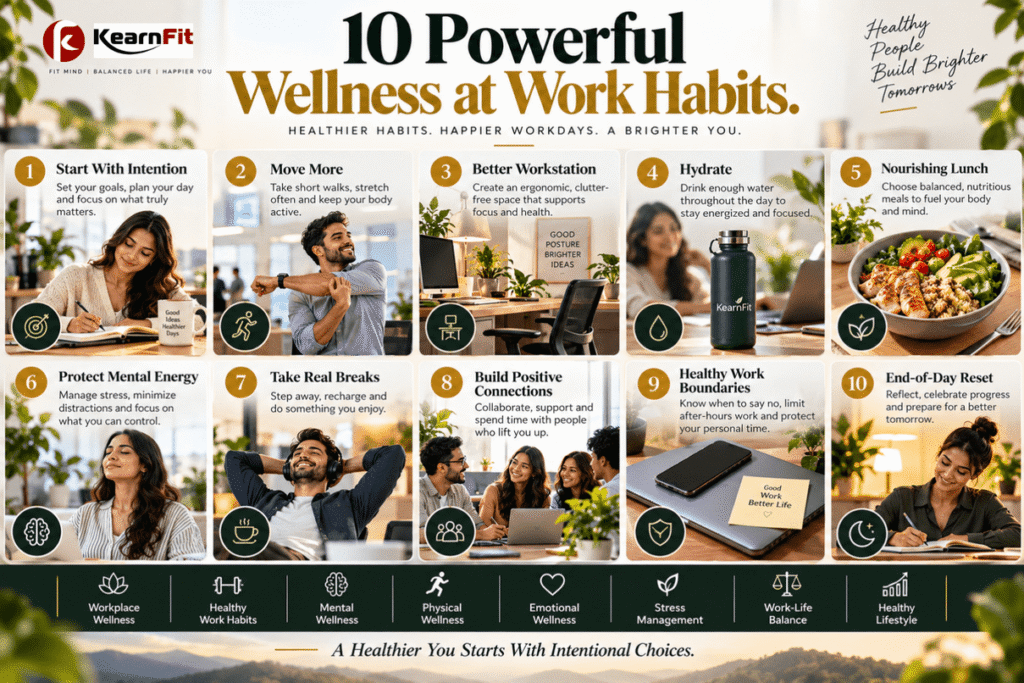
You do not need to implement all ten habits immediately.
Start with one or two.
Once those become easier, add another.
The most sustainable approach is often the one that fits your actual life.
Here are ten practical habits you can begin using during a busy workday.
Habit #1: Start Your Workday With Intention
The first habit of Wellness at Work begins before your workload becomes overwhelming.
Instead of opening your inbox and immediately reacting to everything that appears, take a few minutes to establish your priorities.
Ask yourself:
- What are the three most important things I need to accomplish today?
- What can wait?
- When will I take my breaks?
- When will I eat lunch?
- What would make today feel successful?
- What can I realistically complete?
This simple planning process can create a sense of direction.
Without a plan, your day can become a constant reaction to incoming requests.
Emails arrive.
Messages appear.
Meetings move.
Notifications interrupt.
Someone asks for something urgent.
Another deadline appears.
Suddenly, your priorities have been replaced by everyone else’s priorities.
Intentional planning helps you create structure.
Try creating a simple morning routine:
5 minutes: Review your calendar.
5 minutes: Identify your top three priorities.
2 minutes: Check your energy and emotional state.
1 minute: Decide when you will take your first movement break.
You can also use a short written intention:
“Today, I will work with focus without ignoring my health.”
That sentence can become a powerful reminder.
Wellness at Work does not require you to control everything that happens.
It requires you to become more intentional about the things you can control.
Habit #2: Move More Throughout the Day
One of the easiest workplace habits to overlook is movement.
A workday can quickly become hours of sitting at a desk, attending meetings, commuting, or working on a laptop.
But movement does not have to mean a full workout.
It can be accumulated throughout the day.
The CDC has specifically developed workplace resources encouraging short physical activity breaks, including 5–10-minute movement opportunities that can involve stretching, walking, or simple office exercises.
OSHA also recommends changing working positions, standing, walking periodically, and varying activities instead of staying in one posture for prolonged periods.
Try these simple options:
- Walk during a phone call.
- Take the stairs when practical.
- Stand during selected meetings.
- Walk to speak with a colleague when appropriate.
- Stretch between meetings.
- Set a reminder to change position.
- Walk for five minutes after lunch.
- Do a few gentle mobility movements.
- Keep frequently used items positioned so you can move naturally rather than remaining completely static.
Think of movement as a workday ingredient rather than another task.
A five-minute walk does not have to compete with your fitness routine.
It can complement it.
If you already exercise before or after work, movement breaks can still help break up long periods of inactivity.
The goal is not to turn every workday into a workout.
The goal is to make movement normal.
Habit #3: Build a Better Workstation
Your workstation deserves attention because you may spend hours there.
A poorly arranged workstation can encourage awkward positioning, repetitive movements, visual discomfort, or unnecessary strain.
OSHA’s computer workstation guidance emphasizes adjustable equipment, neutral body positioning, appropriate monitor placement, supported feet and back, and easy access to frequently used items.
You do not necessarily need an expensive office makeover.
Start by reviewing your setup.
Is your monitor positioned so you can view it without constantly bending your neck?
Are your keyboard and mouse close enough that you are not repeatedly reaching?
Are your wrists reasonably neutral while typing?
Are your feet supported?
Does your chair provide appropriate support?
Can you change positions throughout the day?
If you use a laptop as your primary computer, consider whether its design forces you into an uncomfortable position.
OSHA notes that laptops can create special workstation challenges and recommends applying ergonomic principles when they are used for extended periods.
Your workstation should support your body rather than make your body adapt to an awkward arrangement.
And remember:
There is no single perfect posture that you must hold all day.
Variation matters.
Change your position.
Stand when appropriate.
Move.
Stretch.
Reset.
Your best posture may be your next posture.
That is a simple but useful principle for Wellness at Work.
Habit #4: Hydrate Before You Feel Drained
Water is easy to forget when your attention is focused on work.
You can become so absorbed in meetings, projects, or deadlines that hours pass before you realize you have barely had anything to drink.
The CDC notes that getting enough water is important for health and that dehydration can contribute to symptoms such as unclear thinking and mood changes. Individual fluid needs vary based on factors such as age, activity, climate, pregnancy, and other circumstances.
Instead of waiting until you feel extremely thirsty, create a simple hydration routine.
Keep a reusable bottle within reach.
Drink water when you begin your workday.
Take a few sips during meetings.
Drink water with meals.
Refill your bottle when you get up to move.
Use your movement breaks as hydration reminders.
You do not need to obsess over a single universal water target.
Your needs are individual.
Your goal is simply to make hydration visible and convenient.
If your bottle is sitting beside you, you are more likely to remember it.
You can also make water part of your workday transitions:
Start work → drink water.
Finish a meeting → drink water.
Take a movement break → drink water.
Eat lunch → drink water.
Small associations can turn hydration into an automatic habit.
Habit #5: Eat a Nourishing Lunch
A busy schedule can make lunch feel optional.
But food is not simply another item to squeeze between meetings.
Your lunch is an opportunity to support your energy and overall nutrition.
The CDC recommends planning meals and choosing a variety of nutritious foods, including vegetables and fruits, protein foods, whole grains, and healthy fats while limiting excess added sugars, saturated fats, and highly processed foods.
A practical workplace lunch does not need to be complicated.
Try combinations such as:
- Whole grains + vegetables + protein
- Rice + vegetables + beans or lentils
- Salad + eggs or another protein source
- Whole-grain wrap + vegetables + protein
- Yogurt + fruit + nuts
- Homemade leftovers with vegetables
- Soup + whole-grain option + fruit
The exact meal will depend on your preferences, culture, budget, dietary needs, and access to food.
The important part is planning.
When lunch is unplanned, convenience often wins.
When lunch is prepared in advance, healthier choices can become easier.
You can prepare a few basics on weekends or during less busy periods.
Cook a grain.
Prepare vegetables.
Keep convenient protein sources available.
Wash fruit.
Pack snacks.
Then assemble meals quickly.
Also, give yourself permission to actually step away from work when possible.
Eating while responding to emails can turn lunch into another productivity task.
A healthier lunch routine can be part of Wellness at Work, not something that interrupts it.
Habit #6: Protect Your Mental Energy
Your body is not the only thing working during a busy day.
Your brain is processing information, switching between tasks, making decisions, solving problems, communicating, and responding to unexpected challenges.
Mental wellness deserves protection.
Work-related stress can affect wellbeing, and CDC guidance recommends healthy coping strategies that can include taking breaks, communicating about job stress, connecting with supportive people, and using healthy activities outside work.
One practical strategy is to reduce unnecessary task switching.
Instead of checking email every few minutes, create specific windows for email when your role allows it.
Group similar tasks together.
Turn off nonessential notifications.
Use a written task list.
Give important projects uninterrupted focus time.
Take a few slow breaths before moving from one difficult task to another.
And learn to distinguish between urgency and importance.
Not every notification deserves an immediate response.
Not every message needs to be answered within seconds.
Not every problem has to be solved the moment it appears.
Mental wellness at work can also involve asking for help.
If your workload is consistently unrealistic, consider discussing priorities, deadlines, resources, or expectations with the appropriate person.
A healthy individual habit cannot always compensate for an unhealthy workplace system.
WHO guidance on mental health at work emphasizes that workplace conditions and organizational interventions matter alongside individual strategies.
That distinction is important.
Wellness at Work is not about blaming employees for every workplace health problem.
Sometimes the healthiest action is to communicate that a workload, schedule, or working condition needs to change.
Habit #7: Take Real Breaks
A break is not the same thing as opening social media while continuing to answer emails.
A real break creates some distance from the task that was demanding your attention.
You might walk.
Stretch.
Drink water.
Look outside.
Talk to a colleague.
Sit somewhere different.
Practice a few slow breaths.
Eat your lunch away from your workstation when possible.
Even short breaks can provide opportunities for physical movement and mental recovery. OSHA specifically discusses short micro-breaks and task variation as ways to reduce prolonged repetitive computer work.
CDC guidance for worker mental health also encourages breaks during shifts for rest, stretching, or connecting with supportive colleagues.
Try creating a simple rhythm.
Work → pause → move → reset → return.
You do not have to wait until you are completely exhausted.
Preventive breaks are often easier to maintain than emergency recovery.
A good workday should contain moments of effort and moments of recovery.
Habit #8: Build Positive Workplace Connections
Wellness is not only individual.
People are social.
Supportive relationships can contribute to emotional wellbeing, belonging, and resilience.
CDC guidance on emotional wellbeing highlights supportive relationships, healthy communication, and asking for help as important parts of emotional wellbeing.
Your workplace can provide opportunities for connection.
That does not mean you need to become close friends with everyone.
Simple connection can be enough.
Say hello.
Ask a colleague how they are doing.
Eat lunch with someone occasionally.
Celebrate another person’s progress.
Offer help when appropriate.
Join a professional community.
Have a genuine conversation that is not about deadlines.
Create a culture where asking questions is acceptable.
Healthy workplace connection can also involve boundaries.
You do not need to participate in every conversation, event, group chat, or social activity.
The goal is meaningful connection, not constant interaction.
At KearnFit, community is an important part of a broader wellness philosophy because personal growth can become easier when people learn, connect, and grow together.
Your workplace can become healthier when connection becomes part of the culture rather than an afterthought.
Habit #9: Create Healthy Work Boundaries
One of the biggest challenges in modern work is that the workday can follow you everywhere.
Your phone can deliver work notifications at dinner.
Your laptop can sit beside your bed.
A message can arrive while you are exercising.
A “quick task” can turn into another hour of work.
Healthy boundaries create a clearer separation between work and personal life.
Your boundaries will depend on your job, responsibilities, industry, culture, and workplace expectations.
But you can still identify where you have control.
Try:
- Creating a clear end-of-work routine.
- Turning off nonessential work notifications outside working hours.
- Avoiding unnecessary work messages during personal time.
- Setting expectations about response times.
- Keeping your workspace separate from your relaxation area when possible.
- Using your commute as a transition period.
- Writing tomorrow’s priorities before ending today.
- Taking vacation and personal time when available.
- Communicating workload concerns early.
Healthy boundaries are not about caring less about your career.
They can help you protect the energy required to show up sustainably.
CDC and WHO workplace mental-health guidance both recognize the importance of healthy working conditions, manageable demands, support, and organizational factors in protecting worker wellbeing.
If you are constantly available, your brain may never receive a clear signal that work is finished.
Create that signal intentionally.
Close the laptop.
Clear the desk.
Write down tomorrow’s first task.
Take a walk.
Change clothes.
Exercise.
Cook dinner.
Spend time with people you care about.
Build a transition.
That transition is part of Wellness at Work because work health does not end when the clock does.
Habit #10: Finish Your Workday With a Reset
The final few minutes of your workday can influence how you enter your evening.
Instead of shutting your laptop while your mind is still racing, create a short closing routine.
Ask:
What did I complete today?
What still needs attention?
What is tomorrow’s first priority?
Is there anything I need to communicate before I finish?
Write down unfinished tasks.
Clear urgent items.
Review tomorrow’s calendar.
Then close your work environment as intentionally as possible.
This prevents your brain from repeatedly trying to remember everything after work.
A workday reset can be as short as five minutes.
Try:
- Review completed tasks.
- Move unfinished tasks to tomorrow.
- Choose your first priority for tomorrow.
- Clear your immediate workspace.
- Close work applications.
- Take a few deep breaths.
- Physically leave the workspace.
The final step is important.
Your body benefits from transitions.
Moving from work mode into personal time can support a healthier rhythm.
And remember: good sleep is a major part of overall wellness. CDC guidance notes that most adults need at least seven hours of sleep, while sleep supports health, emotional wellbeing, and normal daytime functioning.
A healthier evening begins with knowing when the workday is actually over.
Wellness at Work for Busy Professionals
Busy professionals often feel that wellness requires more time than they have.
But the opposite can be true.
The busier your schedule becomes, the more valuable simple habits become.
You may not have an hour for exercise during lunch.
But you may have five minutes to walk.
You may not have time for a long meditation.
But you may have sixty seconds to breathe before your next meeting.
You may not have time to prepare elaborate meals.
But you may be able to pack a simple lunch the night before.
You may not be able to control every workplace demand.
But you may be able to communicate priorities and protect certain boundaries.
Think in terms of minimum effective habits.
What is the smallest action that moves your health in the right direction?
Five minutes of walking.
One extra glass of water.
A balanced lunch.
A better workstation.
A genuine break.
A clear end-of-day routine.
These small actions can create momentum.
Wellness at Work for Remote Workers
Remote work can create freedom, but it can also blur boundaries.
Your office may be your bedroom.
Your dining table may become your desk.
Your commute may be ten seconds from one room to another.
That makes intentional transitions even more important.
Create a dedicated work zone if possible.
Get dressed in a way that signals the beginning of your workday.
Take movement breaks.
Use natural light when available.
Keep water nearby.
Schedule lunch.
Leave the house for a short walk when practical.
Create a shutdown routine.
Avoid working from bed whenever possible.
Most importantly, create physical and psychological separation between work and personal life.
Your home should not feel like a workplace twenty-four hours a day.
Wellness at Work for Desk-Based Employees
Desk-based work creates unique challenges because many tasks require prolonged computer use.
That makes workstation design, movement, task variation, and breaks especially important.
OSHA recommends changing working positions frequently and avoiding prolonged sitting or standing in the same position. It also recommends organizing computer tasks so that people can vary activities and incorporate recovery pauses.
A practical desk wellness checklist:
Every hour: Change position and move.
Throughout the day: Drink water.
Before lunch: Check whether you have been sitting too long.
During meetings: Stand or walk when appropriate.
At your desk: Keep frequently used items within comfortable reach.
Before finishing: Review your workstation and reset your space.
Your desk does not need to become your fitness center.
It simply needs to stop being a place where your body remains completely static for hours.
Wellness at Work and Mental Wellness
Mental wellness is a major part of workplace health.
A busy day can create cognitive overload through constant information, notifications, multitasking, meetings, deadlines, and decisions.
Protect your mental energy by creating periods of focus.
Use realistic task lists.
Take breaks before exhaustion becomes overwhelming.
Reduce unnecessary notifications.
Communicate when priorities conflict.
Practice healthy stress-management techniques.
And recognize when you need additional support.
CDC guidance explains that long-term stress can contribute to worsening health problems and encourages healthy coping strategies and seeking additional support when needed.
If workplace stress becomes severe, persistent, or begins interfering with daily functioning, consider speaking with an appropriate healthcare or mental health professional.
Workplace wellness should never mean handling everything alone.
Wellness at Work and Physical Fitness
Your workout routine does not have to carry the entire responsibility for your physical health.
Your workday can contribute too.
Walking to meetings.
Taking stairs.
Stretching.
Changing positions.
Standing periodically.
Walking during calls.
Taking a short movement break.
These habits can complement structured exercise.
CDC physical activity guidance encourages adults to include regular physical activity, while workplace resources provide practical ideas for adding movement into working hours.
Think about physical fitness as something you practice across your lifestyle.
Your workout is one piece.
Your workday movement is another.
Your sleep is another.
Your recovery is another.
Your nutrition supports the entire system.
This broader approach makes fitness more sustainable.
Wellness at Work and Emotional Wellness
Work can bring excitement, achievement, frustration, uncertainty, pressure, disappointment, connection, and pride.
All of those emotions can appear in the same week.
Emotional wellness does not mean feeling positive all the time.
It means learning to recognize and manage emotions in healthy ways.
CDC guidance on emotional wellbeing highlights skills such as identifying emotions, managing difficult feelings, communicating effectively, solving problems, and seeking support.
Try creating a short emotional check-in during your day.
Ask:
What am I feeling?
What triggered it?
What do I need right now?
What can I control?
Would talking to someone help?
You do not need to analyze every emotion.
Sometimes simply naming what you feel can prevent you from reacting automatically.
That awareness can improve communication and decision-making.
Wellness at Work and Financial Wellness
Financial wellness may not seem like a workplace wellness topic.
But your work and financial life are closely connected.
Your income, benefits, career decisions, spending habits, savings goals, and financial stress can all influence your overall wellbeing.
Financial wellness at work can begin with awareness.
Understand your compensation.
Review available benefits.
Know your recurring expenses.
Create a realistic savings strategy.
Build an emergency fund when possible.
Avoid unnecessary lifestyle inflation.
Invest in skills that support your career development.
Set financial goals.
You do not need to solve your entire financial future during your lunch break.
Instead, create a small weekly financial habit.
For example:
Friday — 15-minute financial check-in
Review:
- Spending
- Upcoming bills
- Savings
- Subscriptions
- Financial goals
- Career opportunities
This is another way KearnFit’s broader wellness approach becomes relevant.
A healthy life is not only about what happens in the gym.
It includes the choices that shape your security, confidence, relationships, and future.
7 Common Workplace Wellness Mistakes
Even people who care deeply about their health can fall into unhealthy work patterns.
Here are seven common mistakes to watch for.
1. Waiting Until You Feel Exhausted to Take a Break
Breaks are not only for emergencies.
Create them before you need them.
2. Treating Lunch Like an Interruption
Food is part of your health.
Give your meal appropriate attention whenever your environment allows.
3. Staying in One Position for Too Long
Even a well-designed workstation should not encourage complete stillness all day.
Change positions and move.
4. Using Your Phone as Your Only Break
A digital break can still keep your brain stimulated.
Try walking, stretching, breathing, or talking to someone.
5. Trying to Solve Everything Yourself
Asking for support is not weakness.
It is often a practical workplace skill.
6. Ignoring Your Workstation
Small ergonomic adjustments can improve comfort and reduce unnecessary strain.
7. Taking Work Into Every Part of Your Personal Life
A healthy career should fit into a healthy life.
Create boundaries where you can.
How to Create a Simple Healthy Workday Routine
You can combine the ten habits into a simple routine.
Before work
Drink water.
Review your priorities.
Check your schedule.
Set a realistic intention.
Morning
Work in focused blocks.
Change positions.
Take short movement breaks.
Stay hydrated.
Lunch
Eat a nourishing meal.
Step away from your workstation when possible.
Walk for a few minutes.
Afternoon
Review priorities.
Take another movement break.
Practice a short breathing or relaxation exercise.
Connect with a colleague.
End of day
Review what you completed.
Write tomorrow’s priorities.
Close work applications.
Leave your workspace.
Evening
Move your body.
Eat a nourishing dinner.
Spend time with people you care about.
Create a relaxing transition into sleep.
The goal is not to create a rigid schedule.
The goal is to create anchors.
Anchors make healthy behavior easier to remember.
Your 30-Day Wellness at Work Challenge
Ready to turn these ideas into action?
Try this 30-day challenge.
Days 1–3: Drink water consistently during your workday.
Days 4–6: Take at least one intentional movement break.
Days 7–9: Review your workstation.
Days 10–12: Protect your lunch break.
Days 13–15: Reduce unnecessary notifications.
Days 16–18: Practice one minute of mindful breathing during a stressful moment.
Days 19–21: Connect with a colleague.
Days 22–24: Create a clear end-of-work routine.
Days 25–27: Review one aspect of your financial wellness.
Days 28–30: Combine your favorite habits into one complete routine.
At the end of 30 days, ask yourself:
Which habits felt natural?
Which habits improved my workday?
Which habits were difficult to maintain?
What can I continue next month?
You do not need to maintain every habit.
Keep the habits that genuinely fit your lifestyle.
How KearnFit Can Support Your Wellness Journey
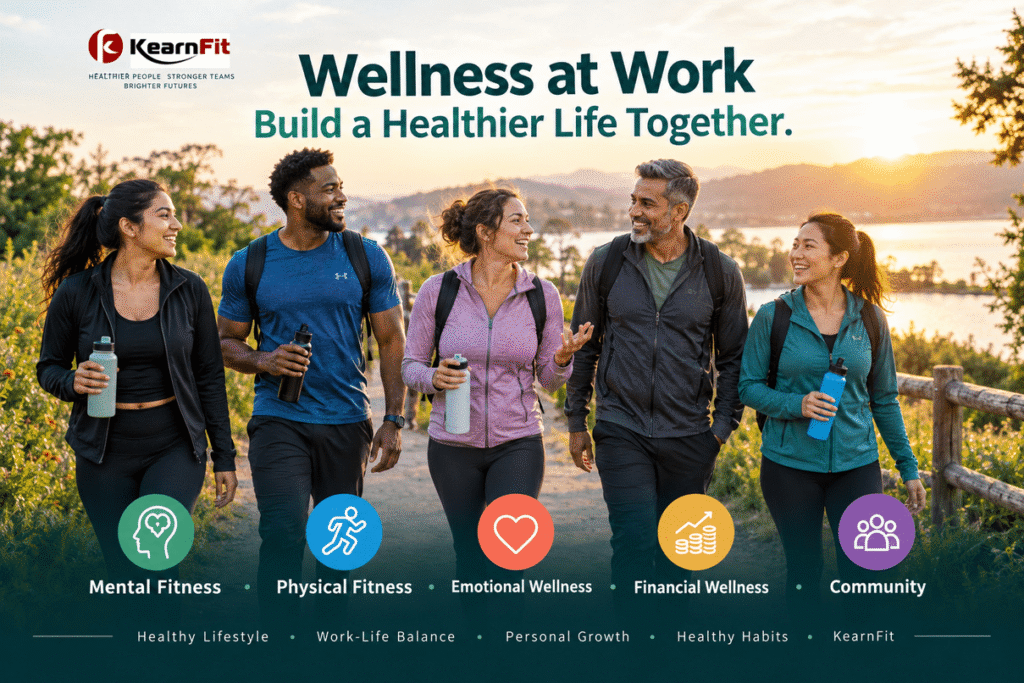
At KearnFit, this approach is built around four dimensions of fitness: mental, physical, emotional, and financial wellness. Learn more about the four dimensions of fitness and how they work together to create a stronger, more balanced lifestyle.
We believe a stronger lifestyle is built by developing multiple dimensions of wellbeing.
That includes mental fitness.
Physical fitness.
Emotional wellness.
Financial wellness.
And community.
Wellness at Work fits naturally into that philosophy because your career is part of your life.
The habits you practice between meetings matter.
The way you manage stress matters.
The way you move matters.
The food you choose matters.
The relationships you build matter.
Your financial decisions matter.
Your ability to recover matters.
Your personal growth matters.
KearnFit is designed around the idea that becoming healthier is not about becoming perfect.
It is about becoming more intentional.
If you want to explore the broader KearnFit approach, visit www.kearnfit.com and discover practical ways to build a stronger, healthier, and more balanced lifestyle.
Your work can be meaningful.
Your ambition can be powerful.
Your career can grow.
And your health can grow alongside it.
Conclusion: Protect Your Health While You Build Your Career
A busy workday does not have to mean abandoning your health.
You do not need a perfect schedule.
You do not need expensive wellness products.
You do not need to spend an hour exercising in the middle of every workday.
You need small habits that fit into your real life.
Move more.
Drink water.
Eat nourishing food.
Improve your workstation.
Take real breaks.
Protect your mental energy.
Build supportive connections.
Create healthy boundaries.
Finish your workday intentionally.
And remember that your wellbeing is bigger than your productivity.
Your health supports the life you are trying to build.
That is why Wellness at Work should not be treated as another item on your already crowded to-do list.
It should become part of the way you work.
One movement break.
One glass of water.
One nourishing meal.
One healthier boundary.
One mindful pause.
One supportive conversation.
One intentional decision at a time.
Small choices can create powerful momentum.
And when those choices become part of your everyday routine, Wellness at Work becomes less about finding extra time for health and more about building health into the time you already have.
At KearnFit, the goal is simple: help you become stronger across every dimension of your life.
Because a healthier career should support a healthier life.
And a healthier life gives you more opportunity to enjoy the career, relationships, experiences, and personal growth you are working so hard to create.
Start small. Work with intention. Protect your health. Keep growing.
Visit www.kearnfit.com and take the next step toward a stronger, healthier lifestyle.