1. What Are Healthy Boundaries?
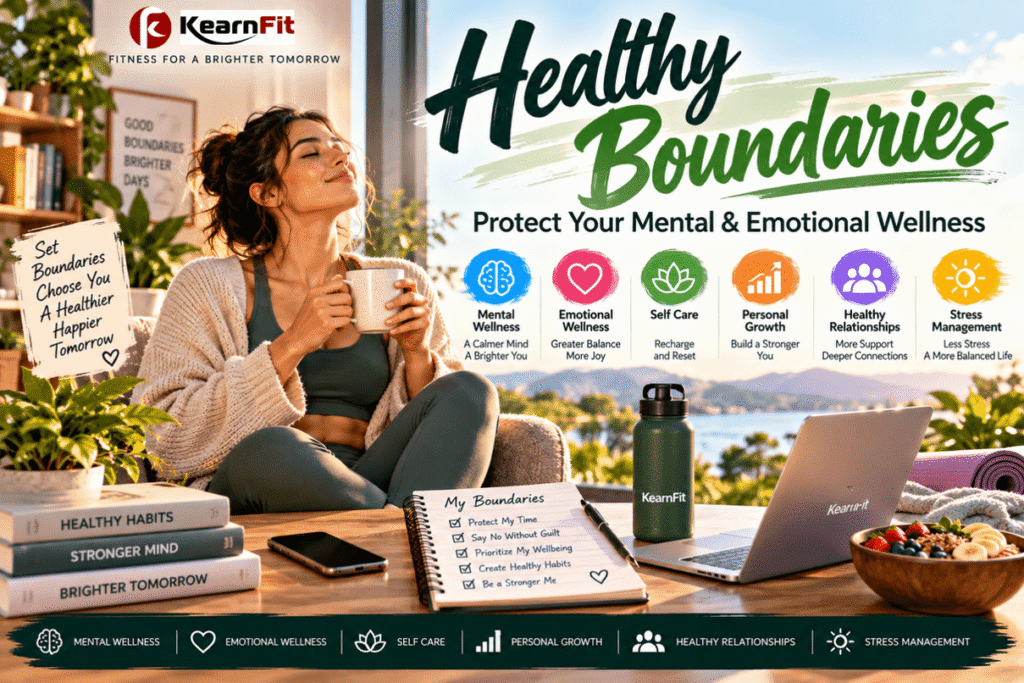
Your time matters. Your energy matters. Your emotions matter. Your attention matters.
Yet in a world filled with constant notifications, demanding schedules, social expectations, work responsibilities, family commitments, and endless opportunities to say yes, it can be surprisingly difficult to protect those things.
That is where Healthy Boundaries become powerful.
Healthy boundaries are the personal limits you establish around your time, energy, emotions, attention, privacy, relationships, work, and responsibilities. They help you communicate what you are comfortable with, what you are not comfortable with, what you can realistically give, and what you need in order to function well.
A boundary might be as simple as deciding not to answer work messages late at night.
It could mean telling a friend that you cannot have a difficult conversation when you are emotionally overwhelmed.
It could mean asking family members to respect your privacy.
It could mean taking a break from social media when constant comparison starts affecting your mood.
Or it could mean saying, “I would love to help, but I do not have the capacity for that right now.”
Healthy Boundaries are not about controlling other people. They are about making clear decisions about your own participation, availability, attention, and wellbeing.
The goal is not to create distance from everyone around you.
The goal is to create enough space to show up for your life with greater clarity, energy, and emotional balance.
2. Why Healthy Boundaries Matter for Mental and Emotional Wellness
Mental and emotional wellness are influenced by many parts of everyday life, including relationships, stress, work, sleep, physical activity, social connection, and the way we respond to challenges.
The CDC describes positive emotional well-being as involving the ability to manage emotions, maintain supportive relationships, find meaning and purpose, and adapt to challenges. It also recommends practices such as healthy communication, self-care, physical activity, adequate sleep, and maintaining social connections.
Healthy Boundaries can support those areas by helping you create realistic limits around the demands competing for your attention.
Imagine waking up and immediately responding to work messages.
Then you spend your lunch break answering personal requests.
After work, you agree to another commitment even though you are exhausted.
Later that evening, you continue scrolling through social media while comparing your life with other people’s lives.
None of these actions automatically means you have unhealthy boundaries. But when this pattern becomes constant, your schedule can leave little room for rest, reflection, relationships, or recovery.
Healthy Boundaries create intentional space.
They help you ask:
What actually deserves my attention today?
What can wait?
What am I responsible for?
What am I not responsible for?
What can I realistically give?
What helps me feel respected and emotionally safe?
These questions can turn an overwhelming lifestyle into a more intentional one.
3. Are Boundaries Selfish?
One of the biggest reasons people struggle with Healthy Boundaries is guilt.
You might worry that saying no makes you selfish.
You might think that taking time for yourself means you are letting someone down.
You might feel responsible for solving everyone else’s problems.
You might believe that being available all the time is the same thing as being supportive.
It is not.
Supporting others and protecting yourself can exist at the same time.
Healthy Boundaries do not mean you stop caring. They mean you recognize that your capacity is limited.
You can care about a friend without answering every message immediately.
You can love your family without being available for every request.
You can be committed to your job without being connected to it 24 hours a day.
You can support someone emotionally without taking responsibility for solving their entire situation.
You can be generous without constantly overextending yourself.
A useful mindset is:
“I can care without carrying everything.”
That sentence captures an important part of emotional wellness.
Boundaries are not rejection.
They are communication.
They are not punishment.
They are clarity.
And they do not need to be aggressive to be effective.
4. The Difference Between Healthy Boundaries and Walls
There is an important difference between creating a boundary and completely shutting people out.
A healthy boundary says:
“I need some time before we continue this conversation.”
A wall may say:
“I never want to talk to anyone about difficult things.”
A healthy boundary says:
“I cannot take on another project this week.”
A wall may say:
“I cannot trust anyone at work.”
A healthy boundary says:
“I am not comfortable discussing that personal topic.”
A wall may say:
“Nobody gets to know anything about me.”
Healthy Boundaries leave room for connection.
Walls often eliminate connection altogether.
This distinction matters because social connection is an important part of wellbeing. The CDC notes that supportive social connections can help people manage stress and support mental and physical health.
The goal is therefore not isolation.
The goal is intentional connection.
You want relationships where you can be present without constantly feeling depleted, pressured, disrespected, or overwhelmed.
5. 8 Powerful Ways to Build Healthy Boundaries
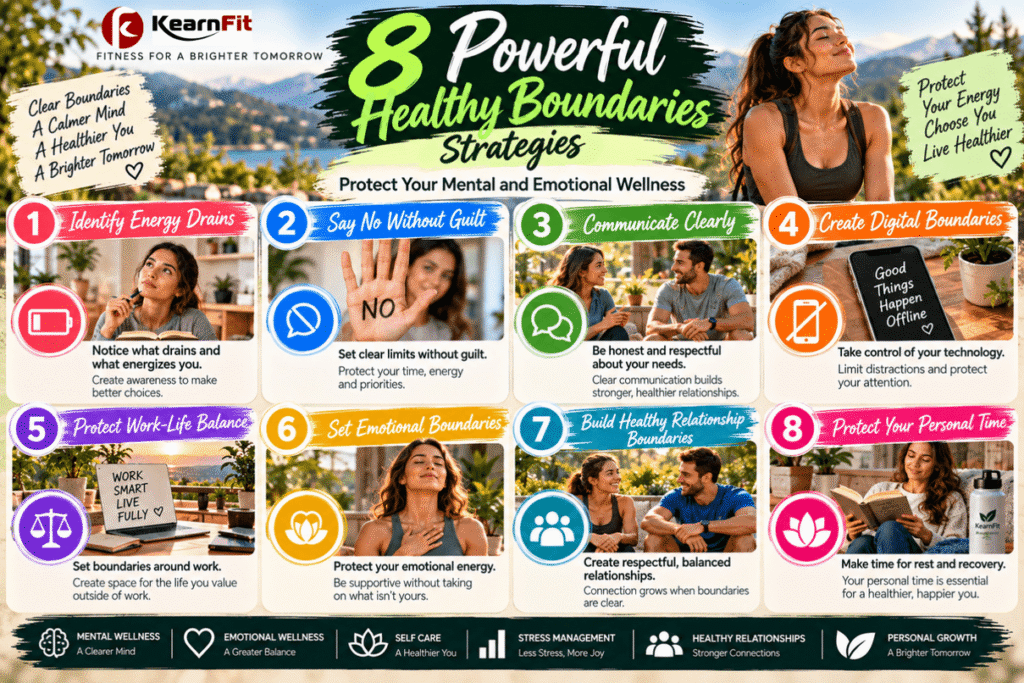
Building Healthy Boundaries does not require changing your entire personality overnight.
It starts with small decisions.
You can change when you respond to messages.
You can communicate your availability more clearly.
You can stop automatically saying yes.
You can create time for recovery.
You can decide which conversations you are willing to have.
You can protect your attention.
You can become more aware of what drains and restores your energy.
Here are eight practical strategies to help you begin.
6. Strategy #1: Identify What Drains Your Energy
Before you can create Healthy Boundaries, you need to understand where your energy is going.
Think of your attention and emotional capacity like a daily budget.
Every conversation, meeting, notification, responsibility, decision, and commitment can require some amount of that budget.
Some activities restore you.
Others drain you.
Some relationships feel supportive.
Others may consistently leave you anxious, exhausted, frustrated, or emotionally overloaded.
Start observing your patterns.
For one week, write down activities that leave you feeling:
- Energized
- Calm
- Focused
- Connected
- Neutral
- Drained
- Irritated
- Overwhelmed
- Guilty
- Emotionally exhausted
You do not need to judge the results.
Simply notice them.
You might discover that checking your phone first thing in the morning creates unnecessary stress.
You might notice that certain meetings regularly run longer than necessary.
You might realize that you keep agreeing to social plans even when you need recovery time.
You might discover that particular conversations repeatedly consume your emotional energy.
Awareness gives you information.
Information gives you choices.
And choices allow you to build better boundaries.
A simple question to ask yourself is:
“What keeps taking more from me than I realistically have to give?”
That question can reveal where your next boundary belongs.
7. Strategy #2: Learn to Say No Without Guilt
“No” is one of the most powerful boundary words.
Yet it is also one of the hardest for many people to use.
Why?
Because saying no can trigger guilt, fear of disappointing others, or concern about being misunderstood.
But saying yes to everything does not make your life healthier.
A better goal is to make your yes meaningful.
Before agreeing to something, pause.
Ask:
Do I genuinely want to do this?
Do I have the time?
Do I have the energy?
Does this support my current priorities?
What will I have to sacrifice if I say yes?
You do not always need a long explanation.
Try simple responses such as:
“I cannot commit to that right now.”
“I appreciate you asking, but I need to say no.”
“I already have plans.”
“I do not have the capacity this week.”
“I would prefer not to discuss that.”
“I can help for 30 minutes, but I cannot take over the entire task.”
These statements are clear without being hostile.
You can also use a pause when you are unsure.
Try:
“Let me check my schedule and get back to you.”
That small sentence gives you time to make a decision instead of responding automatically.
Healthy Boundaries often become easier when you stop treating every request as an emergency.
8. Strategy #3: Communicate Your Limits Clearly
A boundary that only exists in your head can be difficult for other people to understand.
Clear communication matters.
The CDC recommends communicating feelings honestly and respectfully, using “I” statements, maintaining a calm tone, listening actively, and showing empathy.
This approach works well when communicating boundaries.
Instead of:
“You always interrupt me.”
Try:
“I find it difficult to stay focused when I am interrupted. I would like to finish explaining my point before we respond.”
Instead of:
“You are always messaging me too late.”
Try:
“I usually disconnect from messages after 9 p.m., so I may respond the next morning.”
Instead of:
“You never respect my privacy.”
Try:
“I am not comfortable discussing that topic. I would appreciate keeping it private.”
The difference is powerful.
You are communicating the boundary without attacking the other person.
A useful formula is:
When X happens → I feel/need Y → so I will do Z.
For example:
“When work messages come through late at night, I find it difficult to switch off. I need more separation between work and personal time, so I will respond the next morning.”
Clear.
Respectful.
Specific.
9. Strategy #4: Create Strong Digital Boundaries
Your phone can enter almost every part of your life.
It can reach you at breakfast.
During workouts.
While working.
During conversations.
In bed.
On weekends.
Even during moments when you desperately need your mind to switch off.
That makes digital boundaries increasingly important.
Try creating specific technology rules that protect your attention.
For example:
- Keep notifications limited to essential apps.
- Create phone-free meals.
- Avoid checking work messages immediately after waking.
- Establish a work-message cutoff time.
- Keep your phone away during important conversations.
- Schedule short periods without social media.
- Avoid automatically responding to every notification.
- Unfollow accounts that consistently make you feel inadequate or distressed.
- Create a screen-free wind-down period before sleep.
These are not strict universal rules.
They are options.
Choose the boundaries that fit your lifestyle.
Digital wellness is not about rejecting technology.
It is about making technology serve your priorities instead of controlling your attention.
A powerful question is:
“Am I choosing to use this technology, or am I reacting to it?”
That distinction can completely change your relationship with your phone.
10. Strategy #5: Protect Your Work-Life Balance
Work can easily expand into every available space.
A laptop at home.
A work group chat.
Email notifications.
Weekend calls.
Quick “urgent” requests.
One small task after dinner.
Then another.
Then another.
Over time, personal time disappears.
Creating Healthy Boundaries around work can help you protect your non-work identity.
Start with realistic limits.
For example:
Set an end-of-work ritual.
At the end of your workday, close your laptop, review tomorrow’s priorities, and physically leave the workspace if possible.
Create communication windows.
You do not necessarily need to respond to every message immediately.
Protect breaks.
A lunch break should not automatically become another meeting.
Define urgent.
Not everything that arrives quickly requires an immediate response.
Separate work and recovery.
Give yourself transition time between professional responsibilities and personal life.
Use your calendar intentionally.
Schedule personal priorities alongside professional ones.
Work-life balance does not mean spending exactly half your day working and half relaxing.
It means creating a lifestyle where work has a place without consuming every other part of your identity.
11. Strategy #6: Set Emotional Boundaries
Emotional boundaries are especially important because emotions can be contagious and complicated.
You can care about someone’s feelings without becoming responsible for regulating every emotion they experience.
You can listen without becoming their therapist.
You can support someone without absorbing every problem they bring to you.
You can empathize without agreeing with everything they say.
You can love someone while still saying:
“I cannot have this conversation right now.”
“I want to listen, but I need a few minutes first.”
“I care about you, but I do not know how to solve this.”
“I think this situation may require professional support.”
“I am happy to listen, but I cannot make this decision for you.”
Healthy emotional boundaries allow compassion without emotional overload.
They also encourage people to take appropriate responsibility for their own choices.
If someone is constantly using you as their only source of emotional support, it may be appropriate to encourage a wider support system.
The CDC recommends seeking support from others and strengthening healthy social connections as part of emotional wellbeing.
Support should be shared.
You do not have to carry everything alone.
12. Strategy #7: Create Healthier Relationship Boundaries
Healthy relationships need both connection and individuality.
A strong relationship does not require constant access.
You can have separate interests.
Separate friendships.
Separate routines.
Separate opinions.
Separate personal time.
Healthy Boundaries can help relationships become more respectful because expectations become clearer.
Consider boundaries around:
- Personal space
- Privacy
- Money
- Communication
- Time
- Physical affection
- Family involvement
- Social commitments
- Conflict
- Personal decisions
- Digital communication
For example:
“I need an hour alone after work before I start socializing.”
“I would prefer that we discuss financial decisions together before making them.”
“I am not comfortable sharing that private conversation with other people.”
“I want to continue this discussion when we are both calmer.”
These boundaries are not about creating distance.
They are about creating respect.
Supportive social relationships are important for wellbeing, and CDC guidance emphasizes connection, emotional support, and meaningful relationships.
Healthy Boundaries can help protect those relationships by preventing resentment from quietly building underneath constant overcommitment.
13. Strategy #8: Protect Your Personal Time and Recovery

One of the easiest things to sacrifice is time for yourself.
You finish work.
You handle responsibilities.
You answer messages.
You help other people.
You complete errands.
And suddenly the day is over.
Where did you go?
Personal time is not wasted time.
It can be part of your recovery routine.
That might mean:
- Walking outdoors
- Reading
- Exercising
- Journaling
- Cooking
- Spending time with supportive people
- Practicing mindfulness
- Enjoying a hobby
- Resting
- Sleeping
- Sitting quietly without an agenda
WHO describes self-care as including healthy lifestyle choices such as physical activity, adequate sleep, healthy eating, and connecting with others.
You can think of personal time as maintenance.
Your phone needs charging.
Your car needs fuel.
Your body needs recovery.
Your mind needs breathing room.
Your emotional life needs space.
Protecting that space is one of the most practical forms of self-respect.
14. Healthy Boundaries at Work
Workplace boundaries can be challenging because responsibilities and expectations are often shared across teams.
The goal is not to become unavailable.
The goal is to become clear.
Healthy workplace boundaries might include:
Clarifying priorities:
“If both projects are urgent, which should I prioritize first?”
Protecting focus time:
“I will be offline for the next hour while I complete this deadline.”
Setting communication expectations:
“I usually respond to non-urgent messages during working hours.”
Managing workload:
“I can complete this by Friday, but I cannot realistically complete the other request by then.”
Taking breaks:
“I am stepping away for lunch and will return afterward.”
Boundaries can actually improve communication because they make expectations visible.
Instead of silently becoming overwhelmed, you communicate capacity early.
That creates an opportunity to adjust priorities before stress becomes burnout-like exhaustion.
15. Healthy Boundaries in Friendships
Friendships should include mutual respect.
That does not mean every friendship will look the same.
One friend may enjoy daily messaging.
Another may prefer occasional conversations.
One may want spontaneous plans.
Another may need more advance notice.
Healthy Boundaries allow these differences.
You can say:
“I may not reply immediately, but I will get back to you.”
“I need some quiet time this weekend.”
“I cannot make it tonight, but I would love to meet next week.”
“I would rather not talk about that topic.”
“I care about you, but I need some space to process this.”
A healthy friendship can survive a reasonable boundary.
In fact, honest communication can make relationships stronger because people understand one another more clearly.
16. Healthy Boundaries With Family
Family relationships can be deeply meaningful and deeply complicated.
Expectations around time, money, privacy, traditions, responsibilities, and personal choices can sometimes become difficult to navigate.
Healthy Boundaries do not require rejecting your family.
They may simply mean deciding what you can realistically contribute.
For example:
“I can visit this weekend, but I cannot stay for several days.”
“I understand your concern, but I want to make this decision myself.”
“I appreciate your advice. I will think about it.”
“I am not comfortable discussing my finances.”
“I need some time before we continue this conversation.”
Remember that you cannot always control how another person reacts to your boundary.
You can control how clearly and respectfully you communicate it.
That is an important part of personal responsibility.
17. Healthy Boundaries in Romantic Relationships
Romantic relationships can create a strong sense of closeness, but closeness should not eliminate individuality.
Healthy relationships can include shared goals while still allowing each person to maintain personal interests, friendships, routines, and privacy.
Healthy Boundaries may involve:
Time:
Having individual time as well as shared time.
Communication:
Agreeing on how to handle difficult conversations.
Privacy:
Respecting personal messages, journals, accounts, and conversations.
Money:
Discussing expectations around spending, saving, and shared expenses.
Conflict:
Taking a pause when a discussion becomes too heated.
Personal growth:
Supporting each other’s individual goals.
Physical boundaries:
Respecting comfort and consent.
The objective is not perfection.
It is mutual respect.
When boundaries are communicated clearly and respected consistently, relationships can have more room for trust and individuality.
18. Healthy Boundaries for Busy Professionals
Busy professionals often face a unique challenge: being reachable has become part of the job.
Emails.
Meetings.
Calls.
Messages.
Deadlines.
Networking.
Travel.
Family responsibilities.
Personal goals.
Fitness.
Financial planning.
It can feel like there is never enough time.
This is where Healthy Boundaries become a productivity tool as well as a wellness habit.
Try creating three categories:
Must Do
Tasks that genuinely require your attention.
Should Do
Important tasks that can be scheduled.
Could Wait
Tasks that are useful but not urgent.
Then create boundaries around your highest-value activities.
If exercise matters to you, put it on your calendar.
If family time matters, protect it.
If sleep matters, create an evening cutoff.
If mental recovery matters, schedule quiet time.
Your calendar should not only show what other people need from you.
It should also show what you need from yourself.
Social media can blur the line between your private life and the outside world.
You can see hundreds of opinions before breakfast.
You can compare your career with someone else’s.
You can see another person’s vacation while sitting at your desk.
You can encounter arguments you never intended to join.
You can receive messages at any hour.
Healthy Boundaries online can help you use social platforms more intentionally.
Consider asking:
Does this account inspire me or constantly make me compare myself?
Do I feel better or worse after scrolling?
Am I using this platform intentionally?
Do I need to respond to this comment?
Does everyone need access to my personal life?
You can mute, unfollow, limit, pause, or step away.
You can also choose not to participate in every argument.
Your attention is valuable.
Spend it intentionally.
20. How Boundaries Support Emotional Wellness
Emotional wellness does not mean feeling positive all the time.
This whole-person approach connects naturally with the four dimensions of fitness—mental, physical, emotional, and financial wellness—which can work together to support a healthier lifestyle.
Difficult emotions are part of life.
The CDC notes that identifying, processing, and expressing difficult emotions in healthy ways can support emotional wellbeing and resilience.
Healthy Boundaries can create space for that process.
Instead of immediately reacting, you can pause.
Instead of agreeing automatically, you can think.
Instead of absorbing another person’s emotions, you can recognize what belongs to you.
Instead of suppressing frustration, you can communicate respectfully.
Instead of constantly staying busy, you can create room to recover.
A boundary might therefore sound like:
“I need time to think before I answer.”
“I am feeling overwhelmed, so I want to continue this tomorrow.”
“I care about this, but I cannot solve it tonight.”
“I need a quiet evening.”
These small statements can create a meaningful difference in how you experience everyday stress.
21. How Boundaries Can Support Stress Management
Stress is a normal physical and emotional response to challenges. However, long-term stress can contribute to or worsen a range of health problems, according to NCCIH.
Healthy Boundaries can help reduce unnecessary sources of pressure.
That does not mean boundaries eliminate stress.
Life will still contain deadlines, disagreements, uncertainty, responsibilities, and unexpected events.
Instead, boundaries can help you distinguish between:
What needs action
and
What can wait.
They can help reduce unnecessary interruptions.
They can create time for recovery.
They can protect sleep and personal routines.
They can reduce digital overload.
They can make responsibilities clearer.
They can create space for healthy coping strategies.
Relaxation techniques such as deep breathing, meditation, and progressive muscle relaxation are among the approaches NCCIH discusses for supporting the body’s relaxation response.
A healthy lifestyle works best as a system.
Boundaries are one part of that system.
22. Signs You May Need Stronger Boundaries
You may want to examine your boundaries if you frequently:
- Say yes when you want to say no.
- Feel responsible for everyone’s emotions.
- Check work messages constantly.
- Feel guilty when resting.
- Avoid expressing your needs.
- Become resentful after helping others.
- Have little personal time.
- Feel emotionally exhausted after certain conversations.
- Struggle to disconnect from work.
- Constantly monitor your phone.
- Agree to commitments you cannot realistically maintain.
- Feel uncomfortable asking for privacy.
- Apologize whenever you express a reasonable need.
- Feel like other people’s priorities always come first.
None of these signs automatically means your boundaries are unhealthy.
They are simply prompts for reflection.
Ask yourself:
“Where do I need more clarity?”
“Where am I overcommitting?”
“Where am I ignoring my own needs?”
“Where could a small boundary make my life easier?”
Start there.
23. 7 Common Boundary Mistakes to Avoid
Mistake #1: Waiting Until You Are Angry
Boundaries are easier to communicate before frustration becomes resentment.
Mistake #2: Explaining Too Much
You do not always need a ten-minute explanation for a reasonable decision.
Mistake #3: Expecting People to Read Your Mind
If you need something, communicate it clearly.
Mistake #4: Setting Boundaries You Will Not Maintain
Consistency helps people understand what you mean.
Mistake #5: Using Boundaries as Punishment
A boundary should communicate what you will do, not manipulate someone else.
Mistake #6: Confusing Boundaries With Isolation
Healthy relationships and social connection remain important.
Mistake #7: Expecting Everyone to Like Your Boundaries
Someone may disagree with your limit.
That does not automatically make the boundary wrong.
A boundary is most effective when it is clear, realistic, respectful, and consistently applied.
24. How to Set Boundaries Without Damaging Relationships
One of the biggest fears around Healthy Boundaries is:
“What if people get upset?”
Sometimes they might.
You cannot control every reaction.
But you can control your approach.
Start with respect.
Explain your needs without attacking.
Use specific language.
Avoid bringing up every past disagreement.
Focus on what you need going forward.
For example:
Instead of:
“You never respect my time.”
Try:
“I need more notice before making plans because my schedule is quite full.”
Instead of:
“You are too demanding.”
Try:
“I can help with this part, but I cannot take responsibility for the entire project.”
Instead of:
“You always bring negativity into my life.”
Try:
“I want to support you, but I do not have the emotional capacity for a long conversation tonight.”
The objective is not to win.
It is to create clarity.
And remember: healthy connection still matters.
The CDC emphasizes that supportive relationships can provide emotional support and help people cope with stressful challenges.
The strongest boundary is often not a wall.
It is a clear door.
You decide when it opens, when it closes, and what you are comfortable allowing through.
25. Your 30-Day Healthy Boundaries Challenge
You do not need to rebuild your entire lifestyle in one day.
Use the next 30 days to practice one small boundary at a time.
| Days | Focus | Action |
|---|---|---|
| 1–3 | Awareness | Notice what drains your energy |
| 4–6 | Digital | Reduce unnecessary notifications |
| 7–9 | Time | Protect one personal block |
| 10–12 | Communication | Practice one respectful “no” |
| 13–15 | Work | Create a clearer work cutoff |
| 16–18 | Emotional | Pause before taking responsibility for another person’s emotions |
| 19–21 | Relationships | Communicate one personal need |
| 22–24 | Recovery | Protect sleep, movement, or quiet time |
| 25–27 | Reflection | Review which boundaries are helping |
| 28–29 | Consistency | Repeat the boundaries that matter most |
| 30 | Reset | Create your personal boundary plan |
At the end of the challenge, write down:
Three things I want to protect more carefully.
Three things I need to say no to more often.
Three relationships where clearer communication could help.
Three activities that restore my energy.
One boundary I will continue practicing.
This turns Healthy Boundaries from an abstract idea into a practical lifestyle habit.
26. How KearnFit Supports Mental and Emotional Wellness

At KearnFit, wellness is bigger than physical fitness.
A strong lifestyle includes the way you think, move, feel, manage resources, and connect with other people.
That is why Healthy Boundaries fit naturally into a broader approach to wellness.
Your mental wellness matters.
Your physical health matters.
Your emotional wellbeing matters.
Your financial wellbeing matters.
And your community matters.
Boundaries can support all of these areas.
A financial boundary might mean deciding what you can realistically spend.
A physical boundary might mean respecting your body’s need for recovery.
A mental boundary might mean protecting time for focus and rest.
An emotional boundary might mean communicating what you can and cannot carry for someone else.
A community boundary might mean choosing relationships that encourage respect, growth, and mutual support.
This whole-person approach is central to sustainable personal growth.
You do not have to become perfect.
You simply need to become more intentional.
KearnFit is about building a stronger lifestyle one practical choice at a time.
Explore more wellness ideas at www.kearnfit.com and continue building habits that support the person you want to become.
27. Conclusion: Protect Your Energy, Strengthen Your Life
Healthy Boundaries are not about becoming distant.
They are about becoming intentional.
They help you protect your time without becoming unavailable.
They help you protect your emotions without becoming disconnected.
They help you protect your attention without ignoring the people you care about.
They help you say no without unnecessary guilt.
They help you create space for rest, recovery, relationships, work, personal growth, and the activities that genuinely matter to you.
The most powerful part is that boundaries do not need to be dramatic.
Sometimes a boundary is simply turning off a notification.
Sometimes it is leaving work on time.
Sometimes it is saying, “I cannot do that today.”
Sometimes it is asking for privacy.
Sometimes it is taking a pause before responding.
Sometimes it is choosing not to enter an argument.
Sometimes it is protecting an hour for yourself.
Small decisions can create meaningful changes in the way you experience your days.
Start with one boundary.
Make it clear.
Make it realistic.
Communicate it respectfully.
Then practice it consistently.
Because protecting your energy is not selfish.
It is part of building a healthier life.
And when you protect your mental and emotional wellness, you create more room to show up with clarity, strength, compassion, and purpose.
Set the boundary. Protect your wellbeing. Keep growing.
Visit www.kearnfit.com to continue your KearnFit wellness journey.