1. Why Emotional Fitness Matters More Than You Think
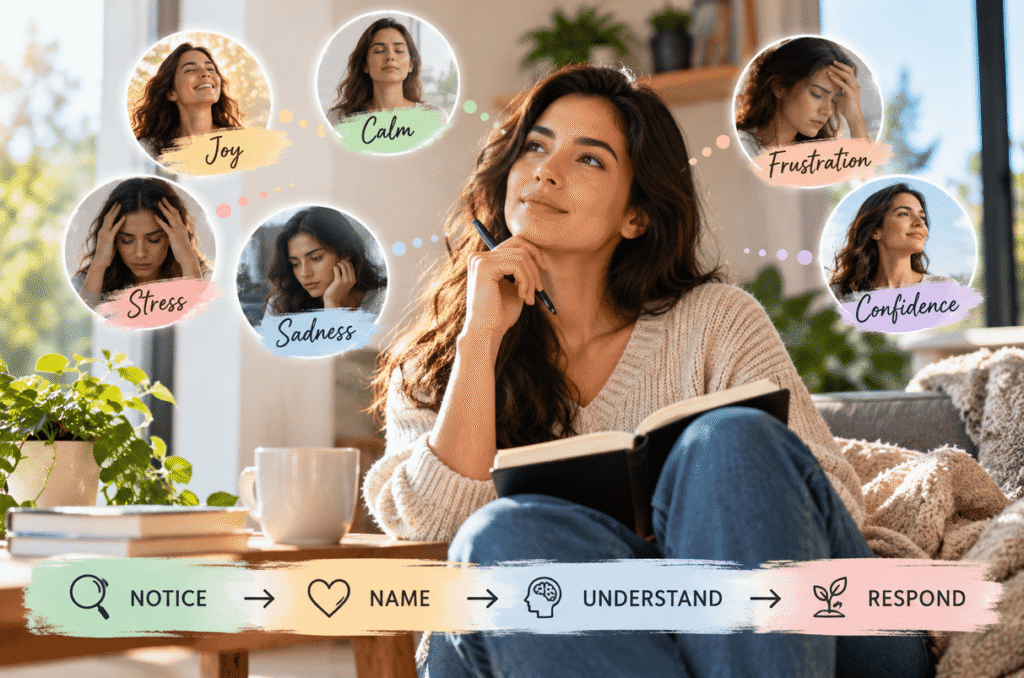
What if the strongest person in the room is not the person who never gets upset, stressed, disappointed, or afraid?
What if real strength is being able to recognise those feelings, understand them, communicate them, and continue moving forward without allowing one difficult moment to define your entire life?
That is the idea behind Emotional Fitness.
Emotional Fitness helps you become more aware of what you feel, understand why you feel it, and choose healthier ways to respond.
We often think of fitness in physical terms. We think about strength, endurance, flexibility, exercise, nutrition, and recovery. But there is another kind of strength that affects almost everything we do: the ability to understand and respond to our emotions in healthy ways.
Think about a normal day.
You wake up late. You rush to work. Someone sends you a frustrating message. Your schedule changes unexpectedly. You have an uncomfortable conversation with a colleague. You come home tired. A family member says something that bothers you. You scroll through social media and compare your life with someone else’s.
None of these moments necessarily seems enormous on its own.
But together, they can create emotional pressure.
Without awareness, you might react immediately, withdraw from people, become irritated, overthink the situation, or carry the frustration into the rest of your evening.
Developing emotional skills does not mean you will stop experiencing difficult feelings. Stress, sadness, frustration, fear, disappointment, excitement, and joy are all normal parts of being human.
The goal is not to eliminate emotions.
The goal is to develop a healthier relationship with them.
The National Institutes of Health describes emotional wellness as the ability to handle life’s stresses and adapt to change and difficult periods. It also highlights resilience, healthy physical habits, self-care, gratitude, and social connection as useful areas to develop.
That makes emotional wellbeing an important part of a broader healthy lifestyle.
At KearnFit, we believe becoming healthier is not only about changing your body. It is also about understanding yourself, building meaningful relationships, developing resilience, and creating habits that support the life you want to live.
And the good news is that these skills can be practised.
2. Understanding Your Emotional Fitness and Everyday Health
Your emotional health can influence how you respond to situations, communicate with others, make decisions, and handle everyday challenges.
By making Emotional Fitness part of your everyday wellness routine, you can create more opportunities to notice emotional patterns and respond to life with greater awareness.
The Centers for Disease Control and Prevention explains that positive emotional wellbeing involves managing thoughts and feelings, adapting to challenges, working through disagreements, seeking support, and maintaining meaningful relationships.
That does not mean you should expect yourself to feel positive every day.
In fact, expecting constant positivity can create another source of pressure.
A healthier goal is emotional awareness.
You might feel disappointed without believing that your entire day is ruined.
You might feel angry without immediately sending an aggressive message.
You might feel nervous before an important event without assuming that you cannot handle it.
You might experience sadness without believing that something is permanently wrong with you.
This distinction is important.
An emotion is an experience. It is not necessarily an instruction.
Feeling angry does not automatically mean you need to confront someone.
Feeling afraid does not automatically mean you should avoid the situation.
Feeling overwhelmed does not automatically mean you have failed.
Learning to notice the difference between what you feel and what you choose to do can create valuable space between an emotional trigger and your response.
That space is where many healthy habits begin.
3. Emotional Fitness Habit #1: Learn to Recognise Your Emotions
You cannot effectively manage something you have not noticed.
One of the most useful skills you can develop is simply learning to identify what you are feeling.
Many people use broad words such as “fine,” “bad,” “stressed,” or “angry.” But emotions can be more specific.
Maybe you are disappointed.
Maybe you are embarrassed.
Maybe you are lonely.
Maybe you feel overlooked.
Maybe you are uncertain.
Maybe you are mentally exhausted rather than angry.
The more accurately you can describe your internal experience, the easier it can become to decide what you actually need.
Try creating a simple emotional check-in during the day.
Ask yourself:
What am I feeling right now?
What happened before I started feeling this way?
What do I need at this moment?
Is there something within my control that I can do?
You do not need to spend 30 minutes analysing yourself.
A one-minute pause can be enough to start developing awareness.
You can also use a journal.
At the end of the day, write down three moments that affected you and describe how you felt during each one.
Over time, you may begin to notice patterns.
Perhaps you become more irritable when you are sleep-deprived.
Maybe certain conversations consistently leave you feeling drained.
Perhaps you feel more positive after exercising or spending time with friends.
Awareness does not immediately solve every problem, but it gives you better information about yourself.
The CDC recommends checking in with yourself, identifying difficult emotions, and allowing yourself to acknowledge feelings without judgment.
That is a simple habit with potentially meaningful benefits.
4. Emotional Fitness Habit #2: Pause Before You React
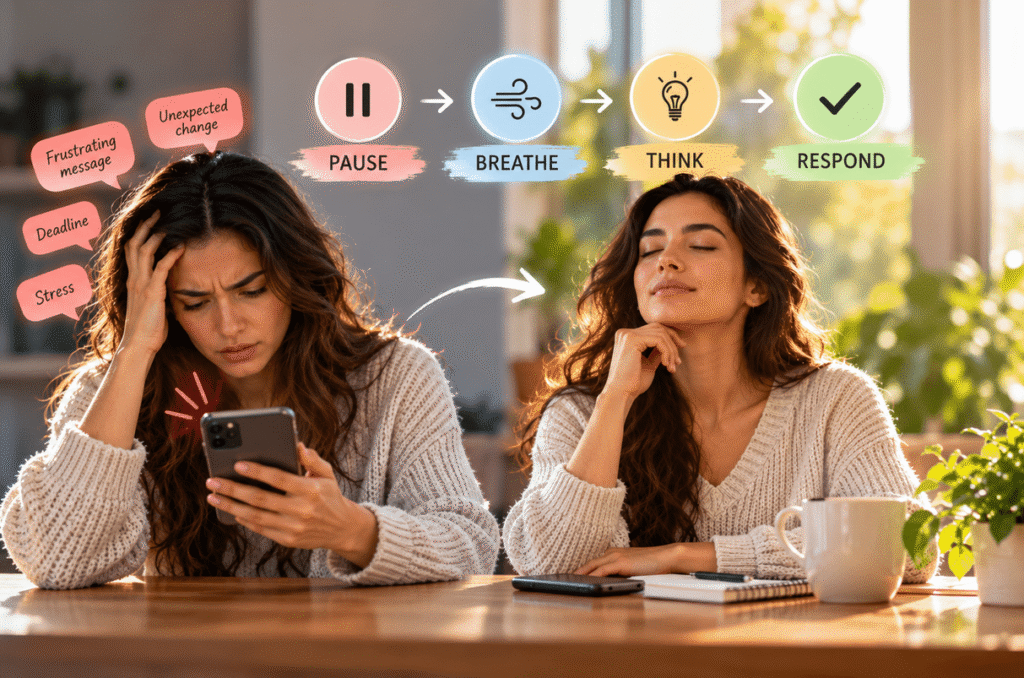
Have you ever sent a message while angry and regretted it later?
Or said something during an argument that you wished you could take back?
Strong emotions can make immediate reactions feel completely justified.
But feelings can change.
That is why learning to pause can be one of the most valuable habits you develop.
A pause does not mean ignoring the issue.
It means giving yourself enough time to choose your response rather than allowing the first emotional impulse to make the decision for you.
When something triggers you, try this simple process:
Stop. Breathe. Notice. Choose.
Stop before responding.
Take a few slow breaths.
Notice what you are feeling.
Then choose what you want to do next.
Sometimes the best response is to continue the conversation.
Sometimes it is better to wait.
Sometimes you need more information.
Sometimes you need to communicate a boundary.
And sometimes you realise that the situation does not deserve as much energy as you initially thought.
This is especially useful in digital communication.
Text messages and social media can make misunderstandings worse because you cannot always hear someone’s tone or see their body language.
If you receive a message that immediately makes you angry, consider waiting before replying.
Ask yourself whether you are responding to what the person actually said or to what you assumed they meant.
The pause creates perspective.
It gives you an opportunity to move from reaction toward intention.
5. Emotional Fitness Habit #3: Develop Healthier Ways to Manage Stress
Stress is part of everyday life.
Work, relationships, financial responsibilities, health concerns, family situations, deadlines, uncertainty, and major life changes can all create pressure.
The goal is not to build a life where nothing stressful ever happens.
Building Emotional Fitness means developing practical ways to manage stress before it begins to overwhelm your thoughts, mood, and everyday routine.
That is unrealistic.
Instead, build habits that help you respond to stress more effectively.
The CDC notes that occasional stress is normal, while long-term stress can contribute to worsening health problems. It recommends healthy coping strategies such as physical activity, adequate sleep, relaxation, journaling, time outdoors, gratitude, and connection with trusted people.
Start by discovering what genuinely helps you recover.
For one person, it may be walking.
For another, it might be music, reading, cooking, meditation, prayer, exercise, gardening, creative work, or spending time with friends.
You do not need to use every strategy.
Build a personal collection of healthy coping tools.
For example:
When I feel mentally overloaded: take a short walk.
When I am overthinking: write down the situation.
When I feel disconnected: contact someone I trust.
When I feel physically tense: stretch or practise slow breathing.
When I feel exhausted: prioritise rest.
The important distinction is between coping and escaping.
Some behaviours may provide temporary distraction without helping you address what is happening.
Healthy coping gives you an opportunity to recover, understand the situation, or take constructive action.
If stress becomes persistent, overwhelming, or interferes with your everyday activities, professional support can be appropriate. NIMH recommends seeking help when distressing symptoms persist or interfere with daily functioning.
Asking for help is not a failure of strength.
It can be an important part of taking care of yourself.
6. Emotional Fitness Habit #4: Practise Self-Compassion
How do you speak to yourself after making a mistake?
Would you speak to a close friend in the same way?
Many people are compassionate toward others but extremely critical of themselves.
You might make one mistake at work and immediately think, “I’m terrible at this.”
You might miss a workout and tell yourself that you are lazy.
You might have a difficult conversation and replay it repeatedly, focusing only on what you could have done better.
Self-reflection can be valuable.
Constant self-criticism is different.
Self-compassion means learning to treat yourself with understanding while still taking responsibility for your actions.
It does not mean making excuses.
It means recognising that being human includes mistakes, difficult emotions, setbacks, and imperfect days.
Self-compassion is an important part of Emotional Fitness because it allows you to learn from difficult experiences without constantly judging yourself.
Try replacing:
“I always mess things up.”
with:
“That did not go as planned. What can I learn from it?”
Instead of:
“I should be doing much better.”
try:
“I am still learning. What is one useful step I can take next?”
This shift can change the way you approach personal growth.
You can hold yourself accountable without attacking yourself.
You can recognise a mistake without turning it into an identity.
You can acknowledge a difficult day without assuming tomorrow will be the same.
The NIH recommends self-compassion as one element of emotional wellbeing and stress management.
A healthier inner voice can become a powerful foundation for resilience.
7. Emotional Fitness Habit #5: Communicate Your Feelings Clearly
Healthy communication is not about winning every conversation.
It is about expressing yourself honestly while respecting the other person.
When emotions are ignored for too long, they can sometimes appear indirectly.
You may become distant.
You may become unusually irritated.
You may withdraw.
You may expect others to know what you need without telling them.
Clear communication can reduce unnecessary confusion.
Instead of saying:
“You never listen to me.”
you might say:
“I feel frustrated when I don’t feel heard. Can we talk about this when we both have some time?”
This approach focuses on your experience rather than immediately attacking the other person.
The CDC recommends expressing feelings honestly and respectfully, using “I” statements, listening actively, and showing empathy even when you disagree.
Listening is just as important as speaking.
When someone shares something difficult, resist the urge to immediately fix the situation.
Sometimes people need understanding before they need advice.
Try asking:
“Do you want me to listen or help you think through a solution?”
That simple question can change a conversation.
Good communication also requires patience.
Not every disagreement needs to be solved immediately.
If emotions are too intense, taking a short break and returning to the conversation later can be healthier than continuing while angry.
Strong communication is not about avoiding disagreement.
It is about learning how to disagree without destroying the relationship.
Strong Emotional Fitness can also make it easier to communicate what you need without allowing frustration or fear to control the conversation.
8. Emotional Fitness Habit #6: Build Stronger and Healthier Relationships
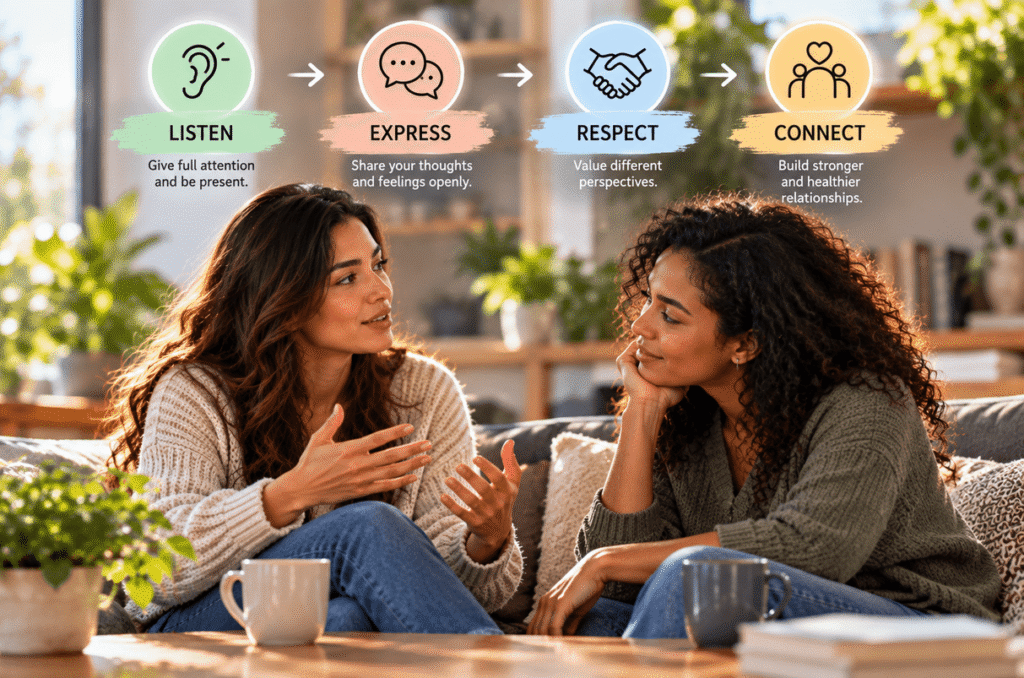
Human beings are social.
The quality of our relationships can influence how supported, connected, and understood we feel.
The CDC reports that meaningful social connections are associated with better wellbeing and can help people manage stress and support healthier behaviours.
This does not mean you need hundreds of friends.
A small number of supportive relationships can be incredibly valuable.
Think about the people in your life.
Who can you call when you have a difficult day?
Who celebrates your progress?
Who tells you the truth respectfully?
Who encourages healthy choices?
Who makes you feel comfortable being yourself?
These relationships deserve attention.
Connection is built through small actions.
Send a message.
Make a phone call.
Have dinner without your phones.
Ask someone how they are actually doing.
Celebrate a friend’s achievement.
Offer support when someone is struggling.
Join a group based on an interest you genuinely enjoy.
Community can also create accountability.
Perhaps you want to exercise regularly but struggle to stay consistent alone. Joining a walking group or fitness community may make the habit more enjoyable.
Perhaps you want to learn more about healthy living. A community can expose you to new ideas and perspectives.
At KearnFit, community is an important part of the broader wellness vision because personal growth does not always have to happen alone.
Sometimes the right conversation can change your perspective.
Sometimes a supportive friend can help you continue when motivation disappears.
And sometimes you can become that supportive person for someone else.
9. Emotional Fitness Habit #7: Create Healthy Personal Boundaries
Boundaries are often misunderstood.
A boundary is not necessarily about controlling another person’s behaviour.
It is about communicating what you are comfortable with, what you need, and what you are able to give.
Without healthy boundaries, people may become emotionally exhausted.
You might say yes when you want to say no.
You might answer work messages late at night because you feel guilty ignoring them.
You might repeatedly accept behaviour that makes you uncomfortable.
You might take responsibility for problems that belong to someone else.
Creating boundaries can feel uncomfortable at first, particularly if you are used to pleasing everyone.
But a respectful “no” can be healthier than an exhausted “yes.”
You can say:
“I won’t be able to take that on this week.”
“I need some time before we continue this conversation.”
“I am not comfortable discussing that.”
“I can help for 30 minutes, but I cannot stay longer.”
“I need some quiet time tonight.”
Boundaries do not guarantee that everyone will be happy with your decisions.
And that is okay.
Healthy relationships allow room for different needs.
A boundary should also be realistic.
If you tell yourself that you will never experience stress or never interact with difficult people, that may not be practical.
Instead, focus on what you can control: your communication, availability, behaviour, and choices.
10. Emotional Fitness Habit #8: Develop Resilience Through Life’s Challenges
Resilience is not the ability to avoid difficult experiences.
It is the capacity to adapt and continue moving forward through challenges.
Everyone experiences setbacks.
A relationship may end.
A career plan may change.
A business idea may fail.
A goal may take longer than expected.
Someone may disappoint you.
Life may simply not go according to plan.
Resilience does not require pretending that everything is fine.
You can acknowledge that something hurts while still looking for the next constructive step.
The NIH identifies resilience as an important component of emotional wellness and suggests strategies such as healthy physical habits, social connection, self-reflection, gratitude, and learning from difficult experiences.
Over time, practising Emotional Fitness can help you approach setbacks as experiences to understand and learn from rather than moments that define you.
One useful question during a difficult situation is:
“What is within my control right now?”
Maybe you cannot change what happened.
But you may be able to choose your next conversation.
You may be able to ask for support.
You may be able to create a plan.
You may be able to rest.
You may be able to learn something.
You may be able to decide what you will do differently next time.
This moves your attention from helplessness toward action.
Resilience also involves flexibility.
Sometimes the original plan is no longer appropriate.
Changing direction is not necessarily giving up.
It can be a sign that you are responding intelligently to new information.
11. Emotional Fitness Habit #9: Make Time for Reflection and Personal Growth
Modern life can become extremely busy.
You move from one task to another without stopping long enough to ask whether the way you are living actually supports what matters to you.
Reflection creates space.
You might spend ten minutes at the end of the day asking:
What went well today?
What was difficult?
What did I learn?
What am I grateful for?
What do I want to do differently tomorrow?
You could write your answers in a notebook or simply think about them while taking a walk.
Reflection does not need to become another productivity exercise.
It is an opportunity to understand yourself.
Over time, you may notice patterns.
Maybe you consistently feel better on days when you spend time outdoors.
Maybe certain commitments are draining more energy than expected.
Maybe you have been saying yes to activities that no longer align with your priorities.
Maybe you have achieved more than you give yourself credit for.
Personal growth is not always about adding more.
Sometimes it is about removing what no longer serves you.
That could mean reducing unnecessary commitments, creating healthier boundaries, spending more time with people you value, or making room for activities that bring meaning and enjoyment.
The CDC recommends practices such as self-reflection, healthy coping, enjoyable activities, gratitude, and maintaining supportive relationships as ways to support emotional wellbeing.
Reflection turns everyday experiences into learning opportunities.
12. Emotional Fitness Habit #10: Know When to Ask for Support
There is an important difference between everyday emotional challenges and problems that require professional support.
You do not need to wait until you are completely overwhelmed before asking for help.
If sadness, anxiety, stress, irritability, loss of interest, sleep problems, concentration difficulties, or other symptoms persist and begin interfering with everyday life, consider speaking with a qualified healthcare or mental health professional. NIMH specifically recommends seeking professional help when significant symptoms persist or interfere with normal activities.
Professional support can take different forms depending on the situation.
A primary care professional may help you understand what you are experiencing and identify appropriate next steps.
A psychologist, counsellor, psychiatrist, or other qualified mental health professional may provide specialised support.
There is no universal solution.
What helps one person may not be the right approach for another.
And professional care does not replace everyday healthy habits.
Exercise, sleep, social connection, relaxation, and meaningful activities can support wellbeing, but they are not substitutes for professional treatment when treatment is needed.
If you or someone you know is experiencing an immediate mental health crisis or thoughts of self-harm, seek urgent help through your local emergency services or an appropriate crisis service in your country.
Taking emotional health seriously is a sign of self-care.
13. Emotional Fitness and the Power of Physical Health
Your mind and body are not completely separate systems.
The habits that support physical health can also contribute to emotional wellbeing.
Regular physical activity, adequate sleep, nutritious food, and recovery are all connected to how you function throughout the day.
NIMH includes exercise, healthy meals, hydration, sleep, positive activities, and social connection among its general self-care recommendations.
Consider the difference between two days.
On the first day, you sleep poorly, skip meals, sit for hours, remain indoors, and spend the evening scrolling through stressful content.
On the second day, you sleep adequately, eat regular meals, move your body, take a break outdoors, and connect with someone you enjoy talking to.
Your circumstances may not always allow the second day.
But the example illustrates an important point.
Emotional wellbeing is influenced by the lifestyle environment around you.
This does not mean every difficult emotion can be solved through exercise or nutrition.
It cannot.
Emotional experiences can be complex, and mental health conditions may require professional care.
But taking care of your physical health can be one useful part of a broader strategy.
Think of it as creating a stronger foundation.
When your basic needs are supported, you may have more capacity to respond to life’s challenges.
14. Emotional Fitness and a Simple Daily Wellness Routine
You do not need a complicated routine.
A simple structure can make these ideas easier to practise.
Even a few intentional minutes each day can strengthen your Emotional Fitness and make emotional awareness a natural part of your overall wellness routine.
Morning
Before starting the day, take one minute to check in.
Ask:
“How am I feeling today?”
Then identify one thing you want to prioritise.
It could be patience, focus, movement, connection, or simply getting through a demanding day with kindness toward yourself.
During the Day
Create small pauses.
Take a few slow breaths.
Stand up and move.
Drink water.
Step outside.
Notice your emotional state.
If something frustrating happens, pause before reacting.
Evening
Give yourself a few minutes to reflect.
What went well?
What challenged you?
Did you communicate clearly?
Did you take care of yourself?
What can you leave behind today?
This routine takes very little time.
Its value comes from consistency.
You are training yourself to notice your internal experience rather than moving through life entirely on autopilot.
15. Emotional Fitness and a Powerful 7-Day Challenge
If you want to begin immediately, try this seven-day challenge.
Day 1: Notice
Three times during the day, stop and identify how you feel.
Do not judge the emotion.
Simply notice it.
Day 2: Pause
Choose one moment when you normally react quickly.
Pause before responding.
Take a breath and consider your options.
Day 3: Connect
Contact someone you care about.
Ask how they are doing and genuinely listen to the answer.
Day 4: Move
Take a walk, stretch, exercise, dance, or participate in another form of movement you enjoy.
Use the time to disconnect from unnecessary digital distractions.
Day 5: Reflect
Write down three things you learned about yourself this week.
Day 6: Set a Boundary
Identify one small boundary that could make your week healthier.
Communicate it respectfully.
Day 7: Review
Ask yourself:
What made me feel better?
What drained me?
What habit felt realistic?
What would I like to continue?
The purpose is not to complete a perfect seven-day programme.
The purpose is to experiment.
You are discovering which habits fit your life.
16. Emotional Fitness Mistakes That Can Hold You Back
Even positive intentions can become unhelpful when taken to extremes.
Here are some common mistakes to avoid.
Mistake 1: Trying to Be Positive All the Time
Positive thinking does not require ignoring difficult experiences.
You can be hopeful while acknowledging that something hurts.
Mistake 2: Suppressing Every Difficult Emotion
Pushing emotions away does not necessarily resolve the underlying issue.
Healthy processing can involve acknowledging what you feel, understanding it, communicating when appropriate, and deciding what action makes sense.
Mistake 3: Trying to Fix Everyone
Supporting people is valuable.
But you cannot control another person’s choices, emotions, or behaviour.
Know the difference between support and responsibility.
Mistake 4: Comparing Your Emotional Journey
Someone else may appear calm, confident, and successful from the outside.
You do not know everything they are experiencing.
Focus on your own growth.
Mistake 5: Expecting Immediate Transformation
Habits take time.
You may understand a concept today and still react differently tomorrow.
That does not mean the effort is pointless.
Practice is part of learning.
Mistake 6: Treating Self-Care as Self-Indulgence
Self-care is not necessarily expensive products, holidays, or spa treatments.
It can be sleep, boundaries, movement, meaningful relationships, healthy food, reflection, or asking for help.
Mistake 7: Avoiding Professional Help
Self-care has limits.
If emotional difficulties persist, worsen, or interfere with everyday life, professional support can be an important next step.
17. Emotional Fitness and the KearnFit Four-Dimension Approach

At KearnFit, we believe health is bigger than a workout.
Our approach looks at four connected dimensions: mental, physical, emotional, and financial wellbeing.
Emotional wellbeing sits within that larger picture because the different areas of life influence one another.
Financial pressure can affect stress.
Poor sleep can affect your mood.
Physical inactivity can affect energy.
Relationship difficulties can affect concentration.
Likewise, positive habits can reinforce one another.
Moving your body may create time for reflection.
A supportive community may make healthy habits easier to maintain.
Better financial organisation may reduce some everyday uncertainty.
A healthier sleep routine may give you more energy for the people and activities you care about.
This is why KearnFit is focused on a broader lifestyle approach rather than one narrow definition of fitness.
We want to create a community where people can learn about healthier habits, share experiences, stay accountable, and continue growing.
You do not need to have everything figured out before joining a wellness community.
You can arrive exactly where you are.
Maybe you are trying to become more active.
Maybe you are working on stress management.
Maybe you want stronger relationships.
Maybe you are trying to build better habits.
Maybe you simply want to understand yourself better.
Progress can begin with curiosity.
18. Emotional Fitness: Build a Stronger and More Balanced Life
Imagine waking up tomorrow with a different relationship with your emotions.
Not a life without stress.
Not a life without disappointment.
Not a life where everything goes according to plan.
Instead, imagine being more aware of what you feel.
Imagine giving yourself a moment before reacting.
Imagine communicating your needs more clearly.
Imagine recognising when you need rest.
Imagine having people you can turn to.
Imagine being able to experience a difficult day without deciding that your entire life is difficult.
That is the direction we are aiming toward.
Emotional strength is not about becoming emotionless.
It is about becoming more aware, adaptable, compassionate, and intentional.
The most meaningful changes often begin with very small actions.
A pause before a reaction.
A conversation you have been avoiding.
A walk after a difficult day.
A journal entry.
A healthier boundary.
A message to someone you trust.
A decision to ask for professional support.
One small action can become a habit.
A habit can become part of your lifestyle.
And your lifestyle can shape the way you experience everyday life.
The goal is not perfection.
The goal is progress.
At KearnFit, we want to help create a community where people can grow across the different dimensions of their lives—not just physically, but mentally, emotionally, and financially too.
If you are ready to take your next step, start small.
Choose one habit from this article.
Practise it today.
Then come back tomorrow and do it again.
Because becoming healthier is not one giant decision.
It is a collection of small decisions made consistently.
Start Your KearnFit Journey
Your wellbeing deserves more than occasional attention.
Build better habits. Learn from others. Connect with a supportive community. Keep growing.
Visit www.kearnfit.com and join the KearnFit community.
KearnFit — Four Dimensions. One Better You.