What Emotional Fitness Really Means
What if becoming stronger had nothing to do with lifting heavier weights?
Imagine waking up after a difficult night, walking into a stressful meeting, receiving unexpected criticism, or having a difficult conversation with someone you care about. Your physical strength may not help you decide what to say, how to respond, or how to process what you are feeling.
That is where emotional fitness becomes important.
Emotional Fitness is about developing a healthier relationship with your emotions so you can recognise what you feel, understand your reactions, communicate more effectively, cope with challenges, and continue moving forward.
It does not mean being happy every day.
It does not mean ignoring sadness.
It does not mean pretending that everything is fine when it is not.
And it certainly does not mean becoming emotionally disconnected.
Instead, emotional strength is about becoming more aware of what is happening inside you and learning healthier ways to respond.
Life will always bring uncertainty, disappointment, pressure, excitement, change, relationships, responsibilities, and unexpected moments. You cannot control every experience, but you can gradually develop skills that help you navigate those experiences.
The National Institutes of Health describes emotional wellness as the ability to handle life’s stresses and adapt to change and difficult times. Building resilience, reducing stress, practising self-care, and maintaining supportive relationships are among the strategies it recommends for emotional health.
At KearnFit, we see this as one important part of a bigger picture. Fitness is not only about how strong your body is. It is also about how you think, feel, connect, and grow.
And the good news is that emotional strength can be developed through small, consistent habits.
Why Emotional Fitness Matters in Everyday Life
Think about how many decisions you make based on how you feel.
You may postpone something because you are overwhelmed. You may react quickly because you are frustrated. You may avoid a conversation because you are afraid of conflict. You may say yes to something because you are worried about disappointing someone.
Emotions influence everyday experiences.
They can affect communication, relationships, motivation, decision-making, and the way you respond to challenges.
This does not make emotions a weakness. Emotions are part of being human.
The goal is not to eliminate difficult feelings. The goal is to become more comfortable recognising them and responding to them thoughtfully.
Positive emotional wellbeing can involve managing thoughts and feelings, adapting to challenges, working through disagreements, asking for support, and developing a sense of meaning and purpose.
This is particularly important in a world where people are constantly exposed to information, deadlines, social expectations, career pressure, financial concerns, and digital distractions.
Sometimes, the most powerful thing you can do is pause.
Take a breath.
Notice what you are feeling.
Then decide what you want your next response to be.
That small space between an emotion and a reaction can become a powerful place for growth.
Emotional Fitness Habit #1: Learn to Name What You Feel
One of the simplest ways to become more emotionally aware is to put your feelings into words.
Instead of saying, “I feel bad,” try becoming more specific.
Are you frustrated?
Disappointed?
Worried?
Lonely?
Excited?
Overwhelmed?
Angry?
Uncertain?
Relieved?
When you can identify an emotion, you may find it easier to understand what is happening and decide what you need.
Imagine coming home after a difficult day and immediately becoming irritated with everyone around you. Instead of assuming that everyone is annoying, pause and ask yourself what is actually happening.
Perhaps you are exhausted.
Perhaps you felt ignored at work.
Perhaps you are worried about an upcoming decision.
Perhaps you have been carrying several small frustrations throughout the day.
Naming the feeling does not instantly solve the problem, but it creates awareness.
Try creating a simple daily check-in.
Ask yourself:
What am I feeling right now?
What might have triggered it?
What do I need at this moment?
What response would help rather than hurt?
You can write the answers in a notebook or simply reflect for a few minutes.
The goal is not to analyse every emotion. It is to become more familiar with your internal world.
Emotional Fitness Habit #2: Pause Before You React
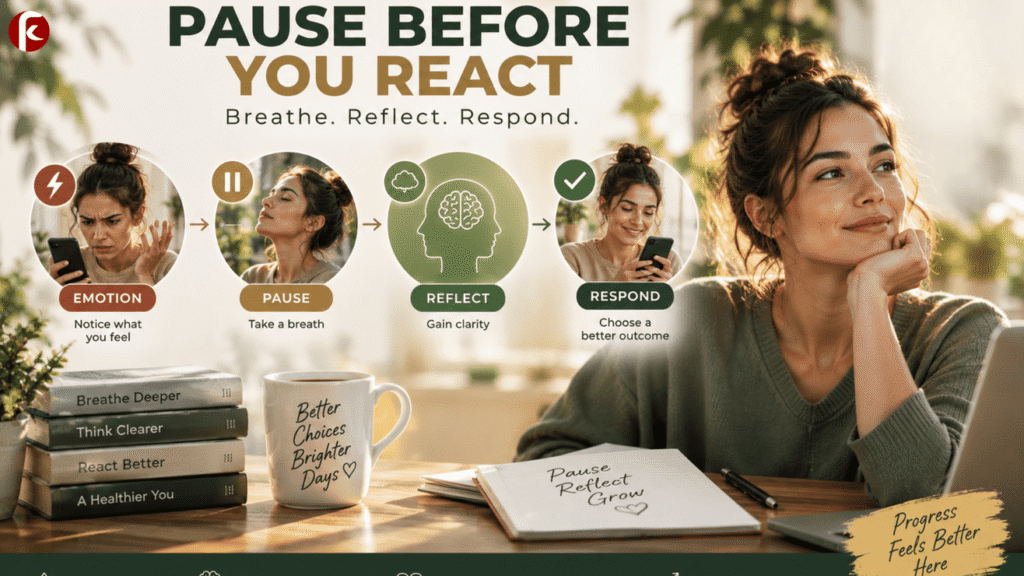
We all have moments when emotions become stronger than our ability to think clearly.
Someone says something that hurts you.
You receive an unexpected message.
A colleague challenges your idea.
A family conversation becomes tense.
Your first instinct may be to respond immediately.
But reacting and responding are not always the same thing.
A reaction can happen automatically. A response gives you an opportunity to choose your next step.
When you notice yourself becoming emotionally activated, try creating a short pause.
Take a slow breath.
Relax your shoulders.
Step away from the conversation if appropriate.
Give yourself time to think.
This does not mean avoiding difficult conversations. In fact, taking a short pause may help you return to the conversation with greater clarity.
A useful question is:
“What outcome do I want from this conversation?”
That question can shift your attention from winning an argument to solving a problem.
You may still disagree. You may still feel hurt or frustrated. But you have created space to communicate instead of simply reacting.
Over time, this small habit can become a powerful part of emotional self-management.
Emotional Fitness Habit #3: Build a Healthier Relationship With Stress
Stress is part of everyday life.
Work deadlines, family responsibilities, financial pressure, relationship challenges, health concerns, and major life changes can all create stress.
Trying to remove every source of stress is unrealistic.
Instead, focus on developing healthier ways to manage it.
Start by recognising your personal signs of stress.
Maybe you become impatient.
Maybe you struggle to concentrate.
Maybe you withdraw from people.
Maybe your sleep changes.
Maybe you constantly think about unfinished tasks.
Recognising these signals can help you take action earlier.
Healthy coping strategies can include physical activity, relaxation techniques, enjoyable hobbies, journaling, social connection, regular sleep, and setting realistic priorities. The NIH and CDC both recommend healthy coping approaches and social support as part of managing stress and supporting emotional wellbeing.
You can also create a simple “reset routine.”
When your stress level rises, step away for five minutes.
Take a walk.
Drink some water.
Take slow breaths.
Listen to calming music.
Write down what is bothering you.
Talk to someone you trust.
You do not need a complicated system.
You need something you can realistically use when life becomes difficult.
Emotional Fitness Habit #4: Practise Positive Self-Talk
Listen to the way you speak to yourself.
Would you speak to a close friend the same way?
If your friend made a mistake, would you tell them they are useless?
If they struggled with something, would you tell them they will never improve?
Probably not.
Yet many people speak to themselves in ways they would never speak to someone they care about.
“I always mess everything up.”
“I’m not good enough.”
“I should be better than this.”
“I can’t handle anything.”
These thoughts can become habits.
Positive self-talk does not mean repeating unrealistic statements that you do not believe.
Instead, try using balanced and compassionate language.
Replace:
“I failed.”
with:
“That did not go the way I wanted, but I can learn from it.”
Replace:
“I can’t do this.”
with:
“This feels difficult right now, but I can take it one step at a time.”
Replace:
“Everyone else is ahead of me.”
with:
“My journey is different, and I can focus on my next step.”
This is not about pretending challenges do not exist.
It is about changing the way you speak to yourself while facing them.
The CDC recommends self-kindness and healthier ways of challenging unhelpful thoughts as part of supporting emotional wellbeing.
Emotional Fitness Habit #5: Strengthen Your Communication Skills
Healthy communication is one of the foundations of strong relationships.
You can care about someone deeply and still misunderstand them.
You can have good intentions and still communicate poorly.
Learning to express your thoughts and feelings clearly can make everyday relationships healthier.
One useful technique is using “I” statements.
Instead of:
“You never listen to me.”
try:
“I feel unheard when I am interrupted.”
The difference is important.
The first statement places blame.
The second explains your experience.
Good communication also involves listening.
When someone is speaking, try to understand their perspective before preparing your response.
Ask questions.
Avoid interrupting.
Pay attention to tone and body language.
You do not need to agree with everything another person says to show that you understand them.
Empathy means making an effort to understand another person’s experience, even when their perspective differs from yours.
The CDC highlights respectful communication, active listening, empathy, and expressing feelings honestly as useful skills for emotional wellbeing and relationships.
Emotional Fitness Habit #6: Create Healthy Boundaries
Being available to everyone all the time is not the same as being supportive.
Healthy boundaries help you understand what you can realistically give to other people without constantly ignoring your own needs.
A boundary might involve saying no to an additional responsibility.
It might mean deciding when you are available for work messages.
It could involve asking someone not to speak to you disrespectfully.
It could simply mean protecting time for sleep, exercise, family, hobbies, or personal recovery.
Many people struggle with boundaries because they fear disappointing others.
But saying no to one request does not automatically mean you do not care.
You can be kind and still have limits.
Try replacing automatic yeses with a pause.
Instead of immediately saying:
“Sure, I’ll do it.”
you could say:
“Let me check my schedule and get back to you.”
That gives you time to decide whether the request fits your priorities.
Boundaries are not walls.
They are guidelines that help relationships become clearer and more respectful.
Emotional Fitness Habit #7: Make Space for Reflection
Modern life can become extremely noisy.
Notifications arrive constantly.
Work follows you home.
Social media provides an endless stream of opinions and information.
Your schedule fills up before you realise it.
When life becomes busy, reflection is often one of the first things to disappear.
But creating quiet moments can help you understand yourself.
You might spend ten minutes at the end of the day writing in a journal.
You might take a quiet walk without headphones.
You might sit with a cup of tea and think about your day.
You could ask yourself:
What went well today?
What was difficult?
What did I learn?
What would I like to do differently tomorrow?
What am I grateful for?
Reflection turns everyday experiences into opportunities for learning.
You do not need to write several pages.
Even a few sentences can help you notice patterns.
Perhaps you are consistently stressed on certain days.
Maybe certain situations make you lose confidence.
Perhaps spending time with certain people makes you feel energised and supported.
Awareness gives you information.
That information can help you make better choices.
Emotional Fitness Habit #8: Build a Strong Supportive Community
You were never meant to navigate everything alone.
Humans need connection.
Friends, family members, colleagues, mentors, neighbours, and communities can all become sources of encouragement and support.
Support does not always mean receiving advice.
Sometimes it simply means having someone who listens.
A short conversation can make a difficult day feel lighter.
A walk with a friend can become an opportunity to talk.
A group activity can create a sense of belonging.
A community can give you motivation when your own motivation is low.
Research and public health guidance increasingly recognise social connection as an important part of mental and physical wellbeing. The CDC notes that meaningful social connections can support stress management, sleep, healthier behaviours, and overall health.
This is where the KearnFit community vision becomes especially meaningful.
Wellness is easier to sustain when you are surrounded by people who encourage learning, growth, healthy habits, and positive conversations.
You do not need hundreds of connections.
You need meaningful ones.
Start small.
Message a friend.
Call a family member.
Join a group.
Attend an activity.
Introduce yourself to someone new.
Ask someone how they are actually doing.
Sometimes one genuine conversation can be the beginning of a valuable relationship.
Emotional Fitness Habit #9: Learn From Difficult Experiences

Nobody gets through life without setbacks.
You may experience failure.
A relationship may end.
A plan may not work.
Someone may disappoint you.
You may make a decision that you later regret.
The experience may hurt.
But difficult experiences can also become opportunities to learn.
After a challenging situation, ask yourself:
What happened?
What was within my control?
What was outside my control?
What could I learn from this?
What would I do differently next time?
This approach does not mean forcing yourself to find something positive immediately.
Some experiences simply hurt.
Give yourself time.
The goal is not to rush through difficult emotions or turn every painful experience into a motivational quote.
Instead, allow yourself to process what happened and gradually look for what you can learn.
The CDC recommends working through difficult emotions, looking at problems from different perspectives, learning from mistakes, and building resilience as part of emotional wellbeing.
Resilience is not about never falling.
It is about developing the ability to keep moving forward after difficult experiences.
Emotional Fitness Habit #10: Make Self-Care a Consistent Practice
Self-care has become a popular phrase, but it does not have to mean expensive products, luxury experiences, or spending an entire day relaxing.
Real self-care can be much simpler.
It might mean getting enough sleep.
Taking a walk.
Eating a nourishing meal.
Making time for a hobby.
Talking to someone you trust.
Taking a break.
Spending time in nature.
Reading a book.
Practising breathing exercises.
Turning off unnecessary notifications.
Asking for help.
The most important question is:
“What helps me function and feel better in a healthy and sustainable way?”
Self-care should support your life rather than become another obligation.
If your self-care routine requires an hour every morning and you have no time for it, it may not be sustainable.
Start with five minutes.
Then build from there.
Small acts of care can become meaningful when they are repeated.
The National Institute of Mental Health notes that self-care can support mental health and that small daily activities can contribute to overall wellbeing.
How Emotional Fitness Connects With Physical Health
The mind and body are not separate worlds.
Your emotions can influence your physical experience, while your physical habits can influence how you feel.
Think about what happens when you are under pressure.
You may feel tense.
You may have difficulty sleeping.
You may lose concentration.
You may feel exhausted.
This is one reason KearnFit approaches fitness through multiple dimensions.
Movement, sleep, nutrition, emotional awareness, social connection, and healthy routines can work together to support a more balanced lifestyle.
Physical activity can also be part of a healthy stress-management routine. The NIH recommends regular physical activity, healthy eating, sleep, and social connection as strategies that can support resilience and stress management.
This does not mean exercise can replace professional mental health care.
It simply means that everyday physical habits can be one part of a broader approach to wellbeing.
How Emotional Fitness Can Improve Your Relationships
Relationships can become stronger when people are able to communicate clearly, listen actively, manage difficult emotions, and respect boundaries.
Imagine two people having the same disagreement.
The first person immediately becomes defensive.
The second person pauses, listens, explains how they feel, and asks questions.
The disagreement may still exist.
But the conversation has a greater chance of becoming productive.
Emotional awareness can also help you understand other people’s experiences.
When someone is upset, your first instinct might be to solve the problem.
But sometimes they simply want to be heard.
Try asking:
“Do you want advice, or would you like me to listen?”
That simple question can change the entire conversation.
Strong relationships are not built by avoiding disagreements.
They are built through communication, respect, trust, empathy, and the willingness to work through difficult moments.
How to Build a Daily Emotional Wellness Routine
You do not need to completely redesign your life.
Start with a simple routine.
Morning: Take two minutes to check in with yourself. Ask how you feel and identify one intention for the day.
During the day: Notice moments when stress or frustration begins increasing. Pause before reacting.
Evening: Spend five minutes reflecting on your day. Think about one thing that went well, one challenge, and one lesson.
Weekly: Connect with someone you care about. Have a meaningful conversation without distractions.
Monthly: Review your emotional habits. Ask yourself what is working and what needs more attention.
The goal is consistency rather than complexity.
A small routine that you actually follow is more useful than a perfect routine that becomes impossible to maintain.
5 Simple Questions to Strengthen Your Emotional Awareness
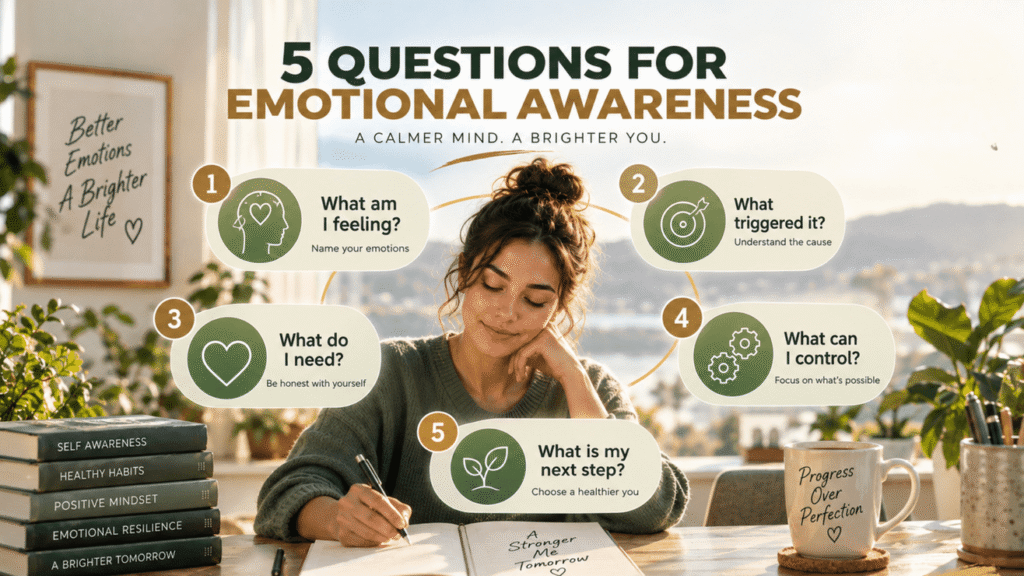
When you feel overwhelmed or uncertain, these five questions can create a useful pause:
1. What am I feeling?
Give the emotion a name.
2. What might have triggered it?
Look at the situation without immediately blaming yourself or someone else.
3. What do I need right now?
Perhaps you need rest, information, space, connection, or support.
4. What is within my control?
Separate what you can influence from what you cannot.
5. What is one healthy next step?
Do not solve your entire life in one moment.
Choose the next useful action.
These questions are not a replacement for professional support, but they can be a practical reflection tool for everyday situations.
Emotional Fitness and the KearnFit Four-Dimension Approach
At KearnFit, emotional wellbeing is one part of a broader vision of fitness.
We believe people are more than their workouts.
Your mental fitness influences how you think and focus.
Your physical fitness influences how you move and care for your body.
Your emotional fitness influences how you understand yourself, manage feelings, and connect with others.
Your financial fitness influences how you approach money, security, and future planning.
These areas are connected.
A stressful financial situation can affect emotions.
Poor sleep can affect concentration.
A supportive community can provide encouragement.
Regular movement can become part of a healthy routine.
That is why KearnFit is building a community around a broader definition of fitness.
The goal is not perfection.
The goal is progress.
When You Should Consider Professional Support
There are times when self-care and lifestyle changes are not enough.
Everyone experiences difficult emotions, but persistent or severe symptoms that interfere with everyday life deserve attention.
If you are struggling with ongoing sadness, anxiety, overwhelming stress, major changes in sleep or appetite, difficulty completing normal activities, or other distressing symptoms, consider speaking with a qualified healthcare or mental health professional.
Professional support is not a failure.
It is a responsible step toward taking care of yourself.
The National Institute of Mental Health recommends seeking professional help when severe or distressing symptoms persist or interfere with everyday activities.
If you or someone you know is in immediate danger or experiencing a mental health crisis, contact your local emergency service or crisis support service.
For readers in the United States, the 988 Suicide & Crisis Lifeline provides crisis support. Readers elsewhere should use their local emergency or crisis resources.
Build a Stronger Emotional Life One Day at a Time
You do not become emotionally stronger in a single afternoon.
It happens through hundreds of small choices.
You pause instead of reacting.
You communicate instead of assuming.
You ask for help instead of struggling silently.
You create boundaries instead of constantly saying yes.
You reflect instead of repeating the same patterns.
You forgive yourself for making mistakes.
You reach out to people who matter.
You learn from difficult experiences.
And you keep moving forward.
That is what makes emotional strength powerful.
It is not about becoming a person who never struggles.
It is about becoming someone who understands that struggling is part of being human and that support, reflection, healthy habits, and professional care can all have a place in the journey.
Your Next Positive Step With KearnFit
Your wellbeing is bigger than a workout.
It is the way you speak to yourself after a difficult day.
It is how you communicate with the people you love.
It is whether you allow yourself to rest.
It is how you handle uncertainty.
It is whether you can recognise when you need support.
It is the community you choose to build around yourself.
And it is the willingness to keep learning.
At KearnFit, we want to create a community where people can explore a broader approach to fitness and personal growth.
Because becoming healthier is not simply about changing your body.
It is about building a life in which your mind, body, emotions, relationships, and everyday choices can move in a healthier direction together.
You do not need to change everything today.
Start with one habit.
Name what you feel.
Take a breath.
Have the conversation.
Set the boundary.
Call the person you care about.
Take the walk.
Write down your thoughts.
Ask for support.
Then take the next step.
Your journey toward a stronger life can start today.
Join the KearnFit community and grow with people who believe fitness is more than physical.
KearnFit — Four Dimensions. One Better You.
Visit www.kearnfit.com to explore KearnFit and become part of the journey.