There comes a point when you realize that the way you have been living is no longer working for you.
Maybe you have been sleeping too little.
Maybe your meals have become mostly convenience foods.
Maybe exercise has disappeared from your routine.
Maybe stress has become your normal.
Maybe you spend most of the day sitting, scrolling, working, or rushing from one responsibility to another.
Or perhaps you simply feel like you have stopped taking care of yourself.
Recognizing that is not failure.
It is awareness.
And awareness can become the beginning of change.
An unhealthy lifestyle does not have to define your future. Your current habits are not a permanent identity. You can make different choices, rebuild your routines, and create a healthier way of living.
The key is not trying to transform everything overnight.
That approach can create excitement for a few days and exhaustion soon afterward.
Instead, think about starting fresh.
Start with one habit.
Then another.
Make your environment more supportive.
Create routines that fit your actual life.
Learn from setbacks instead of using them as reasons to quit.
Most importantly, stop thinking that you need to become a completely different person before you can live differently.
You can begin today.
At KearnFit, wellness is built around more than physical fitness. Mental fitness, physical fitness, emotional wellness, financial wellness, and community all contribute to the quality of life you are creating.
That means overcoming an unhealthy lifestyle is not simply about eating better or exercising more.
It is about creating a healthier relationship with your entire life.
This guide will show you 10 powerful ways to overcome an unhealthy lifestyle, reset your routine, and start fresh without relying on extreme changes or unrealistic expectations.

What Is an Unhealthy Lifestyle?
An unhealthy lifestyle is not one specific thing.
It is usually a combination of habits, routines, environments, and behaviors that make it harder to support your overall wellbeing.
It might involve:
- Consistently poor sleep
- Very little physical activity
- Frequent highly processed convenience foods
- Excessive alcohol use
- Tobacco or nicotine use
- High levels of unmanaged stress
- Constant digital distraction
- Social isolation
- Poor work-life boundaries
- Neglecting preventive healthcare
- Spending without financial awareness
- Little time for recovery or personal growth
Importantly, having one unhealthy habit does not mean your entire life is unhealthy.
You can have a stressful week without having an unhealthy lifestyle.
You can eat convenience food occasionally.
You can skip a workout.
You can stay up late sometimes.
Life is not supposed to be perfect.
The bigger issue is what happens repeatedly.
Patterns matter.
If an unhealthy behavior becomes your default way of living, it may be time to reconsider your routine.
The good news is that patterns can change.
WHO describes self-care as including healthy practices, habits, and lifestyle choices that support health and wellbeing, while emphasizing that self-care complements rather than replaces professional healthcare.
That distinction matters.
Starting fresh does not mean trying to manage every aspect of your health alone.
It means taking responsibility for the everyday choices you can influence while getting appropriate professional support when you need it.
How Do You Know Your Lifestyle Needs a Reset?
Sometimes the signs are obvious.
Sometimes they are subtle.
You may notice that you feel tired more often.
Your energy may be inconsistent.
You may have stopped doing activities you once enjoyed.
Your meals may be driven almost entirely by convenience.
You may feel uncomfortable with how much time you spend on your phone.
You may constantly postpone exercise.
You may feel overwhelmed by your schedule.
These warning signs can indicate that your Unhealthy Lifestyle patterns are becoming routine rather than occasional.
You may find yourself saying:
“I’ll start Monday.”
Then Monday becomes next week.
Then next month.
Then next year.
Another sign is when your habits no longer support the person you want to become.
Ask yourself:
Does my current routine support the life I want?
Do my daily choices give me energy or consistently drain it?
Am I making time for movement?
Am I getting enough sleep?
Do I regularly eat nourishing foods?
How do I respond to stress?
Do I have supportive relationships?
Am I taking care of my financial wellbeing?
When was the last time I intentionally did something for my own growth?
There is no need to judge your answers.
You are collecting information.
Think of this as a lifestyle audit.
The purpose is not to criticize yourself.
It is to understand where you are starting.
Why Changing Everything at Once Usually Does Not Work
When people decide they want to leave an unhealthy lifestyle, they sometimes create an extreme plan.
Wake up at 5 a.m.
Exercise every day.
Completely change their diet.
Stop all sugar.
Meditate for thirty minutes.
Read every night.
Delete every social media app.
Save half their income.
Never eat out again.
Become perfectly productive.
It sounds impressive.
But it can also become overwhelming.
The problem is not ambition.
The problem is friction.
If your new lifestyle requires dozens of major changes simultaneously, maintaining all of them can become difficult.
A better approach is progressive change.
Start with one meaningful habit.
Make it easier.
Repeat it.
Then build from there.
For example:
Week 1: Drink more water.
Week 2: Add a daily walk.
Week 3: Create a consistent bedtime.
Week 4: Improve one meal each day.
Now you are not trying to become a new person overnight.
You are building a new pattern.
CDC guidance similarly emphasizes gradual, practical approaches to becoming more physically active and notes that even small amounts of activity can be useful when getting started.
Starting small does not mean thinking small.
It means making change repeatable.
The Power of Starting Fresh
A fresh start can be powerful because it changes the question.
Instead of asking:
“Why have I been so unhealthy?”
Ask:
“What can I do differently today?”
The first question keeps you focused on the past.
The second gives you an action.
Leaving an Unhealthy Lifestyle behind starts with believing that your daily choices can change.
Starting fresh also means separating your identity from your habits.
You are not “a lazy person” because you have not exercised recently.
You are not “bad at eating healthy” because your meals have been inconsistent.
You are not “undisciplined” because stress has affected your routine.
You are a person who has developed certain patterns.
And patterns can be redesigned.
Your goal is not to erase your past.
Your goal is to learn from it.
Ask:
What caused my current habits?
Which situations trigger them?
What makes healthier choices difficult?
What healthier alternative could fit my life?
This creates a much more useful starting point.
Understanding an Unhealthy Lifestyle is the first step toward identifying which daily patterns you want to change.
10 Powerful Ways to Overcome an Unhealthy Lifestyle
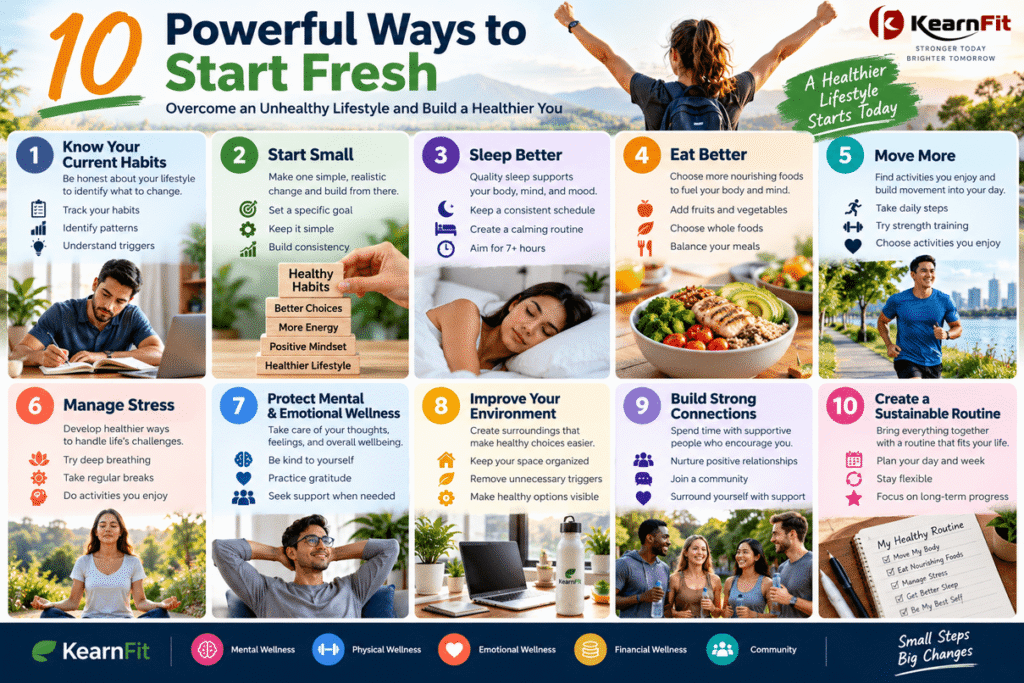
Changing an unhealthy lifestyle becomes more manageable when you stop looking for one magical solution.
There is no single habit that fixes everything.
Instead, build a foundation.
These ten strategies can help you create that foundation.
Strategy #1: Be Honest About Your Current Habits
You cannot change what you refuse to acknowledge.
Before rebuilding your lifestyle, understand what your current lifestyle actually looks like.
For seven days, observe yourself.
Do not try to change anything yet.
The goal is not to label yourself by your Unhealthy Lifestyle, but to understand the habits that are currently shaping your days.
Simply track:
Sleep: When do you go to bed? When do you wake up?
Food: What do you usually eat?
Movement: How much do you move?
Stress: When do you feel most stressed?
Screen time: When do you automatically reach for your phone?
Relationships: Who do you spend time with?
Work: When does your workday begin and end?
Money: Where does your money go?
Recovery: When do you genuinely rest?
You might discover that your biggest problem is not what you thought.
Maybe you believe you need more exercise, but your real issue is lack of sleep.
Maybe you think you eat poorly because you lack discipline, but your schedule makes meal preparation nearly impossible.
Maybe you think you are unmotivated, but you are mentally exhausted.
Data creates clarity.
You do not need a complicated tracking system.
A notebook or simple phone note can be enough.
Write:
What happened?
How did I feel?
What triggered it?
What could I change next time?
This turns self-awareness into a practical tool.
Strategy #2: Start With One Small Healthy Change
Once you understand your habits, choose one change.
Not ten.
One.
The best starting habit is usually something that is:
- Specific
- Simple
- Realistic
- Easy to repeat
- Connected to your existing routine
For example:
Instead of:
“I will become healthier.”
Try:
“I will walk for 10 minutes after lunch.”
Instead of:
“I will eat perfectly.”
Try:
“I will add one fruit or vegetable to my lunch each day.”
Instead of:
“I will stop being stressed.”
Try:
“I will take five quiet minutes after work before checking my phone.”
The smaller habit may appear less impressive.
But it is easier to repeat.
And repetition creates familiarity.
Over time, you can increase the challenge.
This is how sustainable change develops.
Do not underestimate the psychological power of keeping promises to yourself.
Every time you complete a small commitment, you create evidence that you can change.
That evidence builds confidence.
Confidence supports consistency.
Consistency creates momentum.
Momentum makes bigger changes easier.
Strategy #3: Rebuild Your Sleep Routine
If your sleep is consistently poor, improving it can become one of the strongest foundations for a healthier lifestyle.
Sleep affects physical health, emotional wellbeing, and daytime functioning. CDC guidance recommends that adults generally get at least seven hours of sleep, although individual needs vary by age and circumstance.
Instead of trying to completely transform your sleep overnight, start with consistency.
If an Unhealthy Lifestyle has affected your sleep for a long time, rebuilding a consistent routine can be an important place to begin.
Choose a realistic bedtime.
Choose a realistic wake time.
Keep them reasonably consistent.
Create a wind-down period.
Dim the lights.
Reduce stimulating activities.
Put your phone away when practical.
Prepare your clothes and essentials for tomorrow.
Keep your bedroom comfortable.
Use your final thirty minutes for calmer activities.
If you currently sleep at 1 a.m., do not suddenly expect yourself to fall asleep at 9 p.m.
Move gradually.
Your goal is to create a routine your body can recognize.
You can also look at what is disrupting your sleep.
Is work following you into the bedroom?
Are you scrolling late at night?
Are you drinking caffeine too late?
Are you waking repeatedly?
Are you keeping inconsistent hours?
Are you experiencing persistent sleep difficulties?
If sleep problems continue or concern you, speak with a healthcare professional.
A lifestyle reset should include professional care when appropriate.
Strategy #4: Improve Your Everyday Nutrition
You do not need a perfect diet to overcome an unhealthy lifestyle.
You need a more supportive eating pattern.
WHO’s current healthy-diet guidance emphasizes adequacy, balance, moderation, and diversity, with healthy diets built around a variety of foods and generally emphasizing minimally processed or unprocessed foods.
Start by improving what you already eat.
Add more vegetables.
Include fruits.
Choose whole grains more often.
Include suitable protein sources.
Moving away from an Unhealthy Lifestyle does not require perfect meals; it requires gradually creating a more supportive eating pattern.
Drink water regularly.
Reduce your reliance on highly processed convenience foods where practical.
Do not think in terms of:
“Good food versus bad food.”
Think:
“What can I add that makes this meal more nourishing?”
For example:
If you usually eat instant noodles, add vegetables and a suitable protein source.
If breakfast is usually just coffee, add fruit and a nourishing food you enjoy.
If lunch is takeout, choose an option with vegetables and a balanced source of protein.
If you snack on sweets throughout the afternoon, keep fruit, yogurt, nuts, or another preferred nourishing option available.
Small upgrades are still upgrades.
And your food choices should respect your culture, preferences, budget, dietary needs, and access to food.
A sustainable lifestyle is one you can actually live.
Strategy #5: Move Your Body More
If your current lifestyle is mostly sedentary, you do not need to become an athlete.
You need to start moving.
Physical activity includes much more than formal gym workouts.
Walking.
Cycling.
Dancing.
Sports.
Household activities.
Recreational movement.
Strength training.
Active commuting.
All can contribute to an active lifestyle.
WHO defines physical activity broadly as bodily movement and notes that regular activity supports physical and mental wellbeing.
CDC guidance for adults recommends at least 150 minutes of moderate-intensity physical activity per week along with muscle-strengthening activity on at least two days, while also emphasizing ways to overcome barriers and get started.
But if you are currently inactive, do not let the target intimidate you.
Even a few minutes of movement can be a meaningful first step when you are working to change an Unhealthy Lifestyle.
Start where you are.
Walk for ten minutes.
Take the stairs when appropriate.
Do a beginner workout.
Stretch.
Try a recreational activity.
Go outside.
Then gradually build.
If you have a chronic health condition, significant symptoms, or concerns about starting exercise, speak with a healthcare professional about appropriate activity for you.
Your first goal is not maximum performance.
It is participation.
Strategy #6: Manage Stress Before It Takes Over
Stress is part of life.
The goal is not to eliminate every stressful situation.
The goal is to develop healthier ways to respond.
WHO explains that stress affects both the mind and body and that learning to cope with stress can support mental and physical wellbeing.
Start by identifying your stress triggers.
Maybe it is:
- Work overload
- Financial pressure
- Lack of sleep
- Relationship conflict
- Constant notifications
- Social media
- Poor planning
- Unrealistic expectations
- Lack of personal time
Once you identify the trigger, ask:
Can I remove it?
Can I reduce it?
Can I respond differently?
Do I need support?
Some practical stress-management habits include:
Walking.
Slow breathing.
Journaling.
Talking to someone you trust.
Taking short breaks.
Spending time outdoors.
Organizing your tasks.
Protecting sleep.
Reducing unnecessary digital stimulation.
Creating boundaries.
And making time for activities you genuinely enjoy.
Do not treat stress management as a luxury.
Recovery is part of a healthy lifestyle.
Strategy #7: Protect Your Mental and Emotional Wellness
A lifestyle reset should not focus only on food and exercise.
Your thoughts, emotions, relationships, and sense of purpose matter too.
Sometimes an unhealthy lifestyle develops because emotional needs are being ignored.
You may eat when stressed.
Scroll when lonely.
Work constantly to avoid difficult feelings.
Stay busy because slowing down feels uncomfortable.
Avoid asking for help.
This does not make you weak.
It makes you human.
But awareness gives you the opportunity to choose a different response.
Start with a daily emotional check-in.
Ask:
What am I feeling today?
What do I need?
What is draining me?
What is giving me energy?
Who can I talk to?
You might also create a few emotional wellness habits.
Write in a journal.
Spend time with supportive people.
Practice gratitude if it feels useful.
Take quiet time.
Do something creative.
Spend time in nature.
Talk to a mental health professional when appropriate.
WHO’s stress guidance also highlights social connection, healthy eating, exercise, sleep, and coping strategies as useful parts of supporting wellbeing.
Your emotional health deserves the same attention as your physical health.
Strategy #8: Improve Your Environment
Your environment can make healthy behavior easier or harder.
If your kitchen is filled with convenience foods, those choices become easy.
If your workout clothes are buried at the bottom of a drawer, exercise has another barrier.
If your phone is beside your bed, scrolling becomes effortless.
If your workspace is chaotic, concentration may become more difficult.
You do not need perfect surroundings.
You need supportive surroundings.
Try a simple environmental reset.
Kitchen: Make nourishing foods visible and convenient.
Bedroom: Make sleep the priority.
Workspace: Keep your environment organized.
Phone: Remove unnecessary notifications.
Fitness: Keep shoes or equipment accessible.
Calendar: Schedule important health habits.
Social environment: Spend more time around people who support healthy goals.
This is one of the most powerful principles of behavior change:
Make the healthy choice easier.
Make the unhealthy choice less automatic.
You are not relying entirely on willpower.
You are designing your environment to support your goals.
Strategy #9: Strengthen Your Relationships and Community
A healthier lifestyle does not have to be a lonely project.
People can make change easier.
Invite a friend for a walk.
Cook with your family.
Join a fitness community.
Find an accountability partner.
Participate in a group activity.
Talk openly about your goals.
Celebrate progress together.
NIA’s healthy-aging guidance also highlights movement, healthy food, stress management, learning, healthcare, and connection with family and friends as useful elements of a healthier lifestyle.
Community can provide encouragement when motivation disappears.
It can also provide perspective.
If you have a difficult day, someone else can remind you that one difficult day does not erase your progress.
That is powerful.
At KearnFit, community is one of the supporting dimensions of a broader wellness lifestyle because people can learn, connect, stay accountable, and grow together.
You do not need to do everything alone.
Strategy #10: Create a Sustainable Daily Routine
The final strategy is to bring everything together.
Your goal is not to create a perfect schedule.
Your goal is to create a routine that supports your life.
A simple day might look like:
Morning
Wake at a consistent time.
Drink water.
Get some natural light.
Move your body.
Eat a nourishing breakfast if you prefer one.
Review your priorities.
Workday
Take movement breaks.
Stay hydrated.
Eat a balanced lunch.
Manage notifications.
Protect your focus.
Take short recovery moments.
Evening
Finish work intentionally.
Move or relax.
Eat a nourishing meal.
Connect with people.
Reduce unnecessary digital stimulation.
Prepare for sleep.
Weekly
Plan meals.
Schedule exercise.
Review finances.
Make time for relationships.
Plan something enjoyable.
Reflect on your progress.
The routine does not need to be identical every day.
Life happens.
The goal is to have a reliable foundation you can return to.
That is what makes a lifestyle sustainable.
How to Overcome an Unhealthy Lifestyle When You Are Busy
Being busy is one of the most common reasons people struggle to change.
But “busy” does not always mean “unable.”
Sometimes it means your health habits need to become smaller.
Instead of a one-hour workout, take a 15-minute walk.
Instead of cooking complicated meals, prepare simple ingredients.
Instead of a 30-minute meditation, take two quiet minutes.
Instead of planning your entire week, choose tomorrow’s priorities.
Instead of trying to overhaul your finances, review one account.
Instead of spending an entire evening cleaning your home, reset one area.
Think in terms of micro-habits.
A micro-habit is small enough to fit into your current life.
Examples:
After brushing your teeth → drink water.
After lunch → walk for five minutes.
After finishing work → close your laptop.
Before bed → put your phone away.
Sunday morning → plan three meals.
Friday evening → review spending.
This is how a healthier lifestyle becomes integrated into your existing routine.
You are not constantly searching for more time.
You are using existing moments more intentionally.
How to Start Fresh After Years of Unhealthy Habits
If your current habits have been around for years, you may wonder whether it is too late.
It is not.
If an Unhealthy Lifestyle has been part of your routine for years, remember that meaningful change can still begin with one decision today.
You do not need to fix every year of your past.
You need to make your next decision healthier.
That decision could be:
Taking a walk.
Drinking water.
Going to bed earlier.
Preparing breakfast.
Calling a friend.
Booking a healthcare appointment.
Creating a budget.
Taking a break.
Saying no to something that drains you.
Starting therapy.
Joining a community.
The past provides information.
It does not have to control the future.
NIA guidance emphasizes that lifestyle changes can support health and quality of life and that even small changes can contribute to healthier aging.
So if you have been living an unhealthy lifestyle for years, resist the temptation to punish yourself with extreme changes.
Instead, build.
Slowly.
Intentionally.
Consistently.
How to Start Fresh Without a Strict Diet
You do not need to start your lifestyle reset with an extreme diet.
In fact, extremely restrictive approaches may be difficult to maintain.
CDC guidance on healthy weight emphasizes healthy eating patterns, physical activity, adequate sleep, and stress management rather than fad diets, noting that fad diets can restrict nutritional intake and tend not to work well long term.
Instead of asking:
“What foods can I never eat again?”
Ask:
“What can I add to my meals?”
Add vegetables.
Add fruit.
Add suitable protein.
Add whole grains.
Add water.
Add variety.
Add more minimally processed foods.
Then gradually reduce foods that you notice are crowding out more nourishing choices.
This creates a positive approach rather than a punishment-based approach.
Food should support your life.
It should not become a source of constant guilt.
If you have specific medical or nutritional needs, work with a qualified healthcare or nutrition professional.
How to Start Fresh With Exercise
Exercise can feel intimidating if you have been inactive.
You may imagine that you need to run, lift heavy weights, or spend an hour in a gym.
You do not.
Start with movement you can tolerate and enjoy.
Walking is a great starting point for many people.
You could also try:
- Beginner strength training
- Cycling
- Swimming
- Dancing
- Yoga
- Mobility work
- Recreational sports
- Hiking
- Home workouts
The best activity is one you can perform safely and consistently.
CDC guidance notes that regular physical activity provides both immediate and longer-term health benefits, including benefits related to sleep, anxiety, blood pressure, heart health, and chronic disease prevention.
But remember:
Your first workout does not need to be your hardest workout.
Start at an appropriate level.
Build gradually.
Allow recovery.
Pay attention to your body.
If you have health concerns or are unsure what type of exercise is appropriate, speak with a healthcare professional.
How to Start Fresh Mentally and Emotionally

Sometimes the hardest part of a lifestyle reset is not physical.
It is emotional.
You may carry guilt about past choices.
You may compare yourself with other people.
You may feel frustrated that you did not start earlier.
You may have tried to change before and stopped.
You may wonder whether you can actually succeed this time.
Give yourself a different starting point.
Instead of:
“I have wasted so much time.”
Try:
“I can use today differently.”
Instead of:
“I always quit.”
Try:
“I am learning how to build habits that I can maintain.”
Instead of:
“I need to become disciplined.”
Try:
“I need to make the next healthy action easier.”
Your internal language matters.
You do not need constant positivity.
You need constructive thinking.
Be honest without being cruel to yourself.
That creates space for change.
How Financial Wellness Fits Into a Healthier Lifestyle
A complete lifestyle reset should not ignore money.
Financial stress can affect your overall sense of security and wellbeing.
And sometimes unhealthy lifestyle patterns involve spending too.
Takeout meals.
Impulse purchases.
Subscriptions you do not use.
Expensive wellness trends.
Unplanned shopping.
Lifestyle inflation.
You do not have to eliminate everything enjoyable.
Instead, become intentional.
Create a simple weekly money check-in.
Review:
What did I spend?
What was necessary?
What brought genuine value?
What was impulsive?
What can I change next week?
Financial wellness can also involve investing in things that genuinely support your life.
That might mean nutritious food.
A safe exercise environment.
Healthcare.
Education.
Skills.
Experiences.
Relationships.
Personal growth.
The goal is not simply to spend less.
The goal is to use your resources intentionally.
That is another reason financial wellness belongs in a broader approach to personal wellbeing.
7 Common Lifestyle Reset Mistakes to Avoid
Starting fresh is exciting.
But avoid these seven common mistakes.
1. Trying to Change Everything on Day One
Build progressively.
2. Expecting Motivation to Last Forever
Motivation comes and goes.
Build systems and routines.
3. Treating One Bad Day as Failure
A difficult day is an event.
It does not have to become your identity.
4. Comparing Your Beginning to Someone Else’s Progress
Your starting point is unique.
5. Choosing Extreme Restrictions
Sustainable habits generally matter more than dramatic short-term changes.
6. Ignoring Recovery
Rest is part of progress.
7. Forgetting Mental and Emotional Wellness
A healthy lifestyle is more than food and exercise.
Your 30-Day Healthy Lifestyle Reset
Ready to start?
Use this simple 30-day reset.
Days 1–3: Awareness
Track your current habits without judgment.
Days 4–6: Hydration
Make water more visible and consistent.
Days 7–9: Movement
Add a short daily walk.
Days 10–12: Sleep
Create a consistent bedtime and wake-up routine.
Days 13–15: Nutrition
Improve one meal each day.
Days 16–18: Stress
Introduce one stress-management habit.
Days 19–21: Digital Wellness
Reduce one unnecessary source of digital distraction.
Days 22–24: Connection
Reach out to someone supportive.
Days 25–27: Financial Wellness
Review spending and choose one financial improvement.
Days 28–30: Routine
Combine your favorite habits into a realistic daily routine.
At the end, do not ask:
“Did I do everything perfectly?”
Ask:
“What became easier?”
“What improved?”
“Which habits do I want to continue?”
“What should I adjust?”
That is how a reset becomes a lifestyle.
What to Do When You Have a Bad Day
You will have bad days.
That is normal.
Maybe you sleep badly.
You skip exercise.
You eat convenience food.
One difficult day does not mean you have returned to an Unhealthy Lifestyle.
You spend too much.
You lose your temper.
You work too late.
You spend hours scrolling.
The mistake is not having a bad day.
The mistake is deciding that the bad day means you should abandon the entire process.
Use the next-action rule.
Do not wait for Monday.
Do not wait for next month.
Ask:
What is the next healthy action I can take?
Drink water.
Go for a short walk.
Prepare tomorrow’s lunch.
Close your laptop.
Take a shower.
Call someone.
Go to bed.
The next healthy decision is always available.
You do not need a perfect streak.
You need the ability to return.
That ability is one of the most valuable skills you can develop.
How to Make Healthy Habits Last
A habit becomes sustainable when it fits your life.
That means your routine should account for your schedule, responsibilities, energy, preferences, budget, environment, and relationships.
Make healthy habits obvious.
Make them easy.
Connect them to existing routines.
Prepare in advance.
Reduce friction.
Track progress if it motivates you.
The long-term goal is not simply to escape an Unhealthy Lifestyle, but to build a healthier lifestyle that feels natural and sustainable.
Celebrate consistency.
And allow flexibility.
For example, your ideal workout might be 45 minutes.
But on a busy day, ten minutes may be enough to keep the habit alive.
Your ideal meal may be homemade.
But sometimes you will need a convenient option.
Your ideal bedtime may be 10:30 p.m.
But occasionally life will disrupt it.
Healthy living is not about maintaining perfect conditions.
It is about knowing how to return to your foundation.
That is what makes a lifestyle resilient.
How KearnFit Can Help You Build a Healthier Lifestyle
complete approach to wellness starts with understanding the four dimensions of fitness — mental, physical, emotional, and financial wellness. Explore the four dimensions of fitness and discover how these areas can work together to support a healthier, more balanced lifestyle.
A stronger life involves multiple dimensions.
Mental fitness helps you develop clarity, resilience, and healthier ways of handling life’s challenges.
Physical fitness helps you build movement, strength, mobility, and physical capability.
Emotional wellness helps you understand and manage your emotions while developing healthier relationships.
Financial wellness helps you become more intentional about the resources that support your life.
Community gives you opportunities to connect, learn, share, and grow.
This broader approach is especially important when you are overcoming an unhealthy lifestyle.
You are not simply changing your workouts.
You are changing the systems around your life.
You are learning how to sleep better.
Eat more intentionally.
Move more.
Manage stress.
Protect your mental energy.
Build supportive relationships.
Develop financial awareness.
Create meaningful routines.
And continue growing.
If you are ready to explore a more complete approach to wellness, visit www.kearnfit.com and discover how KearnFit can support your journey toward a stronger, healthier, and more balanced lifestyle.
You do not need to become perfect.
You simply need to start.
Conclusion: Your Fresh Start Can Begin Today
Overcoming an unhealthy lifestyle is not about becoming a completely different person overnight.
It is about changing the direction of your everyday choices.
Start by becoming aware.
Choose one small habit.
Improve your sleep.
Eat more nourishing foods.
Move your body.
Manage stress.
Protect your mental and emotional wellbeing.
Improve your environment.
Connect with supportive people.
Create routines that fit your actual life.
Pay attention to your financial wellbeing.
And give yourself permission to begin again whenever you need to.
Your previous habits do not determine every future decision.
You can change your routine.
You can rebuild your confidence.
You can create healthier patterns.
You can start fresh.
And you do not need to wait for the beginning of a new year, a Monday morning, or a major life event.
Your fresh start can begin with the next decision.
Drink the water.
Take the walk.
Prepare the meal.
Close the laptop.
Get some sleep.
Call someone you trust.
Take the first step.
Then take another.
A healthier lifestyle is built one choice at a time.
At KearnFit, we believe wellness is a journey of continuous growth — mentally, physically, emotionally, financially, and through community.
So do not ask yourself whether you can completely transform your life today.
Ask something simpler:
What is one healthy choice I can make right now?
Start there.
Then keep going.
Your past can teach you. Your present can change you. And your next choice can move you forward.
Visit www.kearnfit.com and take your next step toward a stronger, healthier life.