1. What Are Rest and Recovery?
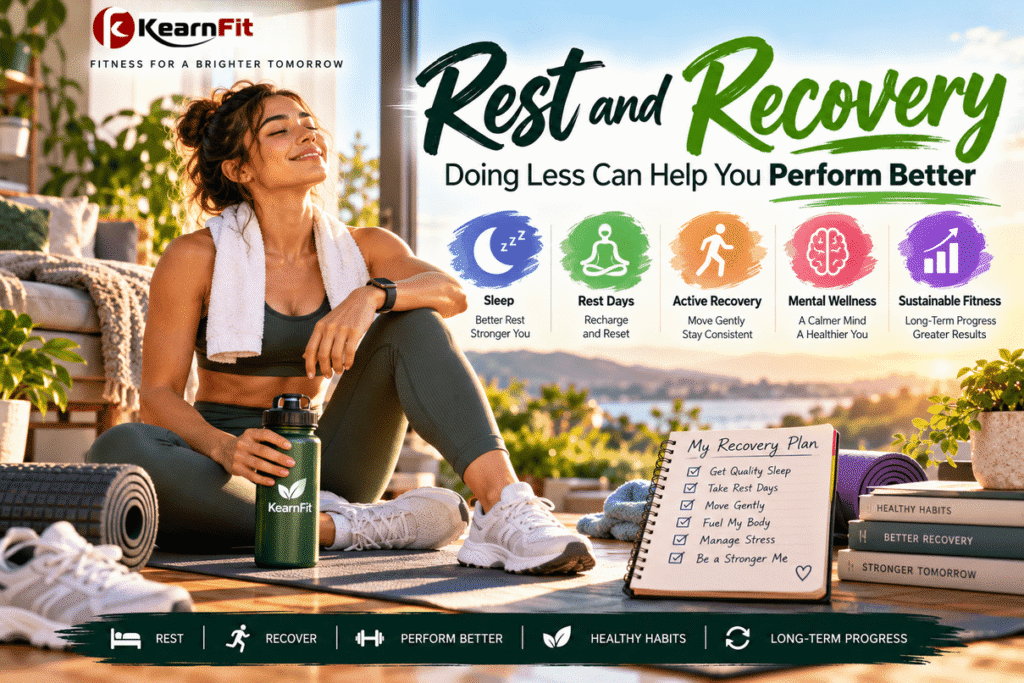
Fitness is often associated with action.
Train harder.
Run farther.
Lift heavier.
Move more.
Push yourself.
Set bigger goals.
But there is another side of fitness that receives far less attention: rest and recovery.
Recovery is the process of allowing your body and mind to return toward a state where they can handle future demands.
That does not mean you need to spend your entire day doing nothing.
It means recognizing that training creates a demand and your body needs appropriate time and resources to adapt to that demand.
Your fitness journey therefore has two sides:
Stress and adaptation.
Effort and recovery.
Training and rest.
You need both.
If you constantly train without giving yourself adequate recovery, you may find that your workouts become harder, your energy drops, your motivation decreases, or your routine becomes difficult to maintain.
On the other hand, a well-planned balance of activity and recovery can make your fitness lifestyle more sustainable.
Rest and recovery also extend beyond exercise.
Your brain needs breaks from constant concentration.
Your emotions need space away from continuous pressure.
Your sleep provides time for important physiological processes.
Your relationships and social life can also benefit from periods when you are not focused exclusively on performance.
This is why recovery belongs in a complete wellness routine.
It is not the opposite of fitness.
It is one of the foundations that helps fitness remain sustainable.
2. Why Rest Is Part of Fitness
Imagine training for a long-distance event.
You train every day at maximum intensity because you believe more work must equal faster progress.
At first, you may feel productive.
Understanding Rest and Recovery can change the way you approach fitness, helping you see downtime as an important part of sustainable progress.
But eventually, your body may struggle to keep up with the demands.
Now imagine a different approach.
You have challenging training days.
You have easier days.
You have recovery periods.
You sleep consistently.
You eat enough nutritious food.
You pay attention to how your body responds.
You adjust your training when necessary.
The second approach recognizes an important principle:
Fitness is not built only while you exercise.
Adaptation also requires recovery.
That does not mean that every person needs the same number of rest days. Recovery needs vary based on training volume, intensity, age, fitness level, sleep, nutrition, stress, health status, and many other factors.
The goal is not to discover one perfect recovery formula.
The goal is to understand that recovery is part of the process.
Current physical activity guidance recommends regular aerobic activity and muscle-strengthening activity for adults, while also emphasizing that activity can be spread throughout the week. The CDC recommends at least 150 minutes of moderate-intensity aerobic activity per week plus muscle-strengthening activity on at least two days.
Those recommendations do not mean you should train intensely every day.
Instead, they provide a broader framework for regular movement.
Within that framework, you can organize your harder sessions, easier sessions, and recovery periods around your individual goals.
3. What Happens When You Never Slow Down?
Many people assume that if some exercise is beneficial, more must always be better.
That is not necessarily how sustainable fitness works.
Your body responds to physical stress.
A demanding workout can create temporary fatigue and place stress on muscles and other body systems.
Your response afterward is part of the adaptation process.
If you continuously add more stress without allowing adequate recovery, your routine may become increasingly difficult to sustain.
Without enough rest and recovery, your body and mind may have less opportunity to recharge between demanding days.
You may notice signs such as:
- Persistent tiredness
- Reduced enthusiasm for training
- Difficulty completing workouts that previously felt manageable
- Declining performance
- Poor sleep
- Increased irritability
- Feeling unusually heavy or sluggish
- Persistent soreness
- Reduced concentration
- Frequent minor setbacks
- A growing desire to skip workouts
These signs do not automatically mean you are overtraining.
They can have many possible causes, including inadequate sleep, stress, nutrition issues, illness, medical conditions, or simply a temporary demanding period in life.
The important lesson is not to diagnose yourself based on one symptom.
Instead, pay attention to patterns.
If you feel unusually exhausted, have persistent pain, experience concerning symptoms, or notice that your ability to function is being affected, consider speaking with an appropriate healthcare professional.
The purpose of rest and recovery is not to create fear around exercise.
It is to help you develop a more intelligent relationship with training.
You can work hard without believing that every workout needs to be harder than the previous one.
4. 10 Powerful Ways to Improve Rest and Recovery
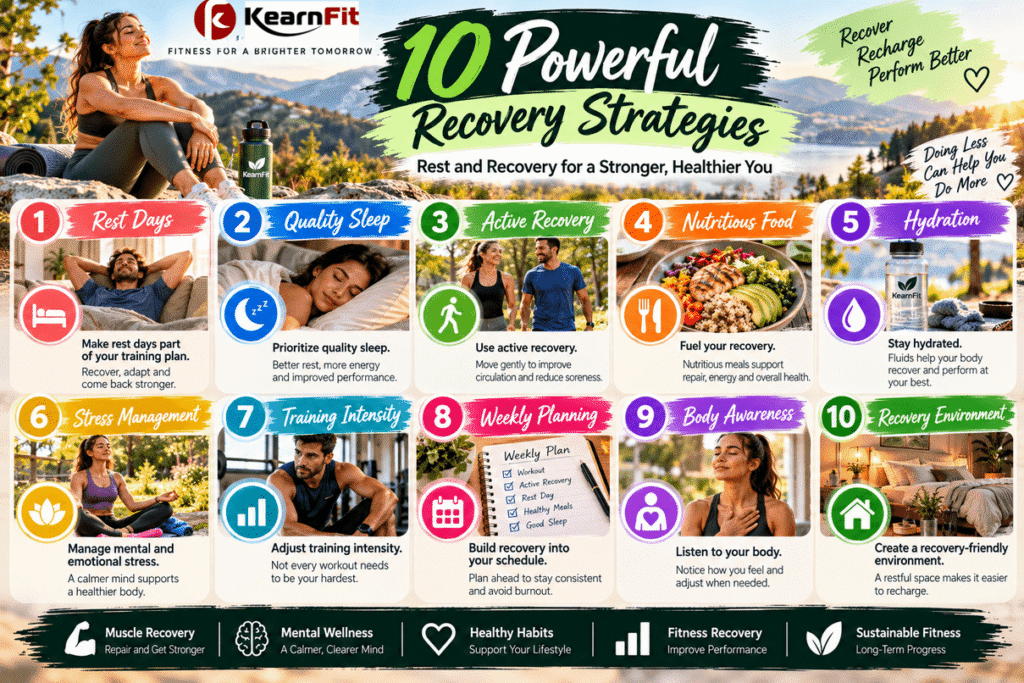
A better recovery routine does not require expensive equipment or complicated technology.
You can start with ten simple principles:
1. Treat rest days as part of your training plan.
2. Prioritize quality sleep.
3. Use active recovery when appropriate.
4. Support recovery with nutritious food.
5. Stay adequately hydrated.
6. Manage mental and emotional stress.
7. Adjust training intensity instead of pushing constantly.
8. Build recovery into your weekly schedule.
9. Listen to your body’s signals.
10. Create an environment that makes recovery easier.
The most important point is that these strategies work together.
Sleeping well can make exercise feel easier.
Regular movement can support sleep and mental wellbeing.
Nutritious meals provide fuel for your active lifestyle.
Stress management can help you transition into rest.
A structured schedule can prevent you from accidentally turning every day into a hard-training day.
Recovery is therefore not one action.
It is a lifestyle system.
5. Strategy #1: Treat Rest Days as Part of Your Training Plan
A rest day should not feel like a failure.
It is not a day when you are “being lazy.”
It can be a planned part of your training structure.
If you train several days per week, you can organize your schedule so that harder sessions are separated by easier days or rest periods when appropriate.
For example:
Monday: Strength training
Tuesday: Moderate cardio
Wednesday: Recovery or light movement
Thursday: Strength training
Friday: Moderate cardio
Saturday: Enjoyable activity
Sunday: Rest
This is only an example.
Your ideal schedule depends on your goals, experience, fitness level, and personal circumstances.
The important concept is variation.
Not every session needs to demand the same amount from your body.
You can also think about rest in terms of different levels.
Complete rest:
No structured exercise.
Active recovery:
Gentle movement such as an easy walk, light mobility, or another comfortable activity.
Low-intensity training:
An easier session that maintains movement without creating the same demand as a harder workout.
These categories can help you move away from an all-or-nothing approach.
A rest day does not erase your progress.
It can help you return to your next training session with greater energy and readiness.
6. Strategy #2: Prioritize Quality Sleep
If there is one part of rest and recovery that deserves special attention, it is sleep.
Sleep is not simply a period when your body stops moving.
It is an important biological process that supports health and emotional wellbeing.
The CDC states that good sleep is essential for health and emotional wellbeing. For adults aged 18–60, the general recommendation is at least seven hours per night, while recommended amounts vary by age.
The CDC also notes that sleep helps the body repair itself and supports normal daytime functioning.
Quality sleep is a foundation of Rest and Recovery, giving your body and mind valuable time to recharge.
For someone pursuing fitness goals, that makes sleep part of the training equation.
You can improve your sleep routine by:
Keeping a consistent sleep schedule.
Going to bed and waking up around the same time can create a more predictable rhythm.
Creating a wind-down period.
Give yourself time to transition away from work and stimulation.
Managing evening screens.
Reduce unnecessary bright light and stimulating content close to bedtime.
Getting natural light during the day.
Morning or daytime outdoor light can support a healthy daily rhythm.
Creating a comfortable bedroom.
A quiet, cool, dark environment may make sleep easier.
Avoiding the mindset that sleep is optional.
If you consistently sacrifice sleep to fit in additional work or exercise, you may be undermining the recovery you need.
And if you have ongoing sleep problems, talk with a healthcare provider rather than simply assuming you need more discipline.
Good sleep is not a luxury.
It is a foundation for a healthy lifestyle.
7. Strategy #3: Use Active Recovery
Recovery does not always mean staying completely still.
For many people, light movement can be a useful way to remain active while reducing training demands.
This is commonly called active recovery.
Examples include:
- Easy walking
- Gentle cycling
- Light mobility exercises
- Comfortable stretching
- Low-intensity recreational activity
- Easy swimming
- Relaxed movement outdoors
The key word is easy.
An active recovery session should not secretly become another hard workout.
You should choose an intensity that is appropriate for your fitness level and recovery needs.
For example, if you completed a demanding lower-body strength session yesterday, an easy walk may be a very different stimulus from another intense leg workout.
Active recovery can also provide a psychological benefit.
You remain connected to your routine without feeling pressure to perform.
A walk outside can give you fresh air and a change of environment.
Gentle mobility can help you reconnect with how your body feels.
A relaxed cycle can make movement enjoyable rather than competitive.
The goal is not to maximize calorie burn.
It is to support a balanced relationship with movement.
8. Strategy #4: Support Recovery With Nutritious Food
Your body needs energy and nutrients to support normal function.
Food therefore plays an important role in rest and recovery.
You do not need a complicated diet to support a healthy active lifestyle.
Start with the fundamentals.
Build meals around a variety of nutritious foods.
Nutrition is an important part of rest and recovery because your body needs adequate nourishment to support everyday repair and energy.
Include vegetables and fruits.
Choose protein-rich foods that fit your dietary preferences.
Include whole grains or other carbohydrate-rich foods as appropriate.
Use healthy fats.
Drink enough fluids.
The exact amount and composition of food you need depends on factors such as your body size, activity level, goals, dietary pattern, and health status.
Avoid the idea that recovery requires an expensive collection of supplements.
Supplements may have specific uses in certain situations, but they should not replace a generally nutritious eating pattern.
Your everyday meals matter.
For example, after exercise you might choose a balanced meal containing protein, carbohydrates, vegetables, and fluids.
Or you might simply continue with your normal nutritious eating routine.
There is no need to turn every workout into a complicated nutrition calculation.
Consistency matters more than perfection.
Food is not a reward for exercise.
It is part of taking care of your body.
9. Strategy #5: Stay Hydrated
Hydration is another simple but important part of a recovery-friendly lifestyle.
Your fluid needs vary depending on factors such as activity, climate, body size, diet, and individual circumstances.
Instead of obsessing over one universal number, develop practical habits.
Keep water accessible.
Drink regularly throughout the day.
Pay attention to thirst.
Increase attention to hydration during hot weather or prolonged physical activity.
If you are exercising for long periods or in challenging environmental conditions, your fluid and electrolyte needs may differ.
The important point is to avoid treating hydration as something that matters only during workouts.
It is part of everyday wellbeing.
A reusable bottle can make the habit easier.
Keep one at your desk.
Carry one when walking.
Take one to your workout.
Use it as a visual reminder.
Simple systems reduce the amount of effort required to maintain healthy behaviors.
And remember that hydration should not become another source of anxiety.
Your needs are individual, and people with certain medical conditions may have specific fluid recommendations from their healthcare professionals.
10. Strategy #6: Manage Mental and Emotional Stress
Physical recovery becomes more difficult to think about when your mind is constantly under pressure.
Imagine completing a workout and then immediately returning to hours of stressful work, endless notifications, difficult conversations, and poor sleep.
Your body may be physically finished with the workout, but your day is still demanding.
That is why rest and recovery should include mental recovery.
Stress is a normal response to challenges, but chronic stress can contribute to or worsen a range of health problems. NCCIH notes that long-term stress can be associated with issues such as sleep problems, headaches, and digestive symptoms.
Creating periods of relaxation can therefore be valuable.
Try:
Deep breathing.
Mindfulness.
Reading.
Walking outdoors.
Journaling.
Spending time with supportive people.
Listening to calming music.
Taking breaks from notifications.
Practicing a relaxing hobby.
NCCIH notes that relaxation techniques such as deep breathing, progressive relaxation, guided imagery, and mindfulness can help produce a relaxation response, although they should not replace conventional medical care.
You do not need to become perfectly calm.
You simply need opportunities to move from constant stimulation toward periods of restoration.
11. Strategy #7: Adjust Training Intensity
Not every workout needs to be your hardest workout.
This sounds simple, but it can be surprisingly difficult for people who associate progress with constantly pushing harder.
Training intensity should have variation.
Adjusting your training intensity when needed allows Rest and Recovery to remain part of a balanced and sustainable fitness routine.
You might have:
Hard days.
Moderate days.
Easy days.
Recovery days.
This creates room for adaptation and helps your routine remain sustainable.
For example, you could have a challenging strength session followed by an easier walking day.
You might complete a more demanding cardio session one day and choose mobility the next.
You might reduce intensity during a stressful week.
You might modify a workout when sleep has been poor.
This does not mean you should avoid challenge.
Progress requires an appropriate training stimulus.
But challenge and exhaustion are not the same thing.
You want training to be productive rather than simply punishing.
If you work with a qualified coach, they can help structure training volume and intensity around your goals.
If you train independently, learn to distinguish between normal training effort and signals that suggest you need to reduce your load.
And when in doubt about persistent pain or concerning symptoms, seek appropriate professional guidance.
12. Strategy #8: Build Recovery Into Your Weekly Schedule
If recovery is not scheduled, it can easily disappear.
Work expands.
Errands appear.
Social plans fill the calendar.
And suddenly every day becomes another opportunity to “do more.”
Instead, place recovery on your calendar.
You might schedule:
A weekly rest day.
Short movement breaks.
A consistent bedtime.
A relaxing evening.
A screen-free period.
Time outdoors.
A social activity.
A weekly meal-preparation period.
Scheduling recovery does not mean turning relaxation into another productivity project.
It simply protects space for it.
You can also use transition periods.
For example:
After work → 20-minute walk.
After dinner → relaxed conversation.
Before bed → reading and reduced screen use.
Weekend morning → gentle outdoor activity.
These transitions can teach your mind that the day has different phases.
Not every hour needs to be optimized.
Some time can simply be restorative.
That is an important part of sustainable wellness.
Scheduling rest and recovery makes it easier to treat recovery as a consistent part of your fitness routine rather than something you only do when you feel exhausted.
13. Strategy #9: Listen to Your Body
Learning to listen to your body does not mean obeying every feeling.
It means developing awareness.
Ask:
How do I feel today?
How did I sleep?
Am I unusually tired?
Do I feel recovered from my previous workout?
Is this normal training discomfort or something concerning?
Would a lighter session make more sense today?
Do I need rest?
This type of self-awareness becomes especially important as your fitness experience grows.
A beginner may benefit from learning basic movement patterns and building consistency.
An experienced athlete may need to become more precise about training load and recovery.
The appropriate balance changes over time.
Your body also does not operate separately from the rest of your life.
A stressful work week can influence how you feel during exercise.
Travel can affect sleep.
Poor nutrition can affect energy.
Emotional strain can change motivation.
Paying attention to your body can help you recognize when Rest and Recovery should take priority over another demanding workout.
A good recovery routine takes the whole person into account.
If something feels persistently wrong, do not rely on self-assessment alone.
Professional evaluation can be important when symptoms are ongoing or concerning.
14. Strategy #10: Create a Recovery-Friendly Environment
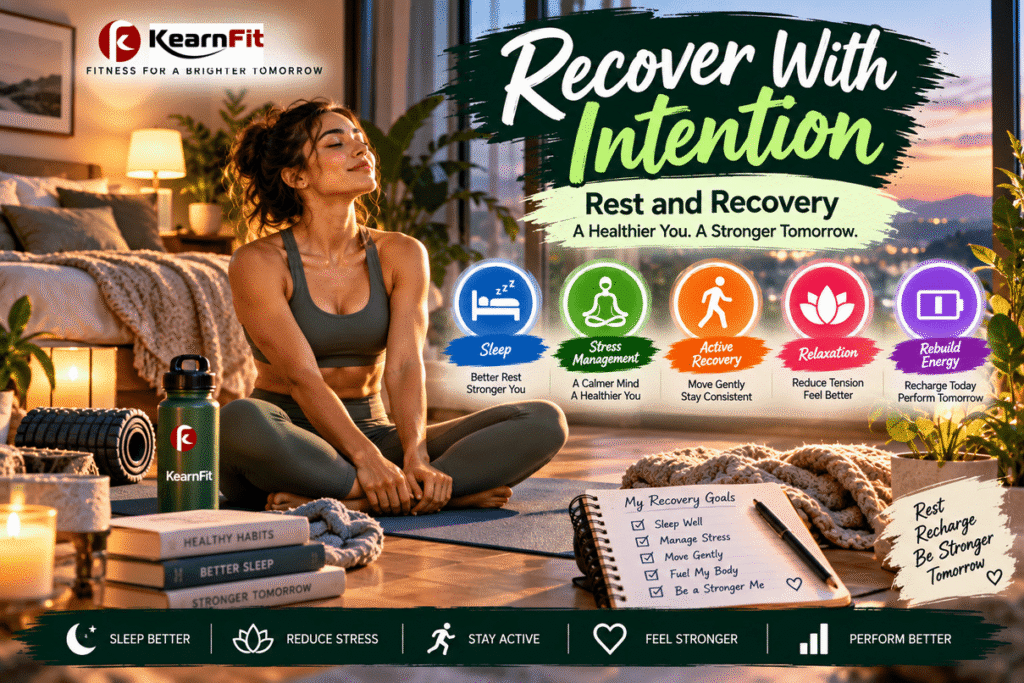
Your environment can either encourage recovery or make it harder.
Consider your bedroom.
Is it comfortable and conducive to sleep?
Consider your evenings.
Do you have a transition between work and personal time?
Consider your phone.
Does it stay beside your bed, constantly demanding attention?
Consider your home.
Do you have a comfortable place to sit, stretch, read, or relax?
Small environmental changes can have a surprisingly large effect on routines.
Prepare your sleep environment.
Keep your workout equipment organized.
Have nutritious food available.
Put your phone away during meals or relaxation.
Create a comfortable place for reading.
Keep a journal nearby.
Make outdoor movement easy.
The goal is to make recovery behaviors visible and accessible.
You are not relying entirely on willpower.
You are designing your surroundings to support your goals.
This is particularly useful for busy people.
When life becomes demanding, the easier healthy choices are to start, the more likely you are to maintain them.
15. Rest and Recovery for Beginners
Beginners sometimes believe they need to train every day to make progress.
That is rarely the best mindset.
When you are new to exercise, your body is adapting to unfamiliar demands.
Your goal should be to build a sustainable relationship with movement.
Start gradually.
Learn basic movement patterns.
Allow your body time to adjust.
Avoid turning every session into a test of how much discomfort you can tolerate.
A beginner schedule might include three structured activity days with easier movement or recovery periods between them.
For example:
Monday: Full-body strength
Tuesday: Easy walk
Wednesday: Rest or gentle mobility
Thursday: Full-body strength
Friday: Easy walk
Saturday: Enjoyable activity
Sunday: Rest
This is simply an example, not a universal prescription.
Your current fitness level, health, schedule, and goals should guide your plan.
CDC guidance emphasizes that some physical activity is better than none and encourages people to choose activities that fit their abilities.
That means beginners do not need to wait until they are “fit enough” to start.
Start where you are.
Build gradually.
Recover appropriately.
16. Rest and Recovery for Busy Professionals
Busy professionals often have a unique recovery problem.
They may exercise regularly but still feel exhausted because the rest of their lifestyle remains highly demanding.
Imagine someone who works long hours, sleeps five or six hours, spends most of the day sitting, rushes through meals, and then attempts intense workouts several evenings a week.
The workout may be healthy.
The overall lifestyle may still need more recovery.
The solution is not necessarily stopping exercise.
It is looking at the entire system.
Ask:
How much sleep am I getting?
How stressful is my workday?
Do I take breaks?
Do I eat regularly?
How much time do I spend sitting?
Do I have time for relationships and hobbies?
Do I ever disconnect from work?
A short walk between meetings may be more useful than adding another intense workout.
A consistent bedtime may be more valuable than another late-night training session.
A real lunch break may improve your day more than eating at your desk while answering emails.
Recovery should fit your life.
The objective is not simply to become more productive.
It is to become healthier and more capable of enjoying your life.
17. Rest Days vs. Active Recovery
These terms are sometimes used interchangeably, but they do not necessarily mean the same thing.
A rest day generally means taking a break from structured exercise.
An active recovery day involves gentle movement at a lower intensity.
Neither option is automatically better.
The appropriate choice depends on your training, energy, health, and goals.
For example, after a demanding workout, complete rest may feel appropriate.
On another day, an easy walk may help you stay active without adding significant training stress.
You can also use recovery based on how you feel.
Both approaches can play a valuable role in Rest and Recovery, depending on your energy, training demands, and individual needs.
If you are physically and mentally exhausted, more rest may be appropriate.
If you feel good but want a break from intense training, gentle movement may work well.
This flexible approach prevents recovery from becoming another rigid rule.
Your body is not a machine that performs exactly the same way every day.
Your recovery needs can change.
Your schedule can change.
Your stress can change.
Your training should have enough flexibility to account for those realities.
18. How Sleep and Fitness Work Together
Sleep and exercise can support each other.
Regular physical activity is associated with health benefits that include better sleep, while sufficient sleep supports daily functioning and recovery.
The CDC notes that getting enough good-quality sleep is important for health and emotional wellbeing, and that sleep helps the body repair itself.
Quality sleep is one of the most important foundations of rest and recovery, helping you create a healthier rhythm between training, activity, and downtime.
This creates a useful cycle:
Move regularly → support healthy routines → sleep well → recover → feel more prepared to move.
But the cycle can also become negative:
Sleep poorly → feel exhausted → struggle to exercise → feel less energized → continue sleeping poorly.
The solution is not to force intense exercise when you are severely fatigued.
Instead, consider the whole routine.
Keep consistent sleep and wake times.
Get daylight during the day.
Stay active.
Create a calming evening routine.
Give yourself enough opportunity to sleep.
Avoid treating late-night work as normal if it constantly interferes with your rest.
And if you consistently struggle with sleep, seek appropriate professional advice.
Recovery begins long before you get into bed.
19. How Recovery Supports Mental Wellness
Recovery is not only about muscles.
Your brain also needs periods without constant demands.
Consider how much attention your modern lifestyle requires.
Emails.
Messages.
Meetings.
Notifications.
Social media.
Work.
Family responsibilities.
Planning.
Decision-making.
Even when you are physically sitting still, your mind may be working continuously.
That is why mental recovery matters.
You can create small periods of reduced stimulation throughout the day.
Take a walk without checking your phone.
Eat without multitasking.
Spend five minutes breathing slowly.
Read a book.
Talk to someone face-to-face.
Making Rest and Recovery a regular part of your lifestyle can also create valuable space for relaxation, reflection, and emotional reset.
Spend time outdoors.
Listen to music.
Practice mindfulness.
NCCIH notes that relaxation techniques can help elicit a relaxation response and may be useful as part of a broader approach to managing stress.
These practices do not need to become another performance goal.
You do not need to “win” at relaxation.
You simply need moments when your mind is allowed to slow down.
Mental recovery can make physical recovery feel more complete because you are addressing the demands of your whole lifestyle.
20. 7 Common Recovery Mistakes to Avoid
Even people who understand the importance of recovery can make mistakes.
Here are seven common ones.
Mistake #1: Treating rest as laziness.
Rest is not automatically a sign of weakness.
It can be an intentional part of a training plan.
Mistake #2: Training hard every day.
Constant high-intensity exercise may make your routine harder to sustain.
Variation matters.
Mistake #3: Sacrificing sleep for workouts.
More exercise does not compensate for chronically inadequate sleep.
Mistake #4: Turning recovery into another performance goal.
You do not need to optimize every minute of your day.
Mistake #5: Ignoring nutrition.
Recovery requires more than exercise.
Your overall eating pattern matters too.
Mistake #6: Confusing soreness with progress.
Feeling extremely sore is not a requirement for an effective workout.
Mistake #7: Ignoring persistent pain or unusual symptoms.
Discomfort can have many causes. Persistent or concerning symptoms deserve appropriate professional attention.
Avoiding these mistakes can make rest and recovery a normal part of your lifestyle instead of something you use only when you are already exhausted.
21. A Simple Weekly Rest and Recovery Plan
Here is an example of how recovery can fit into a balanced week:
| Day | Activity | Recovery Focus |
|---|---|---|
| Monday | Strength training | Nutritious meal + sleep |
| Tuesday | Moderate cardio | Evening relaxation |
| Wednesday | Active recovery | Gentle walk + mobility |
| Thursday | Strength training | Hydration + sleep |
| Friday | Moderate cardio | Relaxed evening |
| Saturday | Enjoyable activity | Post-activity recovery |
| Sunday | Rest | Sleep + weekly planning |
Again, this is an example rather than a universal prescription.
You can adapt it to your own schedule.
The important principle is to avoid making every day identical.
A simple weekly plan makes Rest and Recovery easier to prioritize alongside workouts, movement, nutrition, and everyday responsibilities.
A balanced week can include:
Training.
Movement.
Recovery.
Sleep.
Social connection.
Enjoyment.
Personal time.
You do not have to choose between being active and resting.
A sustainable lifestyle includes both.
22. Your 30-Day Rest and Recovery Challenge
If recovery is something you usually ignore, try a 30-day experiment.
The goal is not to stop exercising.
The goal is to become more intentional about how you recover.
Days 1–5: Observe
Track your sleep, energy, workouts, mood, and general sense of recovery.
Do not change anything yet.
Look for patterns.
Days 6–10: Improve Sleep
Create a consistent bedtime and wake-up routine.
Give yourself enough opportunity to sleep.
Days 11–15: Add Recovery
Schedule one intentional recovery period.
This might be rest, gentle movement, reading, or time outdoors.
Days 16–20: Improve Nutrition and Hydration
Pay attention to regular meals, nutritious foods, and hydration.
Avoid unnecessary complexity.
Days 21–25: Reduce Mental Stress
Add short periods of breathing, mindfulness, outdoor walking, or another relaxing activity.
Days 26–30: Build Your Weekly System
Create a realistic weekly schedule containing training, easier movement, recovery, and sleep.
At the end of the challenge, ask:
Do I feel more energized?
Am I sleeping better?
Do my workouts feel more sustainable?
Am I less tempted to push through exhaustion?
Which recovery habits are easiest to maintain?
Which ones need adjustment?
The goal is not to become obsessed with recovery.
It is to make recovery a normal part of your lifestyle.
23. How to Recover After a Difficult Week
Sometimes life becomes chaotic.
You may sleep poorly for several nights.
Work may become overwhelming.
You may travel.
Your meals may become irregular.
Your workouts may feel harder.
You may feel mentally exhausted.
Do not respond by trying to immediately “make up” for everything.
After a demanding week, prioritizing rest and recovery can help you reset your routine and return to your goals with a more sustainable approach.
Start with the basics.
Sleep.
Hydration.
Nutritious meals.
Gentle movement.
Stress reduction.
Time away from work.
Then gradually return to your normal training routine.
A difficult week does not require an extreme recovery week.
It may simply require a reset.
Think about the first 24 hours.
What can you realistically improve?
Maybe you can go to bed earlier.
Maybe you can take a short walk.
Maybe you can prepare a nutritious meal.
Maybe you can turn off work notifications.
Maybe you can ask someone for support.
Small improvements can help you rebuild your rhythm.
The same principle applies to fitness after a period away from exercise.
Do not assume that you need to immediately return to your previous training volume.
Gradual progression is often more sustainable.
24. When You May Need to Reduce Your Training Load
Sometimes the correct recovery strategy is to do less.
This does not mean giving up.
It means adjusting your training to your current capacity.
You may need to reduce training temporarily if:
- You are unusually fatigued for an extended period.
- Your normal performance has noticeably declined.
- You are struggling to recover between sessions.
- Your sleep has deteriorated.
- You are dealing with significant life stress.
- You have persistent soreness or pain.
- You are returning after illness.
- Your schedule suddenly becomes much more demanding.
The right response depends on the situation.
Sometimes reducing intensity is enough.
Sometimes you need an additional rest day.
Sometimes you need to modify an exercise.
Sometimes you should stop and seek professional guidance.
People with chronic conditions or disabilities may have specific activity considerations, and the CDC recommends consulting a healthcare professional or physical activity specialist about appropriate types and amounts of activity when appropriate.
The important lesson is that modifying your plan is not failure.
It is a form of self-management.
Your long-term goal is not to win one week.
Knowing when to reduce your training load is an important part of Rest and Recovery and long-term fitness consistency.
It is to create a lifestyle you can sustain.
25. How KearnFit Supports Sustainable Fitness
At KearnFit, fitness is not simply about pushing harder.
It is about building a healthier life that supports the whole person.
That includes understanding the importance of rest and recovery alongside physical activity.
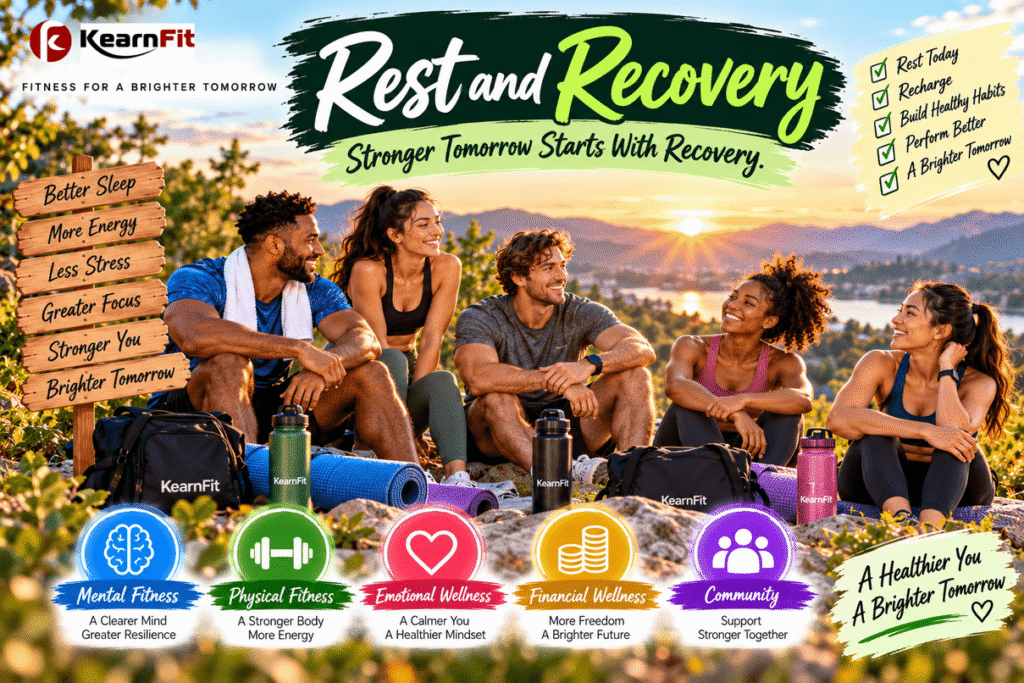
A sustainable KearnFit approach can connect:
Mental Fitness — creating space for focus, resilience, reflection, and stress management.
Physical Fitness — building strength, movement, mobility, endurance, and appropriate training.
Emotional Wellness — recognizing emotions, building self-awareness, and developing healthier ways to handle everyday pressure.
Financial Wellness — creating sustainable habits that support your wider lifestyle and financial priorities.
Community — finding connection, accountability, encouragement, and shared growth.
Recovery fits into all five.
Mental recovery gives your attention a break.
Physical recovery allows you to step away from training demands.
Emotional recovery creates space to process everyday experiences.
Financial wellness can reduce lifestyle pressures that make rest difficult.
Community can provide encouragement and remind you that wellness does not need to be a solo journey.
This is why KearnFit looks beyond the idea that fitness is simply about exercise.
A healthier lifestyle is built through the interaction of many habits.
Sometimes the strongest choice is to train.
Sometimes it is to walk.
Sometimes it is to sleep.
Sometimes it is to pause.
Sometimes it is to ask for support.
And sometimes doing less today helps you show up stronger tomorrow.
At KearnFit, fitness goes beyond workouts. Our approach connects physical progress with mental, emotional, and financial wellbeing. Learn more about the four dimensions of fitness and how they can support a stronger, more balanced lifestyle.
26. Conclusion: Doing Less Can Help You Do More
Modern fitness culture often celebrates intensity.
Push harder.
Do more.
Never stop.
No days off.
But sustainable fitness requires another message:
Recovery matters.
Your body needs time to adapt.
Your mind needs breaks from constant stimulation.
Your emotions need space.
Your sleep needs protection.
Your lifestyle needs balance.
That does not mean you should avoid challenging yourself.
Challenge is an important part of growth.
But challenge without recovery can become difficult to sustain.
The goal is not to train less simply for the sake of doing less.
The goal is to train intelligently.
Move regularly.
Strengthen your body.
Challenge yourself appropriately.
Then give yourself enough time and resources to recover.
Prioritize sleep.
Eat nourishing food.
Stay hydrated.
Manage stress.
Use active recovery when appropriate.
Schedule rest.
Listen to your body.
Create an environment that supports restoration.
Current health guidance encourages regular physical activity while also recognizing that activity can be accumulated throughout the week and that some movement is better than none.
That flexibility is important.
Fitness does not have to be an endless competition with yourself.
You do not need to prove your dedication by being exhausted every day.
You can be ambitious and still rest.
You can be disciplined and still take a day off.
You can care deeply about progress and still recognize when your body needs a break.
Rest and recovery are not obstacles between you and your goals.
They are part of the path toward them.
So the next time you feel guilty about taking a rest day, remember:
Doing less today may help you do more tomorrow.
Sleep when you need sleep.
Move when movement feels right.
Recover when recovery is needed.
And keep building a lifestyle that supports the person you want to become.
Train with purpose. Recover with intention. Grow for the long term.
Build your healthier lifestyle with KearnFit at www.kearnfit.com.