1. Why Fitness Motivation Fades
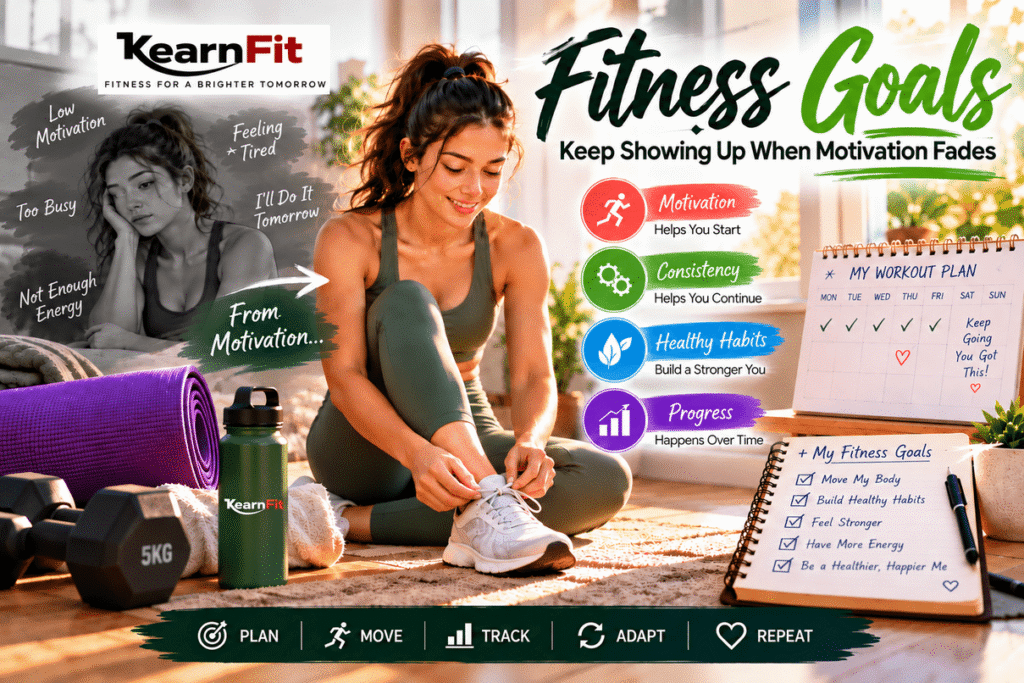
You start with excitement.
A new workout plan feels fresh. Your goals seem clear. You imagine yourself becoming stronger, fitter, healthier, and more confident.
For a few days or weeks, everything feels easy.
When your Fitness Goals are connected to realistic daily actions, it becomes easier to continue even when your initial excitement disappears.
Then real life happens.
Work becomes demanding. Sleep gets disrupted. Your schedule changes. A workout feels harder than usual. Progress slows down. The weather is unpleasant. You have a stressful day. You miss one session.
Then another.
Suddenly, the motivation that once felt powerful is difficult to find.
If this sounds familiar, you are not failing.
Motivation naturally changes.
The mistake is assuming that you need to feel motivated every time you exercise.
You do not.
The long-term answer is learning how to build fitness goals around systems and habits that can continue even when your enthusiasm is temporarily low.
Consistency does not mean feeling excited every day.
It means having a realistic way to continue moving forward when excitement disappears.
Current physical activity guidance emphasizes that adults can benefit from activity even when they cannot immediately reach recommended amounts. The CDC specifically notes that some physical activity is better than none.
That principle is important for motivation.
You do not always need a perfect workout.
Sometimes you simply need to keep the habit alive.
2. Why Consistency Matters More Than Motivation
Motivation can help you start.
Consistency helps you continue.
Think about learning a new language.
You might feel inspired to study for two hours on the first day. But studying for 15 minutes several times a week may be much easier to maintain.
Fitness works in a similar way.
A huge workout performed occasionally may be less practical for your lifestyle than manageable activity you can repeat regularly.
This does not mean intense training is bad.
It means your approach should match your goals, current fitness level, schedule, recovery capacity, and preferences.
The CDC recommends that adults aim for at least 150 minutes of moderate-intensity aerobic activity each week and muscle-strengthening activity on at least two days, while also emphasizing that activity can be spread throughout the week and that some activity is better than none.
You can therefore think about fitness in two layers.
The outcome:
Become stronger, improve endurance, support health, build confidence, or reach another personal goal.
The process:
Walk today. Train tomorrow. Rest when needed. Repeat.
The outcome may take months.
The process happens today.
When motivation fades, focus on the process.
Ask:
“What is the smallest useful action I can take today?”
That question can keep you moving when a big goal feels overwhelming.
3. The Difference Between Motivation, Discipline, and Habit
Motivation, discipline, and habits are related, but they are not the same thing.
Motivation is the desire or enthusiasm to take action.
It can be powerful, but it changes.
Discipline is your ability to follow through on an intended action even when you do not particularly feel like doing it.
Habit is a behavior that becomes more familiar and easier to initiate through repetition and consistent cues.
You need all three at different times.
Motivation can help you begin.
Discipline can help you follow your plan during difficult periods.
Habits can make repeated behaviors feel more automatic and less dependent on an emotional decision.
This is why successful fitness goals are rarely built entirely around motivation.
Imagine that your workout is scheduled for 7 a.m.
At 6:50, you feel energized.
Great.
You train.
The next morning, you feel tired.
You remember that your clothes are already prepared, your shoes are beside the door, and your workout is scheduled for 7 a.m.
You do not need to spend 20 minutes debating whether you should exercise.
Your routine has already made the decision easier.
That is the power of designing your environment and habits around your goals.
4. 10 Powerful Ways to Stay Consistent With Fitness Goals
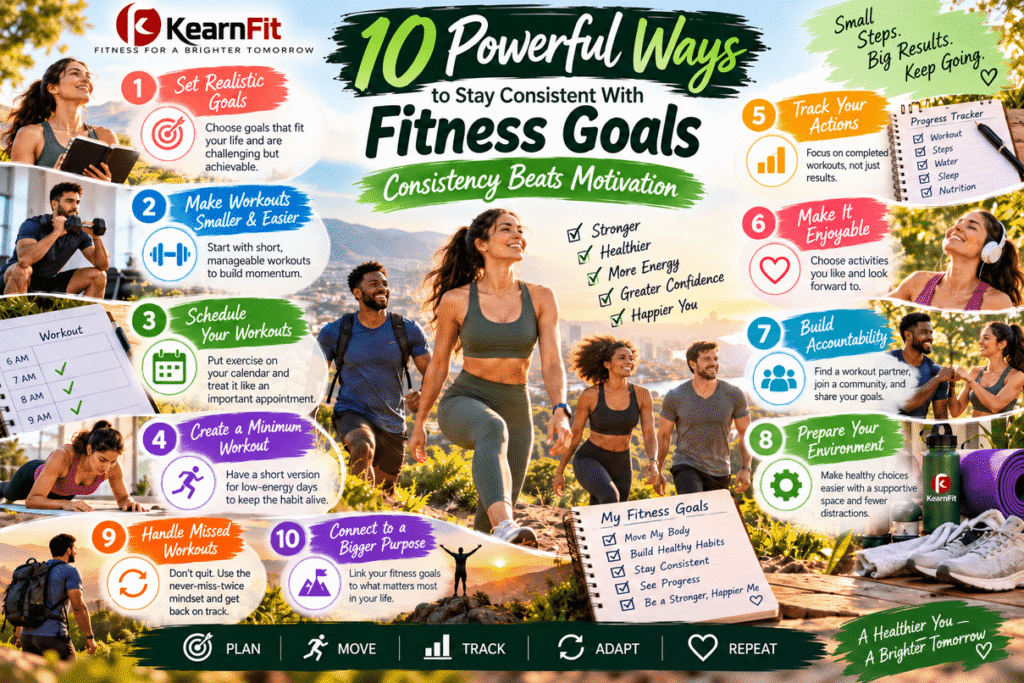
When motivation fades, these ten strategies can help you stay connected to your fitness goals:
1. Set goals you can realistically maintain.
2. Make your workouts easier to start.
3. Schedule exercise instead of waiting for motivation.
4. Create a minimum workout for difficult days.
5. Track your actions, not only visible results.
6. Choose forms of exercise you actually enjoy.
7. Build accountability through people and community.
8. Prepare your environment to make healthy choices easier.
9. Learn how to recover after missed workouts.
10. Connect your fitness goals to a deeper personal purpose.
None of these strategies requires you to feel motivated every day.
Instead, they reduce the amount of motivation you need.
That is an important distinction.
The goal is not to become a person who is always excited to exercise.
The goal is to become a person who has a reliable way to keep moving forward.
5. Strategy #1: Set Fitness Goals You Can Actually Maintain
One of the easiest ways to lose motivation is to create a goal that does not fit your current life.
You decide you will exercise seven days a week.
You promise yourself two-hour workouts.
You completely change your diet overnight.
You commit to waking up at 5 a.m.
You expect dramatic results within a few weeks.
It feels exciting at first.
Then reality arrives.
A better approach is to create fitness goals that are challenging enough to matter but realistic enough to maintain.
Instead of:
“I will work out every day.”
Try:
“I will complete three structured workouts this week and add movement on other days when practical.”
Instead of:
“I will never miss a workout.”
Try:
“I will return to my routine after an interruption.”
Instead of:
“I must lose a certain amount quickly.”
Try:
“I will consistently follow my movement and nutrition routine and review my progress over time.”
Good goals give you direction.
Good systems give you a way to get there.
You can also divide your goals into three levels.
Outcome goal:
What you ultimately want.
Performance goal:
What you want to improve.
Process goal:
What you will repeatedly do.
For example:
Outcome: Improve overall fitness.
Performance: Become more comfortable completing a 5K walk or run.
Process: Walk or train three times per week.
The process is where consistency happens.
6. Strategy #2: Make Your Workout Routine Smaller and Easier
When motivation fades, your brain may make exercise feel much bigger than it actually is.
You think about changing clothes.
Finding your shoes.
Driving to the gym.
Completing a long workout.
Showering.
Getting back to work.
The entire process can feel exhausting before you even begin.
So reduce the friction.
Make starting easier.
Put your workout clothes out the night before.
Keep your shoes visible.
Choose a gym close to home or work if possible.
Keep a simple home workout available.
Prepare a playlist you enjoy.
Have a backup routine for busy days.
Most importantly, create a short version of your workout.
A 60-minute plan might have a 20-minute version.
A 30-minute walk might have a 10-minute version.
A full strength session might have a short routine covering a few major movement patterns.
The goal is not to convince yourself that short workouts are always enough for every goal.
The goal is to create a flexible option that helps you continue being active when circumstances change.
CDC guidance reinforces that physical activity can be accumulated and that smaller amounts still provide health benefits.
A smaller workout can therefore serve as a bridge between “I cannot do everything” and “I will do nothing.”
That bridge is valuable.
A flexible workout structure can help protect your Fitness Goals when your schedule, energy, or available time changes unexpectedly.
7. Strategy #3: Schedule Exercise Instead of Waiting for Motivation
If exercise only happens when you have free time, it may happen less often than you want.
Free time tends to disappear.
Instead, schedule your workouts.
Look at your week.
Identify realistic windows.
Maybe Monday, Wednesday, and Saturday mornings work.
Maybe Tuesday and Thursday evenings are better.
Maybe you prefer walking during lunch.
The exact schedule matters less than creating a predictable pattern that fits your life.
Treat your workout appointment with the same respect you would give another important commitment.
You can also create implementation cues.
For example:
After my morning coffee → I walk for 15 minutes.
After work on Tuesday → I strength train.
Saturday morning → I take a longer outdoor walk.
These connections make behavior easier to remember.
You can also create “if-then” plans.
If I miss my morning workout, then I will walk for 20 minutes after work.
If the gym is too crowded, then I will use my home routine.
If I have only 15 minutes, then I will complete my short workout.
Planning for obstacles is not negative thinking.
It is preparation.
And preparation protects your fitness goals when life becomes unpredictable.
8. Strategy #4: Create a Minimum Workout for Difficult Days
Not every day will be a high-energy day.
Some days you will feel strong.
Some days you will feel average.
Some days you will want to do absolutely nothing.
That is why a minimum workout can be useful.
Your minimum workout is the smallest reasonable version of your planned activity.
For example:
5 minutes of mobility.
10 minutes of walking.
One short bodyweight circuit.
A few gentle stretches.
A brief cycling session.
The exact activity should fit your fitness level and circumstances.
The purpose is not to force yourself through serious fatigue, illness, pain, or an injury.
The purpose is to avoid the all-or-nothing mindset.
All-or-nothing thinking sounds like:
“If I cannot do my full workout, there is no point.”
A flexible mindset says:
“I cannot do the full workout today, but I can choose an appropriate amount of movement.”
That difference can protect consistency.
And sometimes, once you start, you discover that you have more energy than expected.
Other times, you complete your minimum and stop.
Both can be valid.
The habit is still alive.
9. Strategy #5: Track Your Actions, Not Just Your Results
Results are important.
But they can take time.
If you only measure success through body weight, appearance, muscle size, running speed, or another outcome, you may become discouraged before the underlying habits have had enough time to develop.
Instead, track actions.
Did you complete your planned workout?
Did you walk?
Did you strength train?
Did you sleep well enough to support recovery?
Did you take a rest day when appropriate?
Did you follow your planned routine?
You can create a simple weekly tracker:
| Habit | Goal | Completed |
|---|---|---|
| Walking/cardio | 3 sessions | |
| Strength training | 2 sessions | |
| Mobility | 3 sessions | |
| Sleep routine | 5 nights | |
| Recovery | 1 planned period | |
| Social activity | 1 session |
This shifts your attention toward behaviors you can control.
It also gives you evidence of progress when visible results are slow.
You may discover:
“I trained consistently for four weeks.”
“I walked more this month.”
“I am recovering better.”
“I no longer need to debate whether I will exercise.”
Those are meaningful wins.
Your fitness goals become easier to sustain when you can see the process working.
10. Strategy #6: Make Fitness More Enjoyable
If every workout feels like punishment, maintaining your routine becomes harder.
You do not need to love every workout.
But finding forms of movement you enjoy can make consistency more realistic.
Maybe you prefer:
Walking outdoors.
Cycling.
Swimming.
Dancing.
Strength training.
Yoga.
Hiking.
Sports.
Group classes.
Home workouts.
Recreational activities.
The best option is often the one you are willing to do consistently and that is appropriate for your goals and abilities.
You can also make your environment more enjoyable.
Listen to music.
Walk somewhere scenic.
Exercise with a friend.
Try a new class.
Change your route.
Use movement as an opportunity to explore your neighborhood.
Combine fitness with something else you enjoy.
For example:
Podcast + walk.
Friend + workout.
Nature + hike.
Music + cardio.
Family + weekend activity.
Fitness does not have to feel like a separate punishment inserted into your day.
It can become part of your lifestyle.
Choosing activities you genuinely enjoy can make your Fitness Goals feel like part of your lifestyle rather than another obligation on your to-do list.
11. Strategy #7: Build Accountability and Community
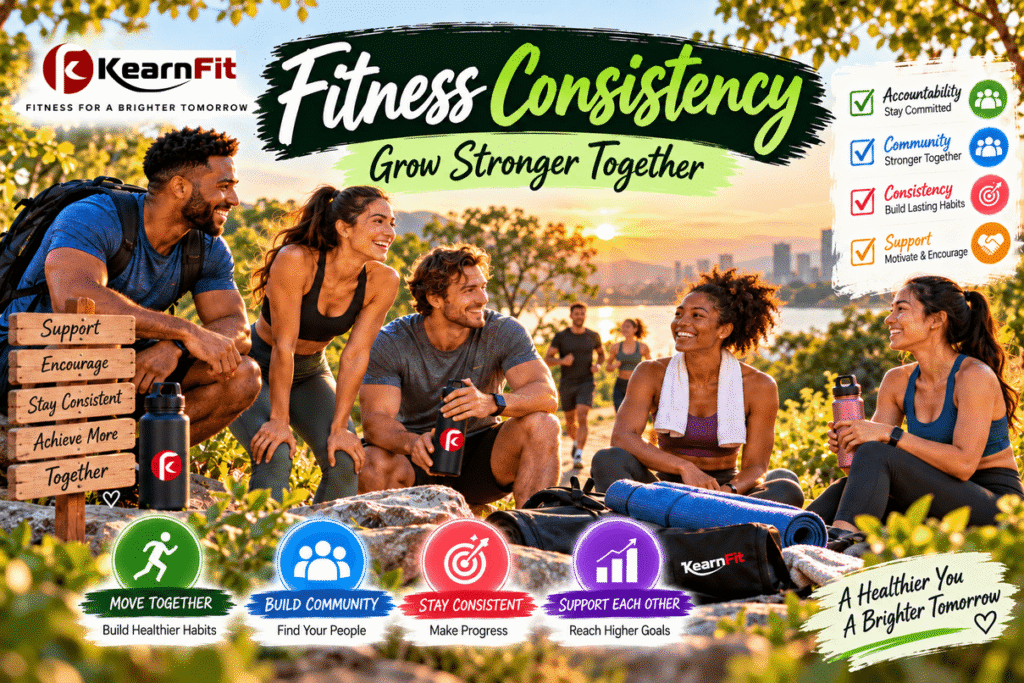
Accountability can be powerful because your goals no longer exist only inside your own head.
Tell a friend what you are working toward.
Schedule workouts together.
Join a group.
Take a class.
Find a walking partner.
Share weekly progress.
Participate in a fitness community.
You do not need someone monitoring you every day.
Sometimes simply knowing that another person expects to see you at a workout can make it easier to show up.
Community can also provide emotional support when progress feels slow.
You may discover that other people are experiencing the same challenges.
That can reduce the feeling that you are somehow uniquely bad at consistency.
A supportive community can provide:
Encouragement.
Accountability.
Ideas.
Perspective.
Celebration.
Shared experience.
This is one reason KearnFit views community as an important part of a broader wellness lifestyle.
Your fitness goals do not have to be a solo project.
When you surround yourself with people who value healthy habits and personal growth, consistency can become part of the culture around you.
12. Strategy #8: Prepare Your Environment for Success
Willpower is useful.
But your environment can either make healthy behaviors easier or harder.
Consider your home.
If your workout clothes are buried at the bottom of a drawer, your shoes are hidden, and your exercise equipment is difficult to access, starting takes more effort.
Change the environment.
Keep your shoes visible.
Place your mat where you can see it.
Prepare your gym bag.
Keep a water bottle nearby.
Save your workout plan.
Put your scheduled workouts on your calendar.
Make healthy choices convenient.
The same principle works with distractions.
If you routinely lose 45 minutes scrolling before a planned workout, create a boundary.
Put the phone away.
Use an app limit.
Start your workout before opening social media.
Create a transition ritual.
The objective is not to build a perfect environment.
It is to reduce unnecessary friction around the behaviors you want to repeat.
Your environment should quietly remind you:
“This is what I do.”
That identity can become more powerful than waiting to feel motivated.
13. Strategy #9: Learn How to Handle Missed Workouts
You will miss workouts.
That is normal.
A meeting runs late.
You travel.
You get sick.
Your child needs you.
You have an unexpected responsibility.
You simply need a break.
The problem is not missing one workout.
The problem is turning one missed workout into a month-long disappearance.
Use the never-miss-twice mindset as a simple reminder.
If you miss Monday, return Tuesday if appropriate.
If Tuesday does not work, return Wednesday.
Do not spend three days criticizing yourself.
Do not attempt to “punish” yourself with an extreme workout.
Do not dramatically cut food to compensate.
Simply return to your normal plan.
Consistency is not a perfect streak.
It is the ability to return.
This is a crucial shift.
Instead of saying:
“I broke my fitness routine.”
Say:
“My routine was interrupted. Now I am restarting.”
That language creates movement instead of shame.
14. Strategy #10: Connect Fitness Goals to a Bigger Purpose
A goal becomes more meaningful when it represents something beyond a number.
Maybe you want more energy to play with your children.
Maybe you want to feel stronger during everyday activities.
Maybe you want to improve your confidence.
Maybe you want to support your long-term health.
Maybe you want to participate in a sport.
Maybe you want to explore new places.
Maybe you want to become more disciplined in other areas of your life.
Maybe fitness is part of becoming the person you want to be.
Ask yourself:
Why does this goal matter to me?
Then ask:
What will consistency allow me to do?
This moves the focus away from temporary motivation and toward personal meaning.
Your fitness goals become connected to identity and lifestyle.
Instead of:
“I have to work out.”
You may begin thinking:
“I am someone who takes care of my body.”
Instead of:
“I need to lose motivation.”
You may think:
“I am building a lifestyle that supports the person I want to become.”
That shift can make consistency feel less like a daily battle.
15. How to Stay Consistent When Life Gets Busy
Life will not always respect your workout schedule.
There will be busy seasons.
Work deadlines.
Travel.
Family responsibilities.
Exams.
Events.
Unexpected problems.
Instead of building a routine that only works during calm periods, create a flexible system.
Use three levels:
Level 1 — Full routine
Your normal workout schedule.
Level 2 — Reduced routine
Shorter workouts during busy weeks.
Level 3 — Maintenance routine
Minimal movement designed to keep you connected to your habit.
For example:
Full: 45-minute strength workout.
Reduced: 20-minute strength session.
Maintenance: 10-minute mobility or walk.
The exact structure depends on your goals and abilities.
The principle is flexibility.
You do not have to abandon your identity as an active person simply because one week is chaotic.
Adjust the plan.
Protect the habit.
Return to your normal routine when life settles.
This approach can make your fitness goals more resilient.
16. How to Stay Consistent When Progress Feels Slow
Motivation often fades when progress becomes less visible.
At first, everything may improve quickly.
Then the changes become harder to notice.
Your body adapts.
Your performance may plateau temporarily.
Your routine starts feeling ordinary.
This is where patience becomes important.
Not every improvement is visible.
You may notice:
Better stamina.
Improved movement confidence.
More consistent sleep.
Better workout technique.
Greater strength.
Improved mood.
More energy.
Greater confidence.
Better stress management.
A stronger relationship with your routine.
These changes may matter even when the scale or mirror does not immediately change.
Track multiple indicators.
Keep a workout log.
Record repetitions or distance when relevant.
Take note of energy and recovery.
Review your consistency over several weeks rather than judging yourself after one session.
Also remember that fitness progress is not always linear.
If you have concerns about stalled progress, persistent fatigue, pain, or other symptoms, consider discussing them with an appropriate healthcare professional or qualified fitness professional.
Progress should be sustainable, not forced.
17. Fitness Goals for Beginners
If you are new to exercise, your first goal does not need to be impressive.
It needs to be repeatable.
Start with movement you can perform safely and comfortably.
Walking can be an excellent entry point for many people.
You can also explore basic strength exercises, mobility work, cycling, swimming, dancing, recreational sports, or other enjoyable activities.
Current CDC guidance encourages adults to add activity in ways that fit their lives and emphasizes that any amount of physical activity has some health benefits.
A beginner-friendly structure could be:
Monday: 20-minute walk.
Tuesday: Rest or gentle movement.
Wednesday: Short strength routine.
Thursday: Walk.
Friday: Rest.
Saturday: Enjoyable recreational activity.
Sunday: Recovery and planning.
As your capacity develops, you can gradually adjust.
Do not compare your first month to someone else’s fifth year.
Your starting point is yours.
The goal is to create confidence through repetition.
Every completed session tells your brain:
“I can do this again.”
18. Fitness Goals for Busy Professionals
Busy professionals often need efficiency more than complexity.
Your fitness plan should fit into the life you actually have.
Start by identifying the most reliable time slots.
Maybe early morning is predictable.
Maybe lunchtime is available.
Maybe evenings are better.
Maybe weekends offer longer sessions.
Then protect those windows.
You can also combine exercise with your existing routine.
Walk during appropriate meetings.
Take short movement breaks.
Use stairs when practical.
Walk after lunch.
Keep resistance bands or other appropriate equipment available if useful.
Choose workouts that minimize unnecessary travel.
A 30-minute session close to home may be more sustainable than a 60-minute session that requires a long commute.
Current CDC guidance notes that physical activity can be broken up across the week and that small amounts of activity can count toward a more active lifestyle.
The objective is not to build a fitness routine that looks impressive on paper.
It is to build one that survives your calendar.
19. How Sleep, Nutrition, and Recovery Affect Consistency
Fitness does not happen only during workouts.
Your body also needs recovery.
Sleep, nutrition, hydration, rest, and stress management all influence how you experience training and daily activity.
If you constantly push through exhaustion, your routine may become increasingly difficult to maintain.
That is why recovery should be part of your fitness goals, not something you think about only after problems appear.
Consider your entire week.
Where are your harder sessions?
Where are your easier days?
When do you sleep?
When do you eat?
When do you rest?
When do you spend time away from exercise?
The right balance depends on your goals, fitness level, health status, and training demands.
Recovery also means respecting warning signs.
Persistent pain, unusual fatigue, dizziness, breathing difficulty, or other concerning symptoms should not simply be ignored in the name of discipline.
A sustainable fitness routine should help you build capacity over time.
It should not require you to constantly fight your body.
20. 7 Common Fitness Consistency Mistakes to Avoid
Sometimes the fastest way to improve consistency is to stop making consistency unnecessarily difficult.
Mistake #1: Depending entirely on motivation.
Motivation changes. Build routines that can operate without it.
Mistake #2: Starting too aggressively.
Doing too much too soon can make your routine difficult to maintain.
Mistake #3: Choosing workouts you hate.
If you consistently dislike the activity, explore alternatives that still support your goals.
Mistake #4: Treating one missed workout as failure.
Missing a session is an event, not an identity.
Mistake #5: Only tracking appearance.
Track actions, performance, energy, confidence, and consistency too.
Mistake #6: Comparing your journey with someone else’s.
Different people have different schedules, abilities, resources, histories, and goals.
Mistake #7: Forgetting recovery.
Rest is part of a sustainable training routine.
Avoiding these mistakes can make your fitness goals feel more manageable.
21. A Simple Weekly Fitness Goals Plan
Here is an adaptable example for an adult who wants to build a balanced activity routine.
| Day | Main Focus | Example |
|---|---|---|
| Monday | Cardio | Brisk walk or another moderate activity |
| Tuesday | Strength | Full-body strength session |
| Wednesday | Light movement | Walking, mobility, or recreational activity |
| Thursday | Cardio | Brisk walk, cycling, swimming, etc. |
| Friday | Strength | Full-body strength session |
| Saturday | Enjoyable movement | Hike, sport, dance, or longer walk |
| Sunday | Recovery | Rest or gentle movement |
This is only an example.
Your actual schedule should reflect your current fitness level, health needs, preferences, and goals.
For general adult guidance, CDC recommends at least 150 minutes of moderate-intensity aerobic activity per week plus muscle-strengthening activity on at least two days.
You can divide those minutes in ways that fit your schedule.
For example, 30 minutes on five days is one option, but it is not the only option.
The key is to create a weekly pattern you can realistically maintain.
22. Your 30-Day Fitness Consistency Challenge
Ready to turn your fitness goals into action?
Try this 30-day consistency challenge.
Days 1–5: Define
Write down your main fitness goal.
Then answer:
Why does it matter?
What would consistency look like?
What is the minimum action you can take on difficult days?
Days 6–10: Schedule
Choose your workout days.
Put them on your calendar.
Prepare your clothes and equipment.
Days 11–15: Simplify
Create your short workout.
Make starting easy.
Remove one obstacle from your environment.
Days 16–20: Track
Record completed workouts and other movement.
Do not obsess over perfection.
Look for patterns.
Days 21–25: Connect
Exercise with a friend.
Join a group.
Share your progress.
Create accountability.
Days 26–30: Review
Ask:
What worked?
What did not?
When did motivation disappear?
What helped me continue?
What obstacles appeared repeatedly?
What will I change next month?
At the end of 30 days, do not ask only:
“Did I achieve my final result?”
Also ask:
“Did I become more consistent?”
That answer can tell you much more about the sustainability of your routine.
23. How to Rebuild Your Routine After Losing Motivation
Maybe you already stopped.
Maybe it has been weeks.
Maybe it has been months.
You do not need to wait for a perfect Monday.
Start again with something manageable.
Do not attempt to compensate for lost time with an extreme workout.
Do not punish yourself.
Do not create an unrealistic schedule to make up for the past.
Instead:
Restart small.
Walk for 10 minutes.
Complete a short workout.
Return to your previous schedule at a reduced level.
Prepare your clothes.
Put your workout on the calendar.
Tell someone you are starting again.
Then repeat.
You are not starting from zero.
You are starting with experience.
You now know which obstacles interrupted your routine.
That information is valuable.
Maybe mornings did not work.
Maybe your gym was too far away.
Maybe your workouts were too long.
Maybe you were trying to do too much.
Use that information to build a better system.
Consistency is not about never falling out of rhythm.
It is about becoming better at finding your rhythm again.
24. Signs You Need to Adjust Your Fitness Goals
Sometimes losing motivation is not a motivation problem.
It may be a plan problem.
Consider adjusting your approach if:
- Your routine consistently feels impossible to maintain.
- You are constantly exhausted.
- You are not recovering adequately.
- You have persistent pain.
- You dread every workout.
- Your schedule has significantly changed.
- Your goals no longer matter to you.
- Your current activity is inappropriate for your fitness level.
- You are constantly comparing yourself with others.
- Your plan leaves no room for normal life.
Adjustment is not failure.
It is feedback.
Maybe your goal needs to become smaller.
Maybe your schedule needs to change.
Maybe you need a different activity.
Maybe you need additional recovery.
Maybe you need guidance from a qualified professional.
If you have a medical condition, significant injury, disability, or other health concern, seek appropriate professional guidance about the type and amount of activity that is suitable for you. CDC guidance specifically recommends consulting a healthcare professional or physical activity specialist when appropriate for people with chronic conditions or disabilities.
The best fitness goals are goals that support your life rather than constantly fighting against it.
25. How KearnFit Can Help You Stay Consistent
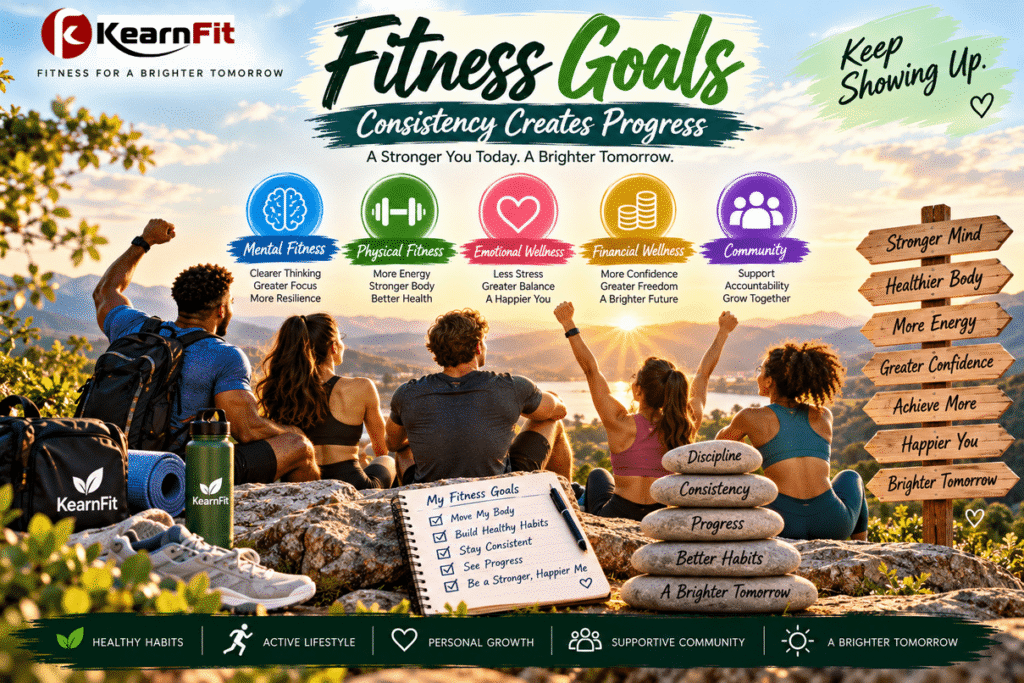
KearnFit takes a broader approach to fitness by connecting physical progress with mental, emotional, and financial wellbeing. Learn more about the four dimensions of fitness and how they work together to support a stronger lifestyle.
It is about building a lifestyle that supports your growth from multiple directions.
That means your fitness goals can connect with mental fitness, physical fitness, emotional wellness, financial wellness, and community.
Mental fitness can help you develop focus, resilience, and a healthier relationship with challenges.
Physical fitness helps you build movement, strength, endurance, mobility, and physical confidence.
Emotional wellness encourages self-awareness, healthier relationships, and constructive ways to respond to everyday experiences.
Financial wellness recognizes that a sustainable lifestyle also needs practical financial habits.
Community gives you connection, encouragement, accountability, and shared growth.
This broader approach matters because consistency becomes easier when your goals fit into your whole life.
You are not simply trying to complete another workout.
You are building habits that support the person you want to become.
KearnFit is designed around that bigger idea: fitness for a brighter tomorrow.
If you want to explore a more connected approach to fitness, wellness, community, and personal growth, visit www.kearnfit.com.
26. Conclusion: Keep Showing Up
Your motivation will fade sometimes.
That is normal.
You will have days when your workout feels exciting and days when putting on your shoes feels like the hardest part.
The goal is not to eliminate those days.
The goal is to build a system that can survive them.
Set realistic goals.
Create manageable routines.
Schedule your workouts.
Have a minimum version for difficult days.
Track your actions.
Choose activities you enjoy.
Build accountability.
Prepare your environment.
Learn how to recover after missed sessions.
Connect your fitness goals to something bigger than a temporary result.
Most importantly, stop expecting consistency to look perfect.
A missed workout does not erase your progress.
A difficult week does not define your fitness journey.
A temporary loss of motivation does not mean you have lost your ability to improve.
You can always return.
You can always take the next step.
You can always make the next healthy choice.
Physical activity guidelines remind us that some movement is better than none, and that activity can be built into life in different ways.
That is encouraging because it means fitness does not have to be an all-or-nothing pursuit.
You do not need to be perfect.
You need a sustainable way to keep showing up.
One walk.
One workout.
One healthy decision.
One recovery day.
One week.
Then another.
Over time, those individual choices become something bigger than motivation.
They become your lifestyle.
And that is where lasting fitness begins.
Keep moving. Keep growing. Keep showing up.
Build your fitness journey with KearnFit at www.kearnfit.com.