1. What Is a Morning Routine?

How you start your morning can influence the way you approach the rest of your day.
That does not mean you need to wake up at 5 a.m., drink an expensive wellness drink, meditate for an hour, complete a difficult workout, journal for 30 minutes, and read an entire book before breakfast.
That may work for someone.
It may not work for you.
A morning routine is simply a series of actions you regularly complete after waking up.
It can be five minutes.
It can be 15 minutes.
It can be an hour.
It can change depending on your schedule.
The important thing is not how complicated your routine looks.
The important thing is whether it helps you begin the day in a way that supports your wellbeing.
A healthy morning can create space for movement, hydration, reflection, planning, nourishment, connection, and personal growth.
It can also help you avoid starting the day in reaction mode.
Instead of immediately reaching for your phone, checking messages, rushing through breakfast, and running into work stressed, you can create a few intentional moments for yourself.
That is the real power of a morning routine.
It gives you an opportunity to choose how you want to enter the day.
2. Why Your Morning Matters
Your morning does not determine whether you will have a good or bad day.
Life is unpredictable.
Unexpected emails arrive.
Traffic happens.
Meetings run late.
Children need attention.
Work becomes stressful.
Plans change.
You cannot control everything that happens after you wake up.
But you can often control a few of your first decisions.
Those decisions can become anchors.
If you begin with movement, you have already given your body some attention.
If you drink water, you have started with a simple act of self-care.
If you take a few quiet minutes, you have created space for your mind.
If you review your priorities, you know what deserves your attention.
If you avoid immediately opening social media, you protect some of your attention before the outside world enters your day.
These actions are small.
But small actions repeated consistently can become powerful lifestyle patterns.
A morning routine is therefore less about creating a “perfect morning” and more about creating a reliable beginning.
Think of it as a foundation.
You are not trying to control the entire day.
You are simply creating a stronger starting point.
3. The Connection Between Your Morning, Mind & Body
Your mind and body are constantly connected.
Your physical state can influence how you feel.
Your emotional state can influence your behavior.
Your sleep can influence your energy.
Your environment can influence your attention.
Your daily routines can influence your choices.
That is why a morning routine should not focus exclusively on productivity.
If your morning consists of nothing but emails, deadlines, and rushing, you may technically be productive while neglecting other dimensions of wellbeing.
A more balanced routine can include:
Physical: movement, hydration, nutrition, sunlight, stretching.
Mental: reading, planning, meditation, journaling, quiet reflection.
Emotional: gratitude, self-awareness, breathing, checking in with yourself.
Financial: reviewing priorities, avoiding impulsive spending, checking important financial tasks when needed.
Social: a meaningful conversation, family time, or connection with someone you care about.
You do not need to include every category every morning.
The goal is balance over time.
Some mornings may be focused on exercise.
Other mornings may require more rest.
Some days may involve a quick breakfast and a busy commute.
Others may give you more space.
Your routine should support your real life.
4. What Makes a Morning Routine Healthy?A healthy morning routine does not need to look impressive.
It needs to be realistic.
Here are five qualities that make a routine more sustainable.
It Is Simple
If your routine contains 15 steps, you may eventually stop following it.
Start with a few habits.
It Is Flexible
Your weekday routine may differ from your weekend routine.
That is okay.
It Supports Your Priorities
If physical health matters to you, include movement.
If mental clarity matters, create quiet time.
If financial organization matters, include a short weekly money check-in.
It Is Enjoyable
A routine should contain at least a few things you genuinely like.
It Is Repeatable
The best routine is one you can follow consistently.
You do not need the most sophisticated routine.
You need the one that fits your lifestyle.
5. 10 Powerful Morning Habits to Try
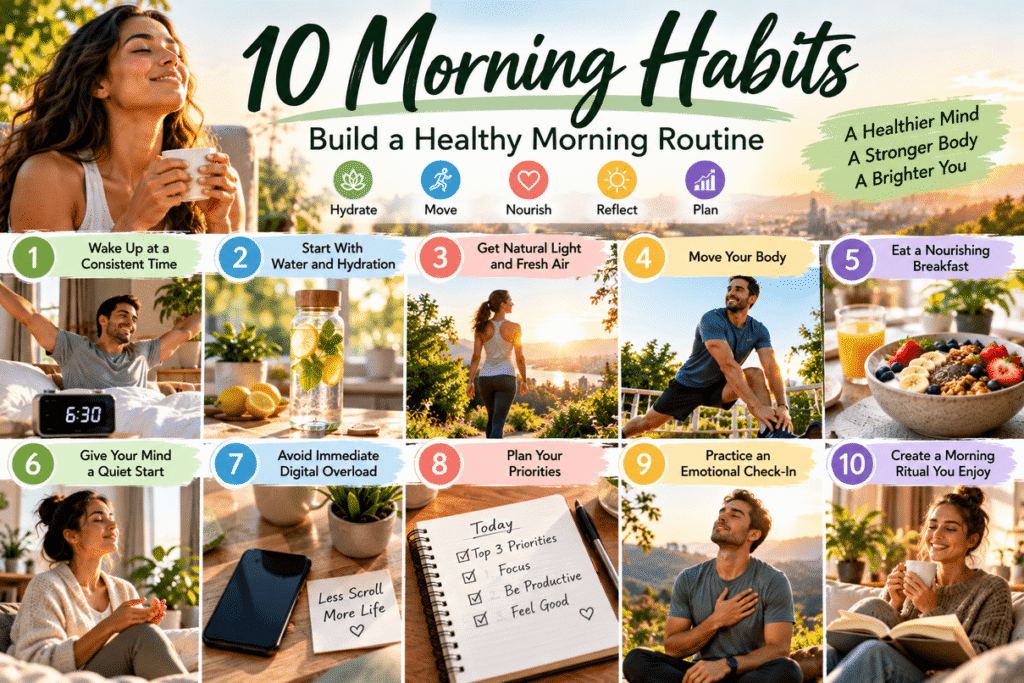
Here are 10 simple habits you can experiment with:
- Wake up at a consistent time.
- Start with water and hydration.
- Get natural light and fresh air.
- Move your body.
- Eat a nourishing breakfast when appropriate for you.
- Give your mind a quiet start.
- Avoid immediate digital overload.
- Plan your priorities.
- Practice an emotional check-in.
- Create a morning ritual you genuinely enjoy.
You do not have to introduce all 10 immediately.
Start with one or two.
Once those feel natural, add another.
Your goal is not to create the most impressive morning routine.
Your goal is to create a morning that helps you feel prepared to live your day intentionally.
6. Habit #1: Wake Up at a Consistent Time
Your wake-up time can become an important anchor for your daily schedule.
The CDC recommends consistent sleep and wake times as part of healthy sleep habits. Adults generally need at least seven hours of sleep, although sleep needs vary by age.
That means your morning routine actually begins the night before.
If you constantly stay up late and try to compensate by waking at different times each day, it can be harder to create a predictable rhythm.
Instead, consider establishing a realistic wake-up window.
For example:
6:30–7:00 a.m. — Wake up
You do not necessarily need to wake at exactly 6:30 every single day.
The key is creating a relatively consistent pattern that works with your schedule.
And remember:
Waking up early is not automatically healthier than waking up later.
If your work schedule starts at 9 a.m., waking at 5 a.m. may not be necessary.
If your work begins at 6 a.m., your schedule will naturally look different.
The goal is enough quality sleep and a consistent rhythm that supports your life.
7. Habit #2: Start With Water and Hydration
After waking, many people immediately think about coffee.
There is nothing inherently wrong with enjoying your morning coffee.
But consider making hydration part of your morning too.
Keep a water bottle beside your bed or in a place you naturally visit after waking.
Then create a simple cue:
Wake up → drink water.
You do not need to turn hydration into a complicated challenge.
You also do not need to force yourself to drink a huge amount of water immediately.
Your fluid needs vary depending on factors such as activity, environment, diet, and individual circumstances.
The goal is simply to build awareness.
A simple hydration routine might be:
Wake up → drink water → get ready → refill bottle → take it with you.
That creates a practical habit that can continue throughout the day.
If you exercise in the morning, especially in hot conditions, pay additional attention to your individual hydration needs.
The key principle is convenience.
If water is visible and accessible, you are more likely to remember it.
8. Habit #3: Get Natural Light and Fresh Air
Morning can be a great opportunity to step outside.
Open your curtains.
Stand on a balcony.
Walk around your neighborhood.
Sit outside with your morning drink.
Take a short walk before beginning work.
Natural light and outdoor time can become useful parts of a healthy morning environment.
You can combine this habit with movement.
For example:
Wake up → drink water → walk outside for 10 minutes.
Now one short activity gives you movement, fresh air, a change of environment, and quiet time before work begins.
You can also use this opportunity to avoid immediately entering a digital world.
Instead of checking your phone while sitting in bed, step outside first.
Give your senses something real to process.
Trees.
Sky.
Sunlight.
Fresh air.
People walking.
Birds.
Your surroundings.
Sometimes wellness begins with simply paying attention to where you are.
9. Habit #4: Move Your Body
Morning movement does not need to be an intense workout.
You can stretch.
Walk.
Do yoga.
Cycle.
Perform mobility exercises.
Practice bodyweight movements.
Go to the gym.
Take a short jog.
Choose the level that fits your fitness, abilities, and schedule.
Current CDC guidance recommends that adults work toward at least 150 minutes of moderate-intensity physical activity each week, plus muscle-strengthening activities on at least two days. Activity can be spread throughout the week and broken into smaller periods.
That means your morning routine does not have to accomplish the entire weekly goal.
A 10-minute morning walk is still movement.
A 15-minute mobility routine is still movement.
A short strength session is still part of an active lifestyle.
For example:
Monday: 20-minute walk
Tuesday: 15-minute strength session
Wednesday: 20-minute walk
Thursday: Mobility and stretching
Friday: 20-minute walk
Saturday: Longer workout
Sunday: Gentle movement or recovery
Your exact routine should depend on your abilities and goals.
If you have a chronic health condition, disability, or concerns about starting vigorous exercise, speak with an appropriate healthcare professional about suitable activity for you.
The goal is to move consistently, not to punish yourself.
10. Habit #5: Eat a Nourishing Breakfast
Breakfast is not a universal requirement, and different people have different eating patterns.
If you enjoy breakfast, make it an opportunity to build a nourishing meal.
Rather than focusing only on calories or trends, think about variety and nutritional quality.
WHO guidance emphasizes varied diets that include foods such as vegetables, fruits, legumes, nuts, and whole grains, with limits on excessive salt, free sugars, and unhealthy fats.
Simple breakfast ideas might include:
Oats + fruit + nuts
Eggs + vegetables + whole-grain toast
Yogurt + fruit + seeds
Vegetable poha + fruit
Idli + sambar + vegetables
Whole-grain toast + nut butter + fruit
Smoothie + oats or another suitable food
You do not need an Instagram-perfect breakfast.
You need something practical that works with your preferences and nutritional needs.
And if you do not usually eat breakfast, you do not need to force yourself simply because someone online says it is mandatory.
Pay attention to your own needs and circumstances.
11. Habit #6: Give Your Mind a Quiet Start
One of the most valuable morning habits may be creating a few minutes without noise.
No notifications.
No social media.
No news headlines.
No work messages.
Just a few minutes to think.
You can use this time to:
- Journal.
- Read.
- Meditate.
- Pray if that is part of your life.
- Practice breathing.
- Sit quietly.
- Think about your priorities.
- Enjoy your morning drink.
- Look outside.
- Reflect on what matters to you.
Five minutes is enough to begin.
You can ask yourself:
How am I feeling today?
What matters most today?
What can I control?
What can wait?
What kind of person do I want to be today?
These questions can shift your morning from automatic behavior to intentional action.
You are not trying to solve your entire life before breakfast.
You are simply giving your mind some space.
12. Habit #7: Avoid Immediate Digital Overload
Your phone can become the first thing you see in the morning.
You wake up.
Check WhatsApp.
Open Instagram.
Read email.
Check news.
Watch videos.
Scroll.
Respond.
Compare.
React.
And suddenly 30 minutes are gone.
The issue is not that technology is inherently bad.
Technology can be useful.
It can help you communicate, learn, work, organize, and connect.
The issue is automatic consumption.
Try creating a simple rule:
No non-essential scrolling during the first 20–30 minutes of the day.
You can still use your phone for necessary tasks such as an alarm, emergency communication, or essential scheduling.
But delay unnecessary digital consumption.
Instead, give your attention to yourself first.
Imagine the difference between these two mornings:
Morning A:
Wake → notifications → social media → emails → stress → rush.
Morning B:
Wake → water → light → movement → breakfast → priorities → technology.
The second morning gives you more opportunity to enter the day intentionally.
You are deciding where your attention goes.
13. Habit #8: Plan Your Priorities
A morning routine should not only help you feel good.
It can also help you become more intentional with your time.
Instead of creating a giant to-do list, choose three priorities.
For example:
Priority 1: Finish the client presentation.
Priority 2: Complete a 30-minute workout.
Priority 3: Call a family member.
Then identify what is essential and what is optional.
You can also use a simple question:
“If I accomplish only three meaningful things today, what should they be?”
This can reduce the feeling that everything is equally urgent.
You might also divide tasks into:
Must Do
Should Do
Could Do
This gives your day structure without making it rigid.
Planning does not mean controlling every minute.
It means knowing where you want your attention to go.
14. Habit #9: Practice an Emotional Check-In

Your emotions are information.
They can tell you that you are excited.
Tired.
Overwhelmed.
Anxious.
Calm.
Motivated.
Frustrated.
Disconnected.
Instead of immediately judging your emotions, take a moment to notice them.
Try asking:
What am I feeling?
What might be contributing to this feeling?
What do I need today?
Is there something I should address instead of ignoring it?
You can write one sentence in a journal.
For example:
“I feel slightly overwhelmed today because I have several deadlines, so I will focus on one task at a time.”
That simple observation can create distance between the feeling and your reaction.
You do not need to force yourself to feel positive.
A healthy emotional routine is not about pretending everything is wonderful.
It is about becoming more aware.
And awareness can help you make more intentional choices.
15. Habit #10: Create a Morning Ritual You Enjoy
Your morning routine should contain something you look forward to.
Maybe it is coffee.
Tea.
Music.
Reading.
A walk.
Cooking.
Journaling.
Gardening.
Stretching.
Talking with your family.
Sitting outside.
Listening to a podcast.
Preparing your favorite breakfast.
Your routine should not feel like punishment.
If every morning is a checklist of things you “should” do, eventually you may resist it.
Instead, build a ritual.
A ritual is more personal.
For example:
Wake → water → open curtains → favorite music → stretch → breakfast → plan day.
The music becomes part of the experience.
The breakfast becomes something you enjoy.
The movement becomes a moment for yourself.
The routine becomes an identity.
You are no longer simply completing tasks.
You are creating a morning that feels like yours.
16. How to Build a 15-Minute Morning Routine
You do not need an hour.
If your mornings are busy, start with 15 minutes.
Try:
Minute 0–2: Wake and drink water.
Minute 2–5: Open curtains and get some natural light.
Minute 5–10: Stretch or walk.
Minute 10–12: Take a few quiet breaths.
Minute 12–15: Choose your top three priorities.
That is it.
A 15-minute routine can provide a simple structure without requiring major changes to your schedule.
You can also modify it.
If movement is your priority:
2 minutes hydration + 10 minutes movement + 3 minutes planning.
If mental clarity is your priority:
2 minutes hydration + 5 minutes quiet reflection + 5 minutes planning + 3 minutes movement.
The best version is the one you will actually use.
17. How to Build a 30-Minute Morning Routine
With 30 minutes, you have more flexibility.
Try this:
0–5 minutes: Wake, hydrate, freshen up.
5–10 minutes: Natural light and light movement.
10–20 minutes: Workout, yoga, stretching, or walking.
20–25 minutes: Breakfast or morning drink.
25–30 minutes: Journaling and daily priorities.
This routine covers several dimensions of wellbeing without becoming excessive.
If you work from home, you could even use the final five minutes to prepare your workspace.
Clear your desk.
Close unnecessary tabs.
Write your first priority.
Put your phone away.
Then begin.
18. How to Build a 60-Minute Morning Routine
If you have an hour and enjoy longer mornings, you can create a more comprehensive routine.
For example:
0–5 minutes: Wake and hydrate.
5–15 minutes: Outdoor light and walking.
15–35 minutes: Exercise.
35–45 minutes: Shower and get ready.
45–55 minutes: Nourishing breakfast.
55–60 minutes: Journal and plan.
Or:
10 minutes meditation
20 minutes exercise
15 minutes breakfast
10 minutes planning
5 minutes preparation
The exact structure does not matter as much as the balance.
Do not fill an hour simply because you have an hour.
Use the time intentionally.
More habits do not automatically equal more wellness.
19. Morning Routine for Busy Professionals
For busy professionals, mornings can feel like a race against the clock.
Your alarm rings.
You check your phone.
You rush through getting ready.
You skip breakfast.
You commute.
You open your laptop.
And the day has already taken control of your attention.
A professional morning routine can be simpler.
Try creating a “minimum morning.”
Your minimum morning could include:
Water
2–5 minutes of movement
No unnecessary scrolling
Top three priorities
One intentional moment of calm
That might take only 10–15 minutes.
Then create a “full morning” for days when you have more time.
For example:
Minimum Morning: 15 minutes.
Standard Morning: 30 minutes.
Full Morning: 60 minutes.
This is a powerful way to make your routine flexible.
You are not failing when you have less time.
You simply switch to the shorter version.
20. Morning Routine for Better Mental Wellness
Your morning can become a daily opportunity to support your mental wellbeing.
Try starting with less stimulation.
Instead of immediately consuming information, create a quiet window.
You can journal:
Today I want to feel…
Today I need to focus on…
One thing I am grateful for is…
One thing I can control is…
One thing I will let go of is…
You can also use your morning to learn.
Read a few pages.
Listen to something educational while walking.
Practice a skill.
Reflect on a goal.
The point is to feed your mind something intentional before the outside world begins demanding your attention.
Mental wellness is not about thinking positively every minute.
It is about creating healthy spaces for reflection, learning, rest, and awareness.
21. Morning Routine for Physical Wellness
A physical wellness morning does not need to involve intense exercise.
Consider creating a simple movement menu.
Low-energy morning: stretching + short walk.
Normal-energy morning: brisk walk + mobility.
High-energy morning: strength training or cardio.
This allows you to adapt without abandoning your routine.
You can also prepare your environment the night before.
Put your shoes beside the door.
Lay out workout clothes.
Prepare your water bottle.
Keep your exercise equipment visible.
Make the healthy behavior easy to start.
Over time, your morning movement can become part of your weekly physical activity pattern.
Remember that current adult activity recommendations are weekly targets, not requirements that must all happen before breakfast. Adults are generally advised to get at least 150 minutes of moderate activity and muscle-strengthening activity on at least two days each week.
Your morning routine is simply one place where movement can fit.
22. Morning Routine for Emotional Wellness
Emotional wellness deserves a place in your morning too.
One simple practice is an emotional temperature check.
Rate your current state from 1 to 10.
Then ask:
What is influencing my number?
You may discover that you are tired because you slept poorly.
Or excited because something meaningful is happening.
Or anxious because you have a difficult conversation later.
Or calm because you had a peaceful evening.
Awareness gives you an opportunity to respond intentionally.
You might decide to:
- Slow down.
- Ask for support.
- Change your schedule.
- Prepare for a difficult conversation.
- Take a short walk.
- Practice breathing.
- Give yourself more recovery time.
Your emotions do not need to be fixed immediately.
Sometimes they simply need to be noticed.
23. Morning Routine for Financial Wellness
Financial wellness may not be something you think about when you wake up.
And you probably do not need to check your investments or bank balance every morning.
But you can use your morning routine to reinforce healthy financial behavior.
For example, once or twice a week, spend a few minutes reviewing your financial priorities.
Ask:
What financial task needs my attention?
What upcoming expense should I prepare for?
Am I spending intentionally?
What am I saving toward?
You can also build financial habits into your weekly planning.
For example:
Monday: Review upcoming expenses.
Friday: Check weekly spending.
Sunday: Plan the next week’s financial priorities.
Financial wellness does not need to dominate your mornings.
It simply needs a place in your overall lifestyle.
A complete approach to wellbeing recognizes that health includes more than your physical body.
24. Morning Routine and Personal Growth
Your morning can also become a space for becoming the person you want to become.
Think about your bigger goals.
Maybe you want to:
- Build a business.
- Become healthier.
- Learn a language.
- Improve your career.
- Read more.
- Develop better relationships.
- Become financially organized.
- Become more confident.
- Learn a new skill.
You do not need to work on every goal every morning.
Choose one.
Spend 10 minutes learning.
Read two pages.
Write one paragraph.
Practice a skill.
Review your goals.
Make one small improvement.
Personal growth compounds through repeated effort.
Your morning routine can become a reminder that your goals deserve attention.
Even when life gets busy.
25. 7 Common Morning Routine Mistakes to Avoid
A morning routine can be helpful, but it can also become unnecessarily complicated.
Here are seven mistakes to avoid.
Mistake #1: Waking Up Extremely Early Just Because It Looks Productive
Your routine should support adequate sleep.
Early does not automatically mean better.
Mistake #2: Copying Someone Else’s Routine
A CEO, athlete, influencer, or fitness creator may have a completely different lifestyle.
Build your own routine.
Mistake #3: Trying to Do Everything
Ten habits are ideas, not requirements.
Start with two or three.
Mistake #4: Checking Your Phone Immediately
Give yourself some attention before giving it to everyone else.
Mistake #5: Making Exercise Punishing
Movement should support your wellbeing.
You do not need to destroy yourself every morning.
Mistake #6: Ignoring Sleep to Create a Longer Morning
Do not sacrifice adequate sleep simply to fit more activities into your routine.
Mistake #7: Giving Up After One Bad Morning
You will oversleep.
You will get sick.
You will travel.
You will have emergencies.
You will have chaotic mornings.
That is life.
One disrupted morning does not erase your progress.
Simply return to your routine when you can.
26. How to Make Your Morning Routine Sustainable
The secret to a lasting morning routine is not motivation.
It is design.
Make the desired behavior easier.
Prepare the Night Before
Put out your clothes.
Prepare breakfast ingredients.
Fill your water bottle.
Write tomorrow’s top priorities.
Charge your devices outside the bedroom if practical.
Use Habit Stacking
Connect a new habit to an existing one.
After I brush my teeth → I stretch.
After I drink water → I open the curtains.
After breakfast → I write my priorities.
Reduce Friction
If you want to walk, keep your shoes ready.
If you want to journal, keep the notebook visible.
If you want to exercise, prepare your equipment.
Keep a Minimum Version
Your normal routine might take 30 minutes.
Your minimum routine might take five.
On difficult days, do the minimum.
This prevents the all-or-nothing mindset.
Make It Enjoyable
Add music.
Make your favorite drink.
Go outside.
Read.
Enjoy the quiet.
A routine becomes easier to maintain when it contains something you genuinely value.
27. Your 30-Day Morning Routine Challenge
Ready to create your own routine?
Try this 30-day challenge.
Days 1–3: Observe
Do not change anything yet.
Write down what you currently do after waking.
Notice what helps and what creates stress.
Days 4–7: Choose Your Wake-Up Anchor
Choose a realistic wake-up time or wake-up window.
Protect your sleep.
Days 8–10: Add Hydration
Keep water somewhere visible.
Create a simple morning hydration cue.
Days 11–13: Add Light and Movement
Spend a few minutes outside and move your body.
Days 14–16: Create Quiet Time
Spend five minutes without unnecessary digital stimulation.
Journal, breathe, read, or simply sit quietly.
Days 17–19: Improve Breakfast
If breakfast fits your eating pattern, make it more balanced and nourishing.
Days 20–22: Add Planning
Choose your top three priorities.
Days 23–25: Add Emotional Awareness
Ask yourself how you feel and what you need.
Days 26–28: Add Personal Growth
Read, learn, practice, or work toward one meaningful goal.
Days 29–30: Review
Ask:
What worked?
What felt forced?
What did I enjoy?
What gave me energy?
What should I remove?
What should I continue?
Then build your permanent routine from what actually worked.
28. How KearnFit Can Help You Build a Stronger Lifestyle

At KearnFit, we believe your morning is more than a productivity opportunity.
It is a chance to support your whole lifestyle.
A strong morning can touch multiple dimensions of fitness.
Mental fitness can begin with reflection, learning, planning, and mindful attention.
Physical fitness can begin with movement, hydration, nutrition, and preparation for an active day.
Emotional fitness can begin with self-awareness, gratitude, breathing, and emotional check-ins.
Financial fitness can be supported through intentional planning and better money habits.
And community wellness can begin with meaningful conversations, shared routines, accountability, and connection.
The goal is not to create a morning that looks impressive on social media.
The goal is to create a morning that helps you become stronger in real life.
At KearnFit, we encourage a holistic approach where personal growth is not limited to one area.
You can work on your mind.
Your body.
Your emotions.
Your financial habits.
Your relationships.
Your confidence.
Your goals.
And you do not have to do it alone.
A supportive community can make the journey more engaging, accountable, and sustainable.
Start with one habit.
Build another.
Learn what works for you.
Adjust when life changes.
And keep moving forward.
Explore more KearnFit wellness resources and connect with the community at www.kearnfit.com.
29. Conclusion: Start Your Day With Intention
You do not need a perfect morning to build a healthier life.
You need an intentional one.
A glass of water.
A few minutes of movement.
Natural light.
A nourishing meal.
A quiet moment.
A short journal entry.
Three priorities.
A conversation.
A few minutes of learning.
These simple actions can become meaningful anchors in your day.
The best morning routine is not necessarily the longest.
It is the one that supports your real life.
If you only have 10 minutes, use 10 minutes.
If you have 30 minutes, use 30.
If you have an hour, use it intentionally.
And if you wake up late tomorrow, do not throw away the entire routine.
Do the minimum.
Drink water.
Take a few breaths.
Move for two minutes.
Choose one priority.
Start.
Consistency is more valuable than perfection.
Your morning is not about becoming a completely different person before breakfast.
It is about giving yourself a few intentional moments to choose how you want to show up.
Choose movement.
Choose awareness.
Choose nourishment.
Choose connection.
Choose growth.
And when the day becomes unpredictable, remember that you can return to your habits again tomorrow.
That is what makes a wellness routine sustainable.
You do not need to transform your life overnight.
You simply need to begin.
Start your morning with intention. Build your day with purpose. Grow stronger with KearnFit.
Visit www.kearnfit.com to explore a holistic approach to mental, physical, emotional, and financial fitness.