1. What Are Healthy Habits?

Healthy habits are repeated behaviors that support your overall wellbeing and become increasingly familiar through practice.
The good news is that healthy habits do not require a complete lifestyle transformation overnight.
Building healthy habits is less about making dramatic changes and more about creating small actions you can realistically repeat.
They can be simple.
Drinking water regularly.
Walking after dinner.
Preparing nutritious meals.
Going to bed at a consistent time.
Writing down your priorities.
Reviewing your finances.
Calling someone you care about.
Taking a few minutes to reflect.
The interesting part is that these behaviors do not need to feel dramatic to be meaningful.
In fact, sustainable lifestyle improvement often begins with actions that are small enough to repeat.
This is where the science of habit formation becomes useful.
A habit is more than something you do frequently. In behavioral science, habits are generally understood as behaviors that become associated with particular contextual cues through repetition. Eventually, the cue can help trigger the behavior with less conscious deliberation.
Think about brushing your teeth.
You probably do not wake up every morning and debate whether you should brush your teeth.
Your routine, environment, time of day, and existing sequence of actions help trigger the behavior.
That is the power of a developed habit.
Now imagine applying the same principle to wellness.
Instead of depending entirely on motivation to exercise, you connect a short walk to an existing part of your day.
Instead of remembering to drink water randomly, you keep a bottle in a visible place.
Instead of hoping you will eat better when you are busy, you prepare nutritious options in advance.
Instead of waiting for inspiration to manage your money, you create a weekly financial check-in.
The objective is to make healthy behavior easier to repeat.
That is the real opportunity behind healthy habits.
2. Why Small Changes Can Create Big Results
Big goals are exciting.
You decide that you will completely transform your lifestyle.
You will exercise every day.
When small actions become consistent, healthy habits can gradually become a natural part of everyday life.
Eat perfectly.
Wake up at 5 a.m.
Read for an hour.
Meditate.
Save a large percentage of your income.
Learn a new skill.
Sleep perfectly.
And never miss a day.
For a few days, motivation may be high.
Then real life happens.
You have a busy workday.
You sleep badly.
You travel.
You have a family responsibility.
You feel tired.
Your schedule changes.
Suddenly, the perfect plan becomes difficult to maintain.
This is one reason small changes can be powerful.
A small change asks less from you at the beginning.
Instead of “I will exercise for an hour every day,” start with “I will walk for 10 minutes after lunch.”
Instead of “I will completely change my diet,” start with “I will add one serving of vegetables to one meal.”
Instead of “I will stop using my phone at night,” start with “I will keep my phone away for the last 30 minutes before bed.”
The small behavior gives you an opportunity to practice.
Practice creates repetition.
Repetition strengthens the association between the behavior and its context.
Over time, the action can become more familiar and easier to initiate.
Research on habit formation supports the importance of repetition within consistent contexts, although habit development varies considerably between people and behaviors.
Small does not mean insignificant.
Small means repeatable.
And repeatability is one of the foundations of habit formation.
3. The Science Behind Habit Formation
The science of habits is fascinating because it explains why motivation alone is not always enough.
Imagine that you decide to start exercising.
On Monday, you feel motivated.
On Tuesday, you feel motivated.
On Wednesday, work becomes stressful.
By Thursday, you are tired.
By Friday, you have forgotten about your original goal.
If the behavior depends entirely on motivation, it can disappear when motivation changes.
Habits provide another mechanism.
Repeated behavior in a stable context can strengthen the relationship between the context and the action. Over time, the context can become a cue for the behavior.
For example:
After breakfast → take a short walk.
After brushing your teeth → prepare for the next day.
After lunch → drink water and move for five minutes.
After work → review tomorrow’s priorities.
Before bed → put your phone away.
These sequences reduce the amount of decision-making required.
You are not asking yourself throughout the day, “When should I do this?”
The existing routine provides the cue.
This is one reason habit-building strategies often focus on context.
The National Institute on Aging’s expert discussion of habit formation highlights the importance of repeated behavior, context, reinforcement, motivation, and memory in developing lasting habits.
The science does not suggest that every habit becomes automatic simply because you repeat it a few times.
It is more complicated than that.
The behavior, context, individual, environment, and consistency all matter.
But the core principle is useful:
Repeated behavior in a stable context can become easier and more automatic over time.
4. How the Habit Loop Works
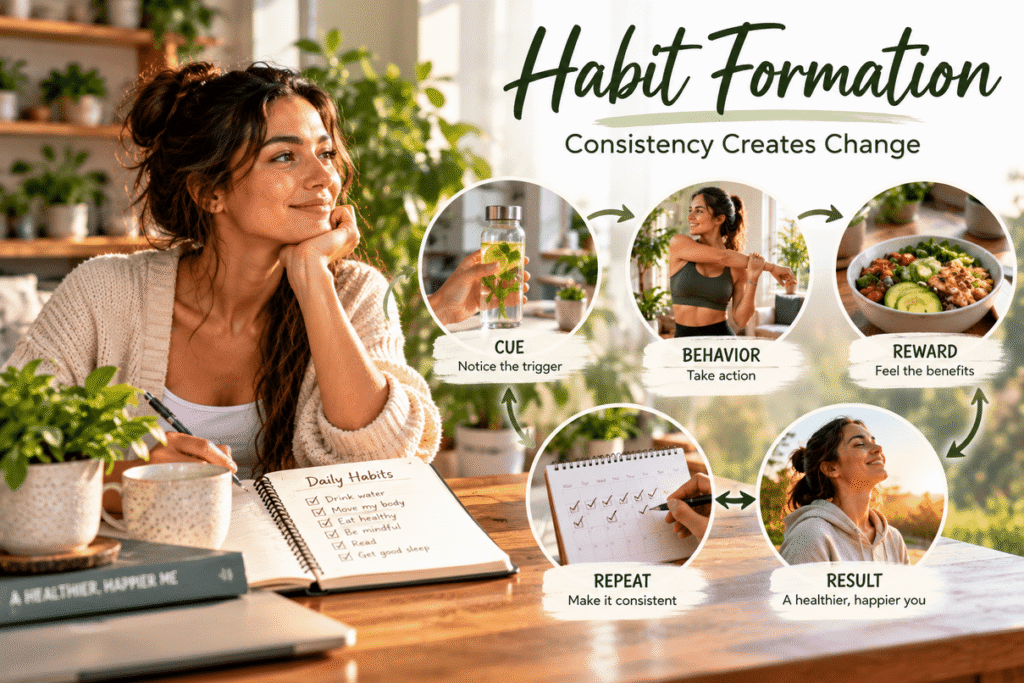
A useful way to understand habits is through a simple sequence:
Cue → Behavior → Result
The cue is what prompts the behavior.
The behavior is the action you take.
The result is what happens afterward.
Consider a healthy example.
Cue: Finish lunch.
Behavior: Walk for 10 minutes.
Result: You get movement, a change of environment, and a mental break.
Repeat this sequence regularly and the post-lunch period can become associated with walking.
Now consider an unhealthy pattern.
Cue: Feel stressed.
Behavior: Automatically open social media.
Result: Temporary distraction.
If the same sequence repeats frequently, the cue may become strongly associated with the behavior.
The goal is not to eliminate every existing habit overnight.
It is to understand your patterns.
Ask yourself:
What happens immediately before this behavior?
What do I usually do next?
What result am I getting?
Can I change the behavior while keeping some of the useful result?
For example, if you scroll because you need a mental break, perhaps the replacement behavior is a short walk, breathing exercise, conversation, or cup of tea.
The key is not simply removing a behavior.
It is designing a better response to the cue.
5. 9 Powerful Strategies for Building Healthy Habits
If you want to turn healthy intentions into lasting routines, these nine strategies can help:
1. Start smaller than you think.
2. Connect new habits to existing routines.
3. Design your environment for success.
4. Make healthy habits easier to repeat.
5. Focus on consistency instead of perfection.
6. Track progress without becoming obsessed.
7. Build rewards into the process.
8. Recover quickly from setbacks.
9. Connect habits to the person and lifestyle you want to become.
The goal is not to use every strategy at once.
Choose one behavior.
Make it specific.
Give it a cue.
Reduce friction.
Repeat.
Then learn from what happens.
6. Strategy #1: Start Smaller Than You Think
One of the biggest mistakes people make when creating healthy habits is starting with a behavior that is too large.
If you have not exercised in months, committing to seven intense workouts every week may be unrealistic.
If you rarely cook, deciding to prepare every meal from scratch may create unnecessary pressure.
If you rarely read, setting a goal of 50 pages every night may not survive a busy schedule.
Instead, reduce the behavior.
Make it almost too easy to ignore.
Walk for five or ten minutes.
Read two pages.
Prepare one healthy breakfast.
Write one sentence in a journal.
Put your workout clothes out the night before.
Transfer a small amount into savings.
Spend five minutes planning tomorrow.
The initial objective is not maximum results.
It is successful repetition.
Once the behavior becomes established, you can increase it.
This is particularly useful when starting physical activity.
CDC guidance emphasizes that some physical activity is better than none and that adults can break activity into smaller periods across the week.
You can gradually build toward broader activity recommendations as your fitness, health, and circumstances allow.
Starting small creates an entry point.
The entry point creates repetition.
Repetition creates experience.
Experience can create confidence.
And confidence can make the next step easier.
7. Strategy #2: Connect New Habits to Existing Routines
You already have routines.
You wake up.
You brush your teeth.
You eat.
You commute.
You start work.
You take breaks.
You have lunch.
You finish work.
You prepare for bed.
These existing events can become cues for new habits.
This strategy is sometimes described as habit stacking.
The idea is straightforward:
After I do X, I will do Y.
After I make my morning coffee, I will drink a glass of water.
After lunch, I will walk for 10 minutes.
After closing my laptop, I will write down tomorrow’s top three priorities.
After brushing my teeth, I will prepare my bedroom for sleep.
After receiving my monthly salary, I will review my budget.
The important part is specificity.
“Exercise more” is vague.
“After lunch, I will walk for 10 minutes” is specific.
“Eat healthier” is vague.
“Add vegetables to dinner” is specific.
“Save more money” is vague.
“Transfer a planned amount on payday” is specific.
Research on habit formation indicates that repeating a behavior in a consistent context can strengthen the cue-behavior association.
Your existing routine can provide that context.
8. Strategy #3: Design Your Environment for Success
Your environment can make habits easier or harder.
If you want to eat more nutritious foods but your kitchen is filled with convenient snack foods, your environment may work against your goal.
If you want to exercise in the morning but your workout clothes are buried at the bottom of a drawer, you have added friction.
If you want to read before bed but your phone is beside your pillow, the phone may win.
You can change the environment.
Put fruit somewhere visible.
Prepare healthy ingredients in advance.
Keep workout shoes near the door.
Place a book on your bedside table.
Charge your phone away from the bed.
Keep a water bottle on your desk.
Automate savings where appropriate.
Put reminders where you will actually see them.
Your surroundings can make healthy habits easier by keeping useful choices visible, accessible, and convenient.
The idea is simple:
Make the healthy choice easier to notice and easier to perform.
Behavioral research suggests that contextual cues can support habit formation and that modifying environments can help make desired behaviors more accessible.
You can also make unwanted habits harder.
Remove distracting apps from your home screen.
Do not keep tempting foods constantly visible if you are trying to change your eating pattern.
Keep unnecessary spending apps away from your primary screen.
Turn off irrelevant notifications.
Environment is not everything.
But it can reduce the amount of willpower required.
9. Strategy #4: Make Healthy Habits Easier to Repeat
A habit becomes difficult when every repetition requires a new decision.
Imagine wanting to go for a morning walk.
Every morning you must decide:
Where will I walk?
What should I wear?
Where are my shoes?
When will I go?
What route should I take?
Should I go today?
That is a lot of friction.
Simplify.
Choose the route in advance.
Keep shoes ready.
Set a consistent time.
Prepare clothing the night before.
Make the first step obvious.
The same applies to nutrition.
Create a small collection of easy meals.
Keep ingredients available.
Prepare portions when convenient.
Have healthy options for busy days.
For financial habits, automate what can reasonably be automated and schedule regular reviews.
For mental wellness, keep your journal visible.
For reading, keep a book accessible.
For sleep, establish a predictable wind-down sequence.
The more complicated a habit becomes, the more opportunities there are to skip it.
Simplification creates consistency.
10. Strategy #5: Focus on Consistency Instead of Perfection
One missed day does not destroy a habit.
One unhealthy meal does not erase months of healthy eating.
One missed workout does not mean you have failed.
One week of financial overspending does not mean you should abandon your financial goals.
Healthy habits become sustainable when you learn how to return after disruption.
Perfection creates an all-or-nothing mindset.
Consistency creates flexibility.
Think in terms of patterns rather than individual events.
If you walk five days this week and miss two days, you still created meaningful movement.
If you eat nourishing meals most of the week and enjoy a celebration meal, that can still fit into an overall healthy eating pattern.
If you miss your evening routine once, return the next evening.
The goal is not an unbroken streak.
The goal is a lifestyle you can repeatedly return to.
This mindset is especially important because real life is unpredictable.
Travel happens.
Work gets busy.
People get sick.
Plans change.
Energy changes.
Your habits need enough flexibility to survive reality.
The more consistently you practice healthy habits, the easier it can become to maintain routines that support your long-term goals.
11. Strategy #6: Track Progress Without Becoming Obsessed
Tracking can make progress visible.
A simple calendar can show whether you completed your habit.
A journal can show how you felt.
A financial tracker can show spending patterns.
A walking app can show activity.
A sleep diary can show bedtime patterns.
Tracking can also create accountability.
But tracking should serve you.
It should not become another source of stress.
Choose one simple measurement.
For example:
Did I complete the habit? Yes or no.
That may be enough.
You can also track weekly rather than daily.
Ask:
How many times did I exercise?
How often did I eat meals at home?
How many evenings did I protect my bedtime?
How often did I review my spending?
How many times did I connect with someone?
The purpose of tracking is learning.
If your numbers are lower than expected, do not criticize yourself.
Ask why.
Was the habit too large?
Was the cue unclear?
Was the timing inconvenient?
Was the environment working against you?
Then adjust.
Tracking becomes useful when it leads to better decisions.
12. Strategy #7: Build Rewards Into the Process
Rewards can reinforce behavior.
But the reward does not need to be expensive.
The experience itself can become rewarding.
A morning walk can give you time outdoors.
A workout can create a sense of accomplishment.
Cooking can become creative.
Reading can become relaxing.
Saving money can create a sense of progress.
A digital-free evening can create calm.
Connecting with friends can create enjoyment.
You can also create simple external rewards.
After completing your weekly wellness goals, enjoy a relaxing activity.
After reaching a savings milestone, plan a meaningful experience within your budget.
After maintaining a workout routine, buy something useful for your activity if it fits your finances.
The important principle is to associate the behavior with something positive.
Behavioral research has highlighted reinforcement and reward as factors involved in how habits develop and persist.
Do not make the reward undermine the habit.
If your goal is financial wellness, do not turn every savings milestone into an expensive purchase.
If your goal is healthy eating, do not create a mindset where nutritious food is punishment and indulgent food is the only reward.
Find rewards that reinforce the lifestyle you want.
13. Strategy #8: Recover Quickly From Setbacks
Setbacks are part of behavior change.
The difference between people who maintain habits and people who abandon them is often what happens after the setback.
Imagine you planned to exercise three times this week.
You completed Monday.
Tuesday became busy.
Wednesday was exhausting.
Thursday you skipped.
You might think:
“I have already ruined the week.”
That thought can turn one missed session into seven.
Instead, ask:
What can I do next?
Maybe you take a walk Friday.
Maybe you train Saturday.
Maybe you simply return to your normal routine Monday.
The same principle works for food, sleep, finances, digital wellness, and personal development.
A setback is information.
It can tell you:
The habit is too ambitious.
The timing is wrong.
The environment is difficult.
The cue is unreliable.
The behavior is not enjoyable.
The goal needs adjustment.
Use the information.
Do not turn it into an identity.
You are not “a person who cannot stick to habits” because one week went badly.
You are a person learning how to build routines that work in real life.
14. Strategy #9: Identity and Long-Term Lifestyle Change
Goals are useful.
But identity can make habits more meaningful.
Instead of only saying:
“I want to exercise.”
Think:
“I am becoming someone who takes care of my physical health.”
Instead of:
“I want to save money.”
Think:
“I am becoming more intentional with my money.”
Instead of:
“I need to meditate.”
Think:
“I am someone who makes space for mental clarity.”
The difference is subtle.
A goal describes an outcome.
Identity describes the person you are practicing becoming.
Your habits provide evidence.
Every walk is evidence that you value movement.
Every healthy meal is evidence that you care about nourishment.
Every financial review is evidence that you are becoming more financially aware.
Every meaningful conversation is evidence that relationships matter to you.
This does not mean you should create unrealistic identities.
It means you can use your actions to reinforce the direction you want your life to take.
Over time, your habits become part of your lifestyle.
15. How Long Does It Take to Build a Habit?
One of the most common questions about habits is:
“How many days does it take to make a habit?”
You may have heard the popular claim that it takes 21 days.
Habit science is more complicated.
Research by Phillippa Lally and colleagues followed people practicing a daily behavior in a consistent context. In that study, the time required for behavior automaticity to approach a person’s eventual level varied widely—from 18 to 254 days among participants whose data fit the researchers’ model. The study therefore does not support a universal number of days that applies to everyone.
This is important because it changes how you think about habit formation.
Do not give yourself an arbitrary deadline.
Instead, focus on repetition.
If a behavior does not feel automatic after 21 days, that does not mean you have failed.
If it becomes easier after several weeks, continue.
If it still feels difficult, examine the design.
Is the behavior too large?
Is the cue inconsistent?
Is the environment making it difficult?
Would another time of day work better?
Could you make the action smaller?
Habit formation is not a race.
It is a learning process.
16. Healthy Habits for Mental Wellness
Mental wellness can be supported by small repeated practices.
You might create a habit of writing down your priorities each morning.
You might spend a few minutes journaling at night.
You might read regularly.
You might schedule periods of focused work without unnecessary notifications.
You might spend time outdoors.
You might practice mindfulness.
You might create regular breaks from digital stimulation.
The important part is not choosing the “perfect” mental wellness habit.
It is finding something realistic that helps you create space for awareness, focus, reflection, learning, or rest.
For example:
After breakfast → write your three priorities.
After work → take a 10-minute walk before checking social media.
Before bed → write down one thing you learned.
Small practices can create structure.
And structure can make wellness easier to maintain.
If you experience persistent emotional distress, significant anxiety or depression, or difficulty functioning in daily life, healthy habits should complement rather than replace appropriate professional care.
17. Healthy Habits for Physical Wellness

Physical wellness is one of the clearest examples of how small actions can accumulate.
You do not need to become an athlete overnight.
Start moving.
Walk.
Stretch.
Cycle.
Dance.
Strength train.
Play a sport.
Take active breaks.
CDC guidance recommends that adults generally aim for at least 150 minutes of moderate-intensity aerobic activity each week, or an equivalent amount of vigorous activity, plus muscle-strengthening activity on at least two days each week. CDC also emphasizes that some physical activity is better than none and that activity can be spread into smaller periods.
That means you can build toward a broader target through manageable steps.
Perhaps your first habit is a 10-minute walk after dinner.
Once that becomes consistent, you might extend it.
Then you might add strength training twice per week.
Then you might include mobility work.
The process is progressive.
Your physical habits can also include recovery.
Sleep.
Nutrition.
Hydration.
Rest.
Mobility.
The objective is not simply to do more.
It is to create a sustainable physical lifestyle.
18. Healthy Habits for Emotional Wellness
Emotional wellness can also benefit from small repeated behaviors.
Try creating a daily emotional check-in.
Ask:
What am I feeling?
What might be contributing to it?
What do I need right now?
You can write the answers down or simply think about them.
Another habit is practicing communication.
If something is bothering you, address it respectfully instead of allowing resentment to build.
Create boundaries when necessary.
Spend time with people who support healthy relationships.
Give yourself recovery time after demanding experiences.
Emotional wellness does not mean feeling positive all the time.
It means becoming more aware of your internal experience and developing healthier ways to respond.
If difficult emotions become overwhelming or persistent, professional support can be an important part of your wellness plan.
Small emotional habits are not substitutes for clinical care when clinical care is needed.
They are everyday practices that can support self-awareness and healthier routines.
19. Healthy Habits for Financial Wellness
Financial habits are another area where small actions can create meaningful long-term structure.
You do not need to become financially perfect.
Start by becoming aware.
Review your spending once a week.
Check your recurring subscriptions.
Set a savings goal.
Automate appropriate contributions.
Create a simple spending plan.
Build an emergency fund according to your circumstances and priorities.
Learn one financial concept each week.
Pause before unnecessary purchases.
The most important step is often simply creating a regular relationship with your finances.
Instead of avoiding your bank account until there is a problem, create a predictable check-in.
For example:
Every Sunday evening → review the week’s spending.
That single habit can create awareness.
Then add another.
On payday → review upcoming expenses.
Then another.
At the end of each month → review progress toward savings goals.
Financial wellness is not about obsessing over every transaction.
It is about becoming more intentional.
20. Healthy Habits and Community Support
Habits are easier to maintain when your environment supports them.
That includes your social environment.
Imagine trying to become more active while everyone around you prefers sedentary activities.
Or trying to eat more nutritious meals while every social event revolves around convenience food.
Or trying to build personal growth habits while nobody around you values learning.
You do not have to abandon your existing relationships.
But finding supportive communities can help.
Invite a friend to walk with you.
Join a fitness group.
Share a reading goal.
Create a savings accountability partnership.
Join a wellness community.
Participate in a challenge.
Social support can make habits more enjoyable and provide accountability.
It can also turn a solitary behavior into a shared experience.
That is one reason community fits naturally into the KearnFit philosophy.
Wellness does not have to be a solo journey.
You can learn together.
Move together.
Share progress.
Celebrate milestones.
Support each other through setbacks.
The right environment can make healthy behavior feel more normal.
21. 7 Common Habit-Building Mistakes to Avoid
Building healthy habits becomes easier when you understand what commonly gets in the way.
Mistake #1: Starting Too Big
A massive behavior is difficult to repeat.
Make the first version smaller.
Mistake #2: Relying Only on Motivation
Motivation changes.
Build routines, cues, and environments that support behavior even when motivation is lower.
Mistake #3: Being Too Vague
“Get healthier” is not an action.
“Walk for 10 minutes after dinner” is an action.
Mistake #4: Changing Too Many Things at Once
Trying to rebuild your entire lifestyle simultaneously can create unnecessary pressure.
Start with one or two high-value habits.
Mistake #5: Ignoring Your Environment
Your environment can either support or compete with your intentions.
Design it intentionally.
Mistake #6: Expecting Instant Automaticity
Habit formation varies.
Give yourself time.
Mistake #7: Treating Setbacks as Failure
Missing a day is information.
Return to the routine.
22. How to Build a Healthy Morning Routine
Morning routines are popular because they create a natural opportunity to establish cues.
But you do not need a complicated routine.
Start with three actions.
Wake up → drink water.
After getting ready → spend five minutes reviewing priorities.
After breakfast → take a short walk or stretch.
That’s enough.
Once these behaviors become familiar, you can add another.
Maybe reading.
Maybe journaling.
Maybe meditation.
Maybe exercise.
The key is sequence.
Your morning already has predictable events.
Use them.
You can also prepare the night before.
Put your shoes near the door.
Prepare breakfast ingredients.
Place your journal where you can see it.
Write tomorrow’s priorities before bed.
Preparation reduces friction.
A good morning routine should give you direction—not another reason to feel behind.
23. How to Build Healthy Habits at Work
Work is one of the most important environments for habit formation because many people spend a large portion of their day there.
Small workplace habits can include:
Standing during certain calls.
Walking during lunch.
Drinking water regularly.
Taking short movement breaks.
Using focused work blocks.
Keeping nutritious snacks available.
Scheduling a financial or personal task during an appropriate break.
Creating a clear end-of-work routine.
One useful habit is linking movement to transitions.
After finishing a meeting, stand and stretch.
After completing a major task, walk for a few minutes.
Before lunch, step outside.
At the end of the workday, write tomorrow’s priorities.
These small actions can help create boundaries between work and the rest of your life.
The objective is not to turn every minute into productivity.
It is to make healthy behaviors part of your normal workday.
24. Your 30-Day Healthy Habits Challenge

Ready to put the science into practice?
Try a 30-day healthy habits challenge.
The goal is not to become perfect.
It is to learn how your behavior responds to cues, repetition, environment, and consistency.
Days 1–3: Choose one habit.
Make it specific and small.
Days 4–6: Choose your cue.
Connect the habit to an existing routine.
Days 7–9: Reduce friction.
Prepare your environment.
Days 10–12: Repeat consistently.
Do not worry about increasing the habit yet.
Days 13–15: Track your behavior.
Simply record whether you completed it.
Days 16–18: Identify obstacles.
What makes the habit difficult?
Days 19–21: Adjust the system.
Change the timing, cue, environment, or size of the behavior.
Days 22–24: Add a positive reward.
Make the process enjoyable.
Days 25–27: Practice recovery.
If you miss a day, return quickly.
Days 28–30: Review your results.
Ask what worked and what you want to continue.
At the end of the 30 days, you do not need to declare the habit “finished.”
Instead, ask:
Is this becoming easier?
Does the cue work?
Does the behavior fit my life?
What should I change?
What is the next small step?
That mindset keeps the process going.
The goal is not to build dozens of healthy habits at once, but to create a few reliable behaviors that fit naturally into your lifestyle.
25. How KearnFit Can Help You Build Better Habits
At KearnFit, healthy living is not treated as a single fitness goal.
The KearnFit philosophy brings together four dimensions of fitness:
Mental Fitness.
Developing focus, awareness, resilience, learning, and healthy thinking patterns.
Physical Fitness.
Building sustainable habits around movement, strength, nutrition, sleep, mobility, and recovery.
Emotional Fitness.
Developing self-awareness, emotional understanding, communication, and healthier responses to everyday challenges.
Financial Fitness.
Creating better awareness around spending, saving, planning, and long-term financial wellbeing.
These areas can all benefit from the science of habit formation.
A healthier mind is built through repeated mental practices.
A stronger body is built through repeated movement and recovery.
Emotional awareness grows through repeated reflection and communication.
Financial confidence grows through repeated attention and intentional decisions.
The principle is consistent:
Small actions become powerful when they become part of your lifestyle.
This is why KearnFit focuses not only on goals but also on the habits that make those goals possible.
You do not need to transform your entire life in one week.
Start with one meaningful change.
Make it easy.
Repeat it.
Learn from it.
Then build from there.
You can explore more wellness resources and connect with the KearnFit community at www.kearnfit.com.
26. Conclusion: Small Actions, Stronger Results
The science of healthy habits teaches us something important:
Lasting change does not always begin with a dramatic transformation.
It often begins with one small behavior repeated in the right context.
Over time, these small decisions can turn healthy habits into lasting routines that support your bigger wellness goals.
A short walk.
A glass of water.
A nutritious meal.
A consistent bedtime.
A few minutes of reflection.
A weekly financial check-in.
A meaningful conversation.
A phone-free period.
A few pages of reading.
These actions may seem ordinary.
But ordinary actions become powerful when they are repeated.
Habit research shows that behavior can become increasingly automatic through repetition in consistent contexts, while the amount of time required varies considerably between individuals and behaviors.
So do not worry about reaching an arbitrary “21-day” finish line.
Focus on the process.
Choose a behavior.
Make it specific.
Connect it to a cue.
Make it easy.
Design your environment.
Repeat it.
Track it if helpful.
Reward progress.
Recover after setbacks.
Then gradually build.
The same approach can be applied across your entire lifestyle.
Mental wellness.
Physical fitness.
Emotional wellbeing.
Financial fitness.
Relationships.
Personal growth.
Healthy habits are not about creating a perfect version of yourself.
They are about creating a lifestyle that supports the person you want to become.
You do not need more motivation every morning.
You need systems that make healthy choices easier.
You do not need to change everything today.
You need one good next step.
You do not need perfection.
You need consistency and the ability to return.
That is where lasting lifestyle change begins.
At KearnFit, we believe your strongest life is built across more than one dimension. Your mind, body, emotions, finances, relationships, and personal growth all deserve attention.
So start small.
Start today.
Choose one habit.
Repeat it tomorrow.
Then repeat it again.
Small actions. Stronger habits. Better lifestyle.
And over time, those small choices can become something much bigger:
a healthier way of living.
Build your habits. Strengthen your four dimensions of fitness. Grow with KearnFit.
Visit www.kearnfit.com and become part of a community focused on healthier habits, meaningful growth, and a stronger life.